
The short answer
A coalition agreement can bind political partners to a programme without itself performing every public act in that programme. The useful question is which institution still has to act after the parties sign.
Compare the records
Match each conclusion to its evidence
Preserve the document’s date, author and object.
| Record | Supported reading | Unwarranted inference |
|---|---|---|
| Party agreement | Allocation and proposed reform timetable. | Completed appointment or amendment. |
| Constitutional procedure | Institutional stages. | Proof that a particular proposal passed. |
| Official office list | Formal service interval. | An explanation of every preceding provisional day. |
Chronology
A timeline of the turning points
Agreement published
Political commitments enter the published record.
What the parties promised
The agreement published on 31 October 1997 designated Kim Dae-jung as the joint presidential candidate, allocated the future premiership to the United Liberal Democrats and provided for equal Cabinet sharing. It also envisaged parliamentary-system constitutional reform by the end of 1999.
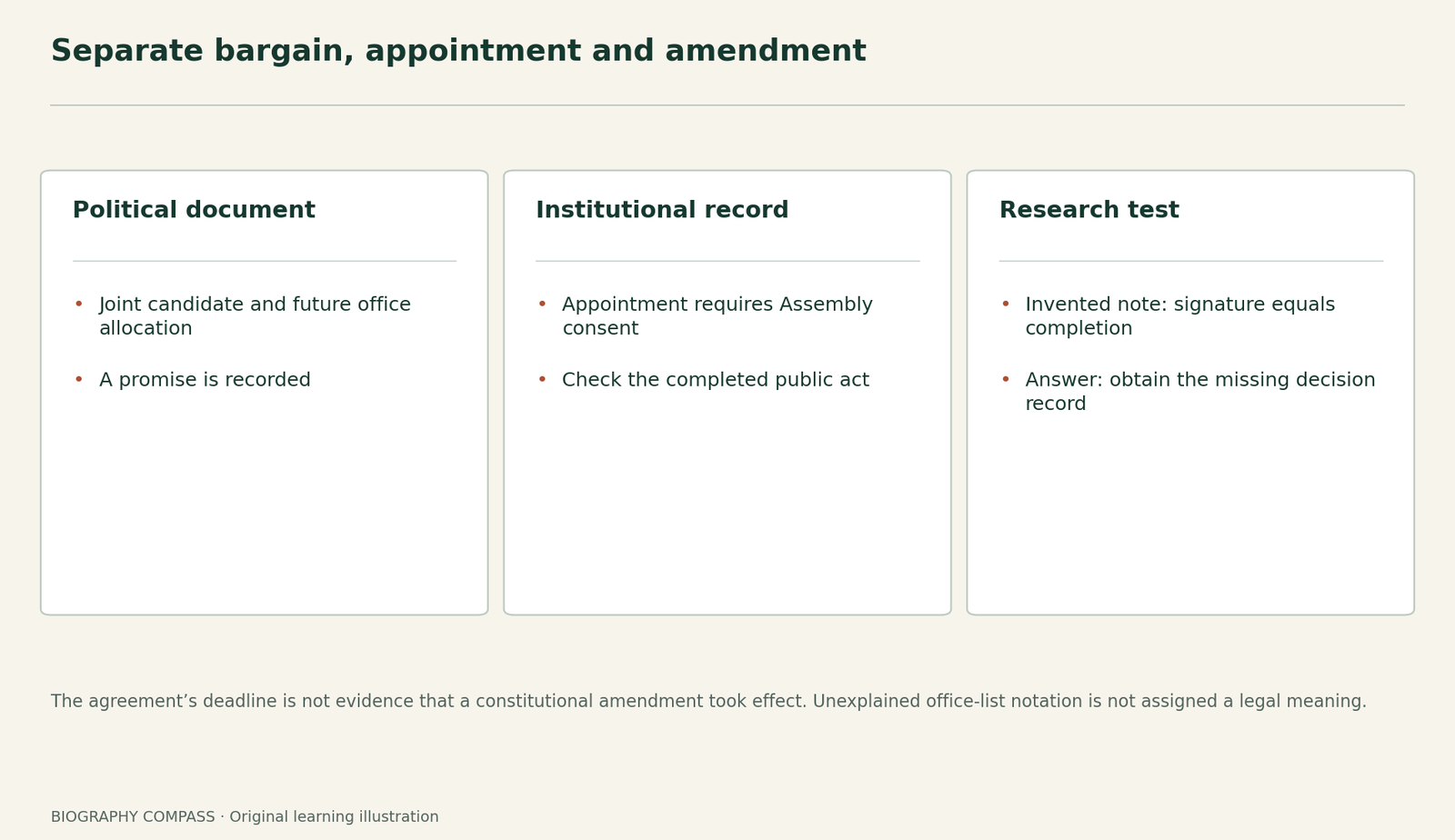
These provisions were a bargain about candidate coordination, personnel and future rules. Their different objects matter: a party can choose whom to support, but promising an office is not the same act as legally filling it. Likewise a promised constitutional timetable is evidence of intention, not proof that the constitutional text changed.
Sources for this section: [1]
Appointment has a separate authority
Article 86 requires presidential appointment of the prime minister with National Assembly consent.
The official list gives Kim Jong-pil’s formal term as 18 August 1998–12 January 2000 and displays an earlier unnumbered interval separately.
The agreement and office list therefore answer different questions. The first records the partners’ allocation; the second records officeholding. The selected list does not explain its dash notation, so this comparison does not invent a legal status for every preceding day. A fuller reconstruction would need the appointment and consent proceedings themselves.
An amendment requires more than a deadline
Articles 128–130 set out proposal, public notice, a two-thirds Assembly decision and a referendum with turnout and approval requirements.
The party text cannot replace those stages. Nor does an officeholder’s arrival establish that the proposed governmental system was adopted. To verify constitutional change, a researcher would need the actual amendment proposal, recorded institutional decisions and promulgated wording. Absence of those records from this selected set is a limit on the conclusion, rather than permission to infer success from the pact’s confident language.
Worksheet: classify three statements
Invented catalogue statements: A, “The parties allocated a future office”; B, “Signing appointed the officeholder”; C, “The deadline proves a constitutional amendment took effect.” Which statement matches this kind of document, and what extra record would repair each of the others?
Reference answer: A is a statement about a bargain. B needs the legally relevant appointment and consent records; the published agreement alone is insufficient. C needs the completed amendment record and operative text. An office list can corroborate service, while a constitutional procedure explains necessary stages. Neither changes a party promise retrospectively into the act it proposed.
Why the distinction changes the history
The comparison preserves the practical importance of bargaining without granting party leaders an authority their document did not possess. It also makes coalition history more precise: negotiations may explain why a nomination was made, while institutional records establish what office was actually held and what law was actually changed.
Continue the chronology
Related history guides
Biography context
Explore South Korea through connected lives
Connected biographies
People and institutions
1926–2018
Kim Jong-pil
Former prime ministerKim combined intelligence leadership with coalition politics.Read biographyQuick answers
Common questions
- Can a promise explain an appointment?
- It may explain the political bargain behind a nomination. Explanation and legal completion still require different evidence.
Primary and institutional sources
How this history was checked
Read the selected records alongside the comparison, then test what each document can establish. This article was reviewed on 30 October 2026.