
The short answer
A headline’s holiday year, a briefing date and the date relief takes effect can all differ. Preserve them as separate fields before drawing conclusions about what changed for a named person.
Compare the records
Match each conclusion to its evidence
Preserve the document’s date, author and object.
| Record | Supported reading | Unwarranted inference |
|---|---|---|
| Holiday label | Occasion for the announcement. | Automatic 1 January effectiveness. |
| Named relief | Specified executive consequence. | A fresh acquittal. |
| Earlier court record | Adjudicated outcome within its case. | A complete statement of all later consequences. |
Chronology
A timeline of the turning points
First effective date
Separate from both announcement and holiday label.
Second effective date
Use the specified relief rather than a blanket erasure claim.
Two announcements, different calendar labels
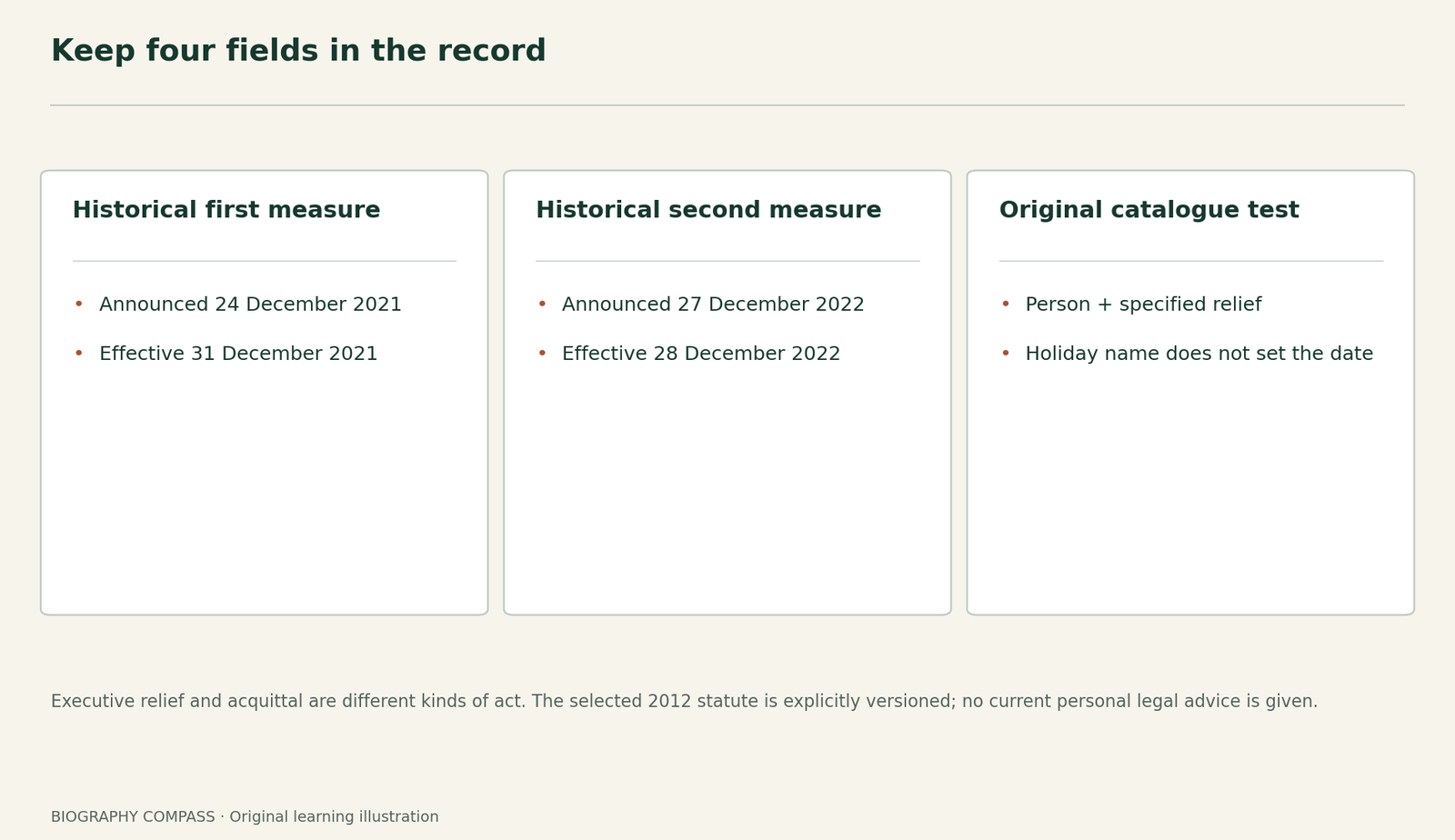
The Ministry of Justice announced the “2022 New Year” measures on 24 December 2021, effective 31 December 2021. Park Geun-hye was named for special pardon and restoration of rights.
The “2023 New Year” measures were announced on 27 December 2022, effective 28 December 2022. For Lee Myung-bak, the specified relief included exemption from execution of the remaining sentence and restoration.
A holiday label describes an occasion; it is not the operative date. Likewise the announcement tells readers what the government says it will do, while the separately stated effective date identifies when that measure is to operate.
A versioned statute helps identify the categories
The selected 2012 English Amnesty Act distinguishes general and special amnesty. Article 5 describes exemption from execution under special amnesty, includes a proviso permitting invalidation of a sentence in specified circumstances, and separately addresses restoration of qualifications. It also preserves effects already produced by a sentence.
This prevents an overbroad summary in either direction. One should not claim that every special pardon has identical effects, or that every measure erases everything that preceded it. Read the specific named relief alongside the correctly dated statutory version. This study does not silently substitute an old translation for a current legal code.
Sources for this section: [3]
Executive relief is a different record from adjudication
Lee’s final-appeal judgment had already dismissed both sides’ appeals in October 2020.
Park’s January 2021 Court press material records rejection of the prosecution’s appeal and preservation of the mixed lower judgment.
A later pardon announcement does not rewrite those documents as acquittals. When preparing a biography, retain the adjudicated outcome and describe the later relief as another event. Where the judgment includes acquittals on some counts, preserve that distinction too; executive relief does not justify saying either that every charge was proved or that none was.
Worksheet: repair the catalogue fields
Invented catalogue entry: “A New Year pardon was announced; therefore the sentence was overturned on 1 January.” Identify the unsupported date and legal conclusion. Propose a four-field entry that can be checked against a short official briefing.
Reference answer: record announcement date, effective date, named person and specified relief. Do not infer 1 January from the holiday name. Replace “overturned” with the exact relief that the source identifies, unless a separate adjudicative record actually overturns the judgment. A final judgment and an executive measure may both belong in the chronology without being contradictory.
Keep the conclusion proportionate
The selected briefings support a historical comparison of dates and stated measures. They do not establish every later administrative consequence, recovery of an honour or present personal status. A reader who needs those answers would require the relevant further record rather than a general inference from the word pardon.
Continue the chronology
Related history guides
Continue with a different documentary question
Compare the kind of act recorded and the limit of the supported conclusion.
Read the timeline1997 agreementContinue with a different documentary question
Compare the kind of act recorded and the limit of the supported conclusion.
Read the timelineBiography context
Explore South Korea through connected lives
Connected biographies
People and institutions
Born 1941
Lee Myung-bak
Former presidentLee led Seoul’s stream-restoration administration.Read biographyQuick answers
Common questions
- Does a pardon establish innocence?
- It is an executive act with specified consequences. An acquittal is an adjudicated outcome; the records should not be relabelled as each other.
Primary and institutional sources
How this history was checked
Read the selected records alongside the comparison, then test what each document can establish. This article was reviewed on 30 October 2026.
- Ministry of Justice, via Korea Policy Briefing2022New Year special-pardon briefing
- Ministry of Justice, via Korea Policy Briefing2023New Year special-pardon briefing
- Korea Legislation Research InstituteAmnesty Act: English version through2012
- Supreme Court of KoreaSupreme Court judgment2020Do3972
- Supreme Court of KoreaSupreme Court2020Do9836: press material