
The short answer
The date an officeholder stops exercising powers need not be the date the office becomes vacant. A documentary timeline should identify the act that changes each status, rather than treating every stage as a synonym for removal.
Compare the records
Match each conclusion to its evidence
Preserve the document’s date, author and object.
| Record | Supported reading | Unwarranted inference |
|---|---|---|
| Passed motion | Suspended exercise of powers. | Completed judicial removal. |
| Court holding | Removal from office. | A criminal sentence. |
| Vacancy provision | Successor election within 60 days. | Every interruption starts that clock. |
Chronology
A timeline of the turning points
Parliamentary decision
Record the immediate institutional effect separately.
Judicial decision
The holding supplies the later status change.
The referral and the holding
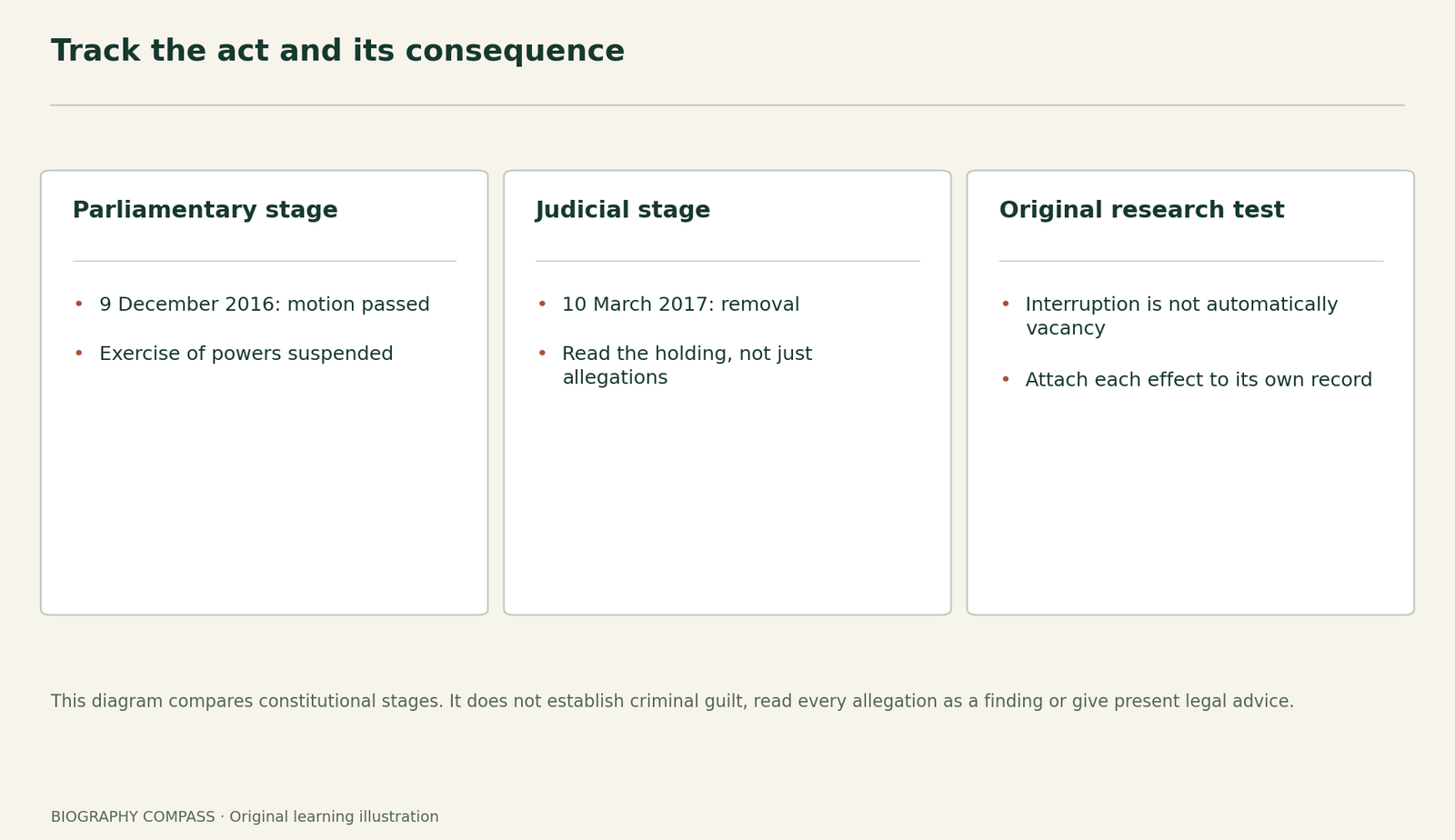
The Court’s English edition records 234 votes in favour in the 300-seat National Assembly on 9 December 2016. Its holding dated 10 March 2017 removes the president from office.
Those entries establish two distinct acts by different institutions. The parliamentary decision initiates a consequence and a judicial process; the later holding states the removal. The edition was published after the events it records, so its publication year should not displace the dates within the case.
Sources for this section: [1]
Read the status-changing clauses
Article 65(3) suspends exercise of powers after an impeachment motion passes. Article 68(2) requires election of a successor within 60 days of a vacancy. Article 71 provides acting authority during vacancy or inability.
Suspension can therefore coexist with someone else exercising authority without proving that the suspended officeholder has already been removed. An acting arrangement is a continuity mechanism, not an alternative judicial verdict. The researcher should ask which condition has arisen before attaching a deadline or a new status to a date.
Sources for this section: [2]
Different records support different propositions
The Court volume’s opening case summary and parliamentary account are sufficient for this sequence comparison. They are not a licence to report every allegation in the petition as a judicial finding. A criminal proceeding would answer another question again: removal from office does not by itself establish a conviction or a prison sentence.
This comparison follows changes in status across institutions. It does not attempt to evaluate every allegation or reconstruct the entire later criminal record.
Worksheet: repair the research timeline
Invented research note: “At the parliamentary vote, the president was removed, the office became vacant, and the successor-election clock necessarily began.” Split that sentence into claims. Which event record and which clause would you require before accepting each claim?
Reference answer: the vote is evidenced by the parliamentary sequence in the Court volume. Suspension follows from the relevant constitutional clause. Removal requires the Court’s holding. The vacancy-election rule should be attached to the vacancy, not automatically to the first interruption in exercising powers. The note wrongly compresses several stages into one. An accurate timeline labels the public act, its immediate consequence and the evidence separately.
A reusable note-taking method
Build three columns: event, institutional effect and source. Do not fill an effect merely because the event sounds decisive. If a document contains allegations as well as a holding, label them separately. This preserves both the importance of the parliamentary action and the authority of the later adjudication, without inventing a contemporary legal opinion.
Continue the chronology
Related history guides
Continue with a different documentary question
Compare the kind of act recorded and the limit of the supported conclusion.
Read the timeline1973 projectionsContinue with a different documentary question
Compare the kind of act recorded and the limit of the supported conclusion.
Read the timelineBiography context
Explore South Korea through connected lives
Connected biographies
People and institutions
Born 1952
Park Geun-hye
Former presidentPark moved from party leadership into the presidency.Read biographyQuick answers
Common questions
- Does an impeachment allegation establish a criminal conviction?
- No. A petition, removal decision and criminal judgment are distinct records with different questions and consequences.
Primary and institutional sources
How this history was checked
Read the selected records alongside the comparison, then test what each document can establish. This article was reviewed on 30 October 2026.