In this biography
Quick facts
- Born
- 7 January 1926
- Died
- 23 June 2018
- Birthplace
- Buyeo, South Chungcheong, Korea
- Country
- South Korea
- Nationality
- Not independently established
- Known for
- Intelligence and coalition politics
- Public role
- Former prime minister
Why this life matters
His changing alliances reveal how political organisation can retain influence across very different governing systems.
Timeline
Key moments
A new party
Established the United Liberal Democrats.
Military power and intelligence
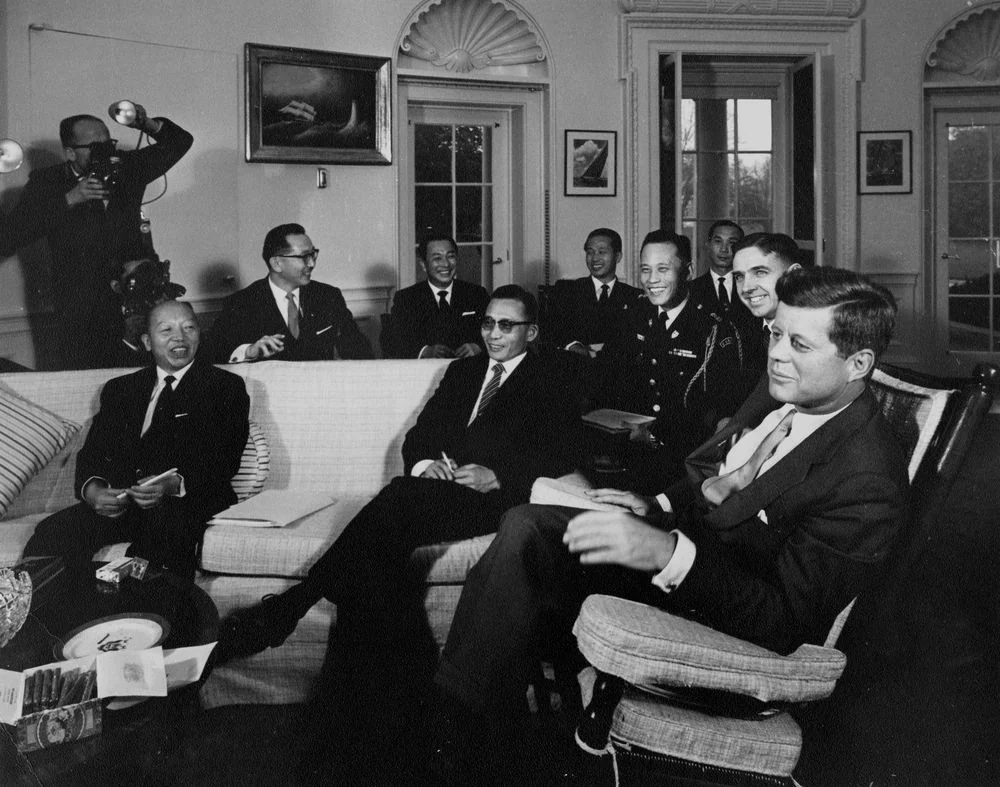
Born in Buyeo, Kim left teacher-training studies and entered the military. He participated in the 1961 coup associated with Park Chung-hee and became the first chief of the newly established Korean Central Intelligence Agency.
His entry into political authority thus involved military seizure of power and the construction of an intelligence institution. That background is essential to understanding the career, even though his later influence often took parliamentary and coalition forms.
Sources for this section: [1]
Party organisation and a first premiership
He helped organise the Democratic Republican Party and became a major figure under Park. His first premiership ran from 1971 to 1975. After Park’s death, the new military authorities accused him of illicit wealth and pushed him from politics.
An accusation by a successor regime is not, on this evidence, a criminal conviction. His position also illustrates the vulnerability of a senior political organiser when military authority changes hands.
Sources for this section: [2]
Return through changing alliances
He returned by forming the New Democratic Republican Party in 1987, joined the three-party merger in 1990 and left to establish the United Liberal Democrats in 1995.
His own 1987 presidential bid failed. The subsequent merger helped Kim Young-sam win the 1992 presidency; the later alliance instead supported Kim Dae-jung. These were consequential changes in partners, not a continuous alliance with one presidential contender.
The 1997 published agreement with Kim Dae-jung’s party designated Kim Dae-jung as the joint presidential candidate and allocated the future premiership to the ULD.
Coalition-making connected parties with distinct histories. It offered a negotiated route to executive cooperation, while leaving the legal steps of appointment and constitutional change to the institutions empowered to perform them.
Government, withdrawal and death
The official list records his later formal prime-ministerial term from 18 August 1998 to 12 January 2000, separately from an earlier unnumbered interval.
He left active politics after his failed 2004 parliamentary bid and died on 23 June 2018.
Across the whole career, continuity lay in political organisation rather than a single unchanging alliance. The same politician operated inside an authoritarian governing party and, later, a negotiated electoral coalition; those settings gave his influence different institutional meanings.
Quick answers
Frequently asked questions about Kim Jong-pil
- Does a party agreement itself complete a public appointment?
- A bargain records political commitments. Completion must be checked against the records of the institution responsible for the public act.
Keep exploring
Lives connected to this story
- Kim Dae-jung
Compare a connected political career and the institutions in which it developed.
Sources and further reading
Explore the evidence
These references support the biography and offer further reading. Official records, first-person accounts and independent reporting provide different perspectives; image records document attribution and licensing.
- 1. Academy of Korean Studies DHLabKim Jong-pil: digital-humanities entry
Project wiki with imperfect chronology. Formal term dates use the official prime-ministerial list; no sole-creator claims inferred.
- 2. Yonhap News AgencyFormer Prime Minister Kim Jong-pil dies
Junta accusations are attributed, not treated as convictions. Inconsistent parliamentary-count shorthand not repeated.
- 3. Office for Government Policy Coordination, KoreaFormer prime ministers: selected rows
Unnumbered/dashed preceding intervals are not silently labelled acting; the list explicitly supplies formal dated terms.
- 4. Maeil Business NewspaperPublished text of the joint-candidate agreement
Contemporary published reproduction, not a signed physical original; a deadline in the pact is not proof of amendment.