
The short answer
A winner can have the largest share without a majority. Use the retained Kenyan constitutional text and invented valid-vote examples to distinguish the county governor contest from the presidential test.
Documentary comparison
Do not swap the test with the office
The numbers below are invented and all votes are assumed valid.
| Record or test | What it supports | What remains separate |
|---|---|---|
| A: county, 460 / 1,000 | Highest total among 460, 340 and 200 | 46% is below one half. |
| B: president, 510 / 1,000; 24 counties | Both selected conditions pass | Eligibility and lawful administration remain assumed |
| C: president, 510 / 1,000; 23 counties | National share passes; spread fails | Check both supplied columns before deciding. |
Chronology
A timeline of the turning points
Text used for the exercise
The retained government transcription supplies the selected rules.
Presidential candidature
Muite’s biography identifies a different electoral office.
Governor election
The Siaya profile records Orengo’s election; no vote totals are taken from it.
Identify the office before counting
The retained 2010 constitutional text uses different tests: a contested governor election turns on the highest vote total, while a presidential winner must satisfy a national majority and a county-spread condition. The First Schedule lists 47 counties. The purpose here is to apply these stated historical rules to invented data, not to certify an election.
The official Siaya biography identifies James Orengo’s election as governor in 2022. A biographical account of Paul Muite identifies his 2013 presidential candidature. Those career records help identify the offices being compared; neither supplies the vote formula or a complete official tally. Record type matters before any arithmetic begins.
A county contest with no majority
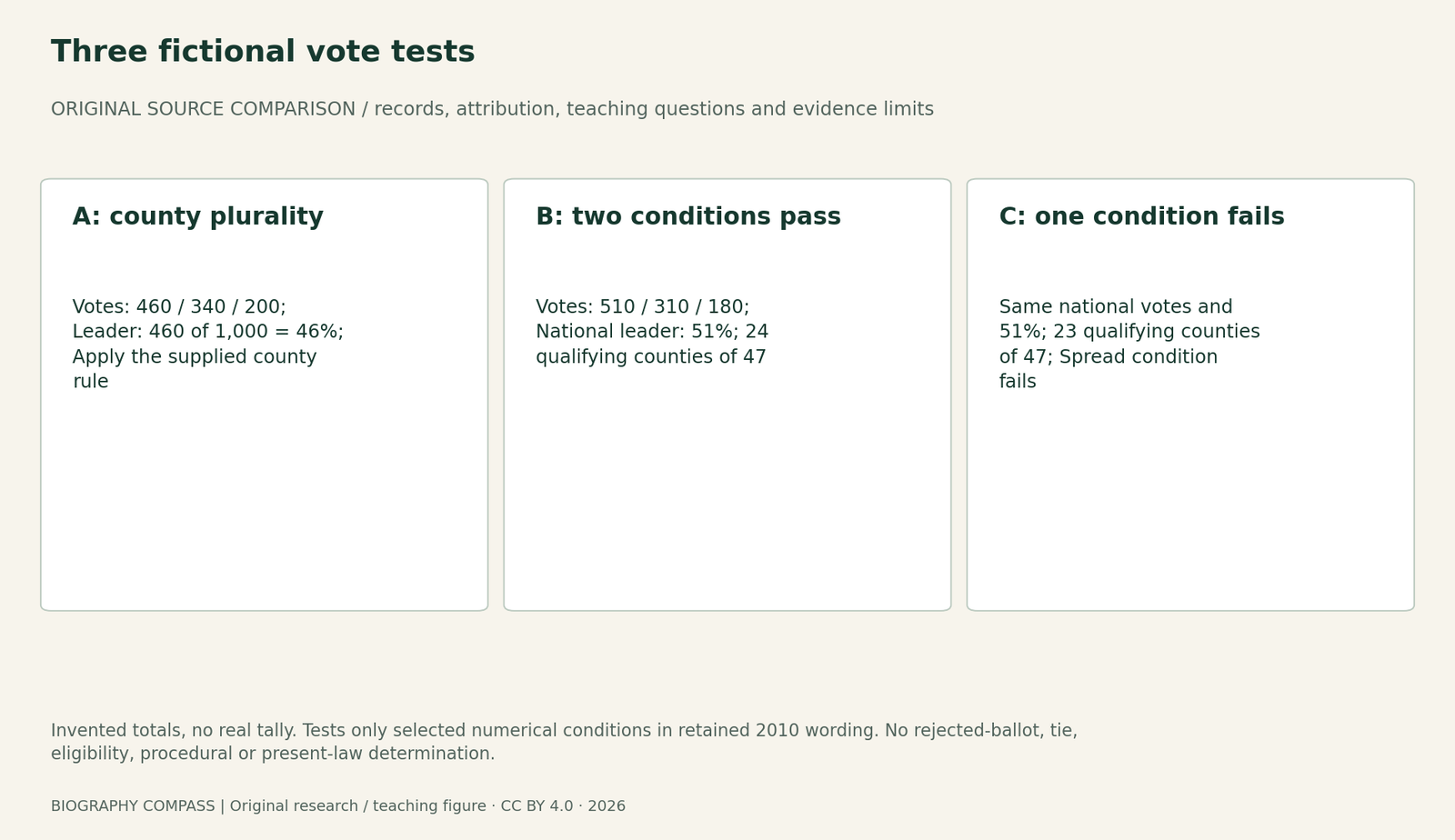
Example A is wholly fictional: 1,000 valid votes are divided between A with 460, B with 340 and C with 200. A has the highest total, and 460 divided by 1,000 is 46%. A’s lead is sufficient for the selected contested-governor test, given the exercise’s assumptions about eligible candidates and a lawful count.
The common mistake is to answer a different question: “Did A receive more than half?” The arithmetic answer is no, but that does not defeat a highest-total test. Conversely, the example does not justify applying the same formula to every Kenyan electoral office. The office determines the test; a percentage by itself does not.
Sources for this section: [1]
A national lead with a second condition
Example B is also fictional: 1,000 valid presidential votes give A 510, B 310 and C 180. A has 51%. Assume A also reaches the specified county share in 24 of the 47 counties. Example C keeps exactly the same national totals but changes the qualifying-county count to 23.
Worked answer: Example B passes the two selected conditions, while Example C fails the geographic one. Half of 47 is 23.5, so more than half requires at least 24 whole counties. A qualifying county reaches at least one quarter, whereas the national share must exceed one half. This worksheet supplies the county qualification counts; it does not pretend that national totals reveal them.
Sources for this section: [1]
Exercise: diagnose three counting errors
An invented answer key for the three examples says: A “loses because 46% is below 50%”; B “wins on 51%, so the county data can be ignored”; and C “passes because 23 is approximately half of 47.” Correct each explanation without changing the supplied numbers.
Worked answer for the three examples: A confuses the governor test with a presidential condition; the fictional county leader has the highest total. Example B reaches the right selected result for the wrong reason: both supplied tests must be checked. Example C fails because an exact whole-county requirement cannot be rounded down to an approximation. A stronger answer names the office, shows the calculation and identifies the extra data used.
Sources for this section: [1]
State the assumptions that make the answer possible
All ballots in the examples are stipulated valid, and all nominees are assumed eligible. There are no ties, disputes, missing returns or challenges to counting. The examples do not address rejected ballots, later judgments, administrative procedures or the full set of legal requirements. A statement that Example B passes these two tests is deliberately narrower than a declaration that a real election was lawful.
For a real historical result, a researcher would need the applicable text and version, certified totals, county-level information and any relevant decisions. The two career biographies cannot substitute for that file. Here the useful result is conceptual: plurality, national share and geographic spread are different quantities, and none should be smuggled into the meaning of another.
Continue the chronology
Related history guides
Who Appointed Kenya’s Chief Justice in 2011?
Trace Kenya’s 2011 chief-justice selection through constitutional text and a committee report, distinguishing consultation, recommendation and appointment.
Read the timeline1999–2024When Did Kenya’s Parliamentary Service Begin?
Compare the records behind Kenya’s parliamentary service commission, separate constitutional creation from a service statute and correct conflicting date labels.
Read the timelineBiography context
Explore Kenya through connected lives
From the Senate to county executive
Read the dated career record behind the governor example.
Explore the biographiesNational and county powersA separate question about functions
Compare allocation of governmental responsibilities after considering the electoral tests.
Explore the biographiesConnected biographies
People connected with these records
Birth year disputed
James Orengo
Lawyer, parliamentarian and governor elected in 2022James Orengo combined legal practice with opposition politics, national ministerial office, Senate leadership and election as Siaya governor in 2022.Read biography1945–
Anyang’ Nyong’o
Political scientist and former national ministerAnyang’ Nyong’o carried an academic career in political science into Parliament, national ministries, the Senate and Kisumu county government.Read biography1945–
Paul Muite
Advocate, former parliamentarian and political organiserPaul Muite combined legal practice, leadership of the Law Society of Kenya, parliamentary service and opposition organising across the multiparty transition.Read biographyQuick answers
Common questions
- Are these actual Kenyan election results?
- No. Every vote total and county qualification count in the worksheet is invented.
- Does this settle how rejected ballots should be treated?
- No. All example ballots are stipulated valid, and no court holding on rejected ballots is asserted.
Primary and institutional sources
How this history was checked
Compare the original institutional records with the dated biographical and retrospective accounts below. This article was reviewed on 29 October 2026.