
The short answer
A county hospital, a health-policy decision and a national referral facility all concern health. Which government is responsible for each, and what evidence would explain a transfer?
Original source comparison
One policy field can contain different responsibilities
Compare what each provision does before judging what implementation achieved.
| Country | National functions | County functions | Evidence still needed |
|---|---|---|---|
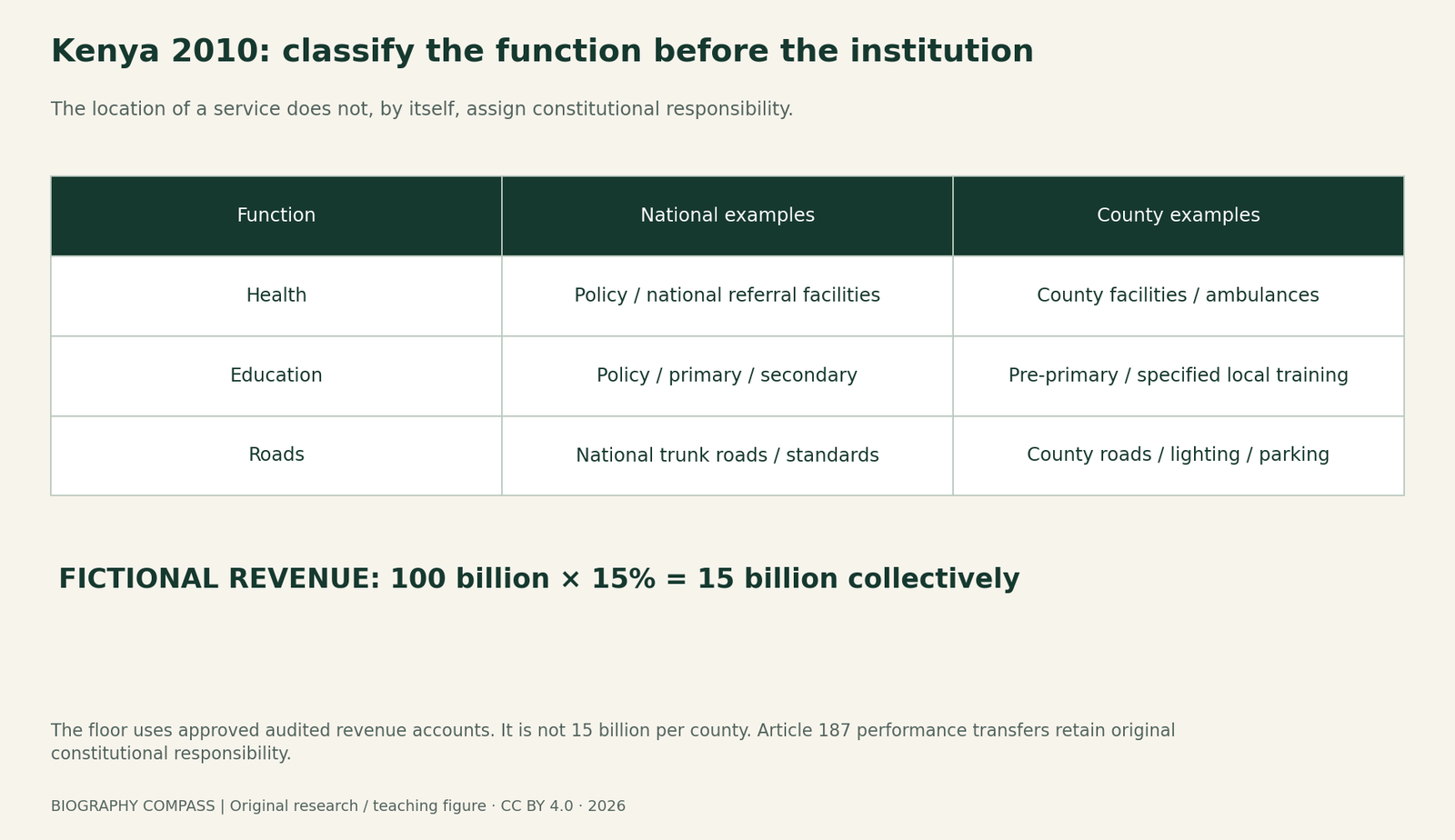
| Health | Health policy; national referral facilities. | County facilities, ambulances and primary-health promotion. | Institution’s status, legislation, budget and any transfer agreement. |
| Education | Policy, standards, curricula; primary and secondary education. | Pre-primary education and named local training functions. | Precise institution and task rather than education as a single label. |
| Transport | National trunk roads, railways and specified standards. | County roads, street lighting, parking and local transport functions. | Road classification and relevant institutional records. |
| Revenue | Annual division between the levels. | Collective county allocation then division among counties. | Named audited denominator and the relevant legislation. |
Chronology
A timeline of the turning points
Constitution promulgated
A new framework establishes national and county institutions.
Transition rules
Devolved-government provisions and phased implementation follow the Sixth Schedule.
First county elections
County assemblies and governors enter the new framework.
Revenue legislation
Separate bills address the national/county division and allocation among counties.
Classify the function before identifying the officeholder
Article 186 directs the reader to the Fourth Schedule for the respective functions of national and county governments. Its rules also recognise concurrent jurisdiction where a power belongs to more than one level, and assign residual functions to national government unless the Constitution or national legislation assigns them to counties. This prevents a misleading shortcut in which everything physically located in a county is assumed to belong to its government.
Health illustrates the division. The national list includes health policy and national referral facilities. The county list includes county health facilities and pharmacies, ambulance services and promotion of primary health care. These categories relate to one another without becoming identical. A national policy can affect a county service, and a national referral institution can be located inside a county. For a real dispute, classification would also require the applicable legislation and facts; the schedule is the starting framework rather than a complete administrative directory.
Sources for this section: [1]
Education and roads reveal the same need for precision
The national functions include education policy, standards, curricula and examinations, together with primary and secondary education and specified higher institutions. Counties have pre-primary education, village polytechnics, homecraft centres and childcare facilities. The word education is therefore too broad to assign the whole field to one government. A useful comparison names the level of education and whether the question concerns policy, an institution or delivery.
Transport follows another differentiated structure. National functions include national trunk roads, railways and standards for construction and maintenance of other roads by counties. County transport includes county roads, street lighting, traffic and parking, and public road transport. A road photograph or a politician’s opening speech will not establish its legal classification. Begin with the function, then consult the classification and institutional records for the particular road. This keeps responsibility visible even when national and county politicians attend the same opening.
Sources for this section: [1]
Transfer does not erase constitutional responsibility
Article 187 allows governments at the two levels to agree to transfer a function where the receiving government could perform it more effectively and legislation does not prohibit transfer. The article also requires arrangements for the necessary resources. Crucially, constitutional responsibility remains with the government to which the Fourth Schedule assigns the function. A diagram should therefore distinguish performance under an agreement from the underlying constitutional assignment.
Article 189 adds duties to respect each other’s institutional integrity, assist and consult, and coordinate information and administration. Governments may create joint committees or authorities. They must make reasonable efforts to settle disputes, with national legislation providing alternatives including negotiation, mediation and arbitration. Cooperation is part of the framework rather than evidence that one level has ceased to exist. To evaluate a claimed transfer, seek the agreement, its scope, the resources and its legal basis.
Sources for this section: [1]
Revenue sharing has two stages and a defined denominator
Article 202 requires equitable sharing of nationally raised revenue between national and county government and permits additional allocations from the national share. Article 203 sets a collective county equitable-share floor of 15 per cent. The calculation uses the most recent audited revenue accounts approved by the National Assembly. It is not 15 per cent for every county, and it is not automatically 15 per cent of an unaudited forecast for the coming year.
Articles 217 and 218 distinguish the basis for sharing among counties from the annual division between the two levels. The Division of Revenue Bill addresses the national/county split; the County Allocation of Revenue Bill distributes the county-level amount among counties using the applicable basis. Criteria include county functions, development needs, disparities and predictability, among other considerations. The Commission on Revenue Allocation makes recommendations under Article 216. A constitutional minimum is a floor within this process, not a statement of the final allocation in every budget year.
Sources for this section: [1]
Exercise: identify both the task and the denominator
Classify four fictional proposals: setting a national school curriculum; running a pre-primary facility; managing a county ambulance service; and operating a national referral hospital. Then assume the relevant approved audited national revenue is 100 billion units. What is the Article 203 collective minimum, and may a student assign that amount to each of 47 counties? Finally, a government says a function has been transferred. List three records you would request before evaluating the claim.
Reference answer: curriculum and national referral facilities belong to the national list; pre-primary provision and county ambulance services belong to the county list. The simplified minimum is 15 billion units collectively, not 15 billion per county. This is invented arithmetic, not Kenya’s historical budget. For a transfer, examine the intergovernmental agreement, the resource arrangements and the legal authority and limits. Article 187 keeps the original constitutional responsibility visible. A richer practical inquiry would then examine budgets, performance and public participation rather than assuming that a constitutional assignment proves a service is working well.
Sources for this section: [1]
Continue the chronology
Related history guides
Kenya’s 2008 Power-Sharing Rules
Read the 2008 coalition agreement beside the National Accord Act: appointments, ministerial removal, parliamentary safeguards and the 2010 transition.
Read the timelineAugust–September 2017Why Kenya’s 2017 Election Was Annulled
Read the 2017 Supreme Court majority judgment: proof, verifiable results, institutional failure and why annulment did not declare an alternative winner.
Read the timeline2003Kenya’s 2003 Primary Education Rollout
Examine the practical rollout before comparing primary and pre-primary constitutional responsibilities.
Read the timeline1965Kenya’s 1965 Economic Policy Paper
Compare an earlier regional investment argument with the later framework for county resources.
Read the timelineBiography context
Explore Kenya through connected lives
Uhuru Kenyatta
Led the presidency after the first elections under the 2010 Constitution; this is later implementation context.
Explore the biographiesLater governmentWilliam Ruto
Served as deputy president and later president within the constitutional framework; not credited here as its sole author.
Explore the biographiesConnected biographies
Leaders in the constitutional transition

1931–2022
Mwai Kibaki
Economist, finance minister and Kenya’s third presidentMwai Kibaki moved from university economics into KANU, Cabinet and opposition politics before winning the presidency in 2002. His administration expanded primary education and later governed through a coalition after the disputed 2007 election.Read biography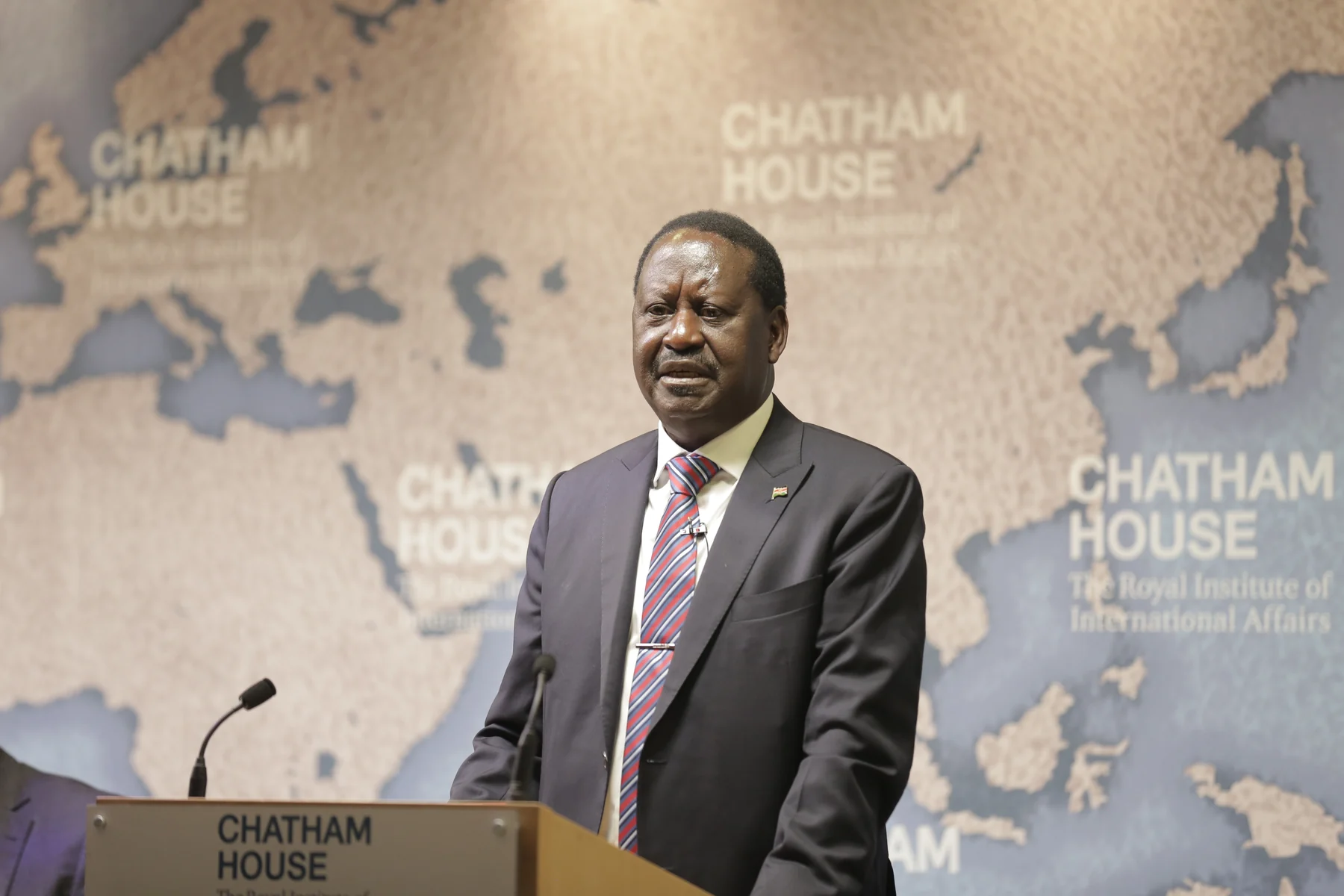
1945–2025
Raila Odinga
Opposition leader, Cabinet minister and Prime Minister of KenyaRaila Odinga moved between opposition, negotiated government and constitutional litigation. He served as prime minister from 2008 to 2013 and remained a central figure in Kenyan politics until his death in 2025.Read biographyQuick answers
Common questions
- Does every service inside a county belong to county government?
- No. The Fourth Schedule assigns particular functions. National institutions and services can operate within a county.
- Does every county receive 15 per cent of national revenue?
- No. Article 203 sets a collective county equitable-share minimum, calculated using the specified approved audited revenue accounts.
- Does transferring performance erase constitutional responsibility?
- No. Article 187 retains constitutional responsibility with the government to which the Fourth Schedule assigns the function.
Primary and institutional sources
How this history was checked
Original legal texts and dated institutional records support this guide. Comparisons and exercises are original explanatory work. This article was reviewed on 27 October 2026.