
The short answer
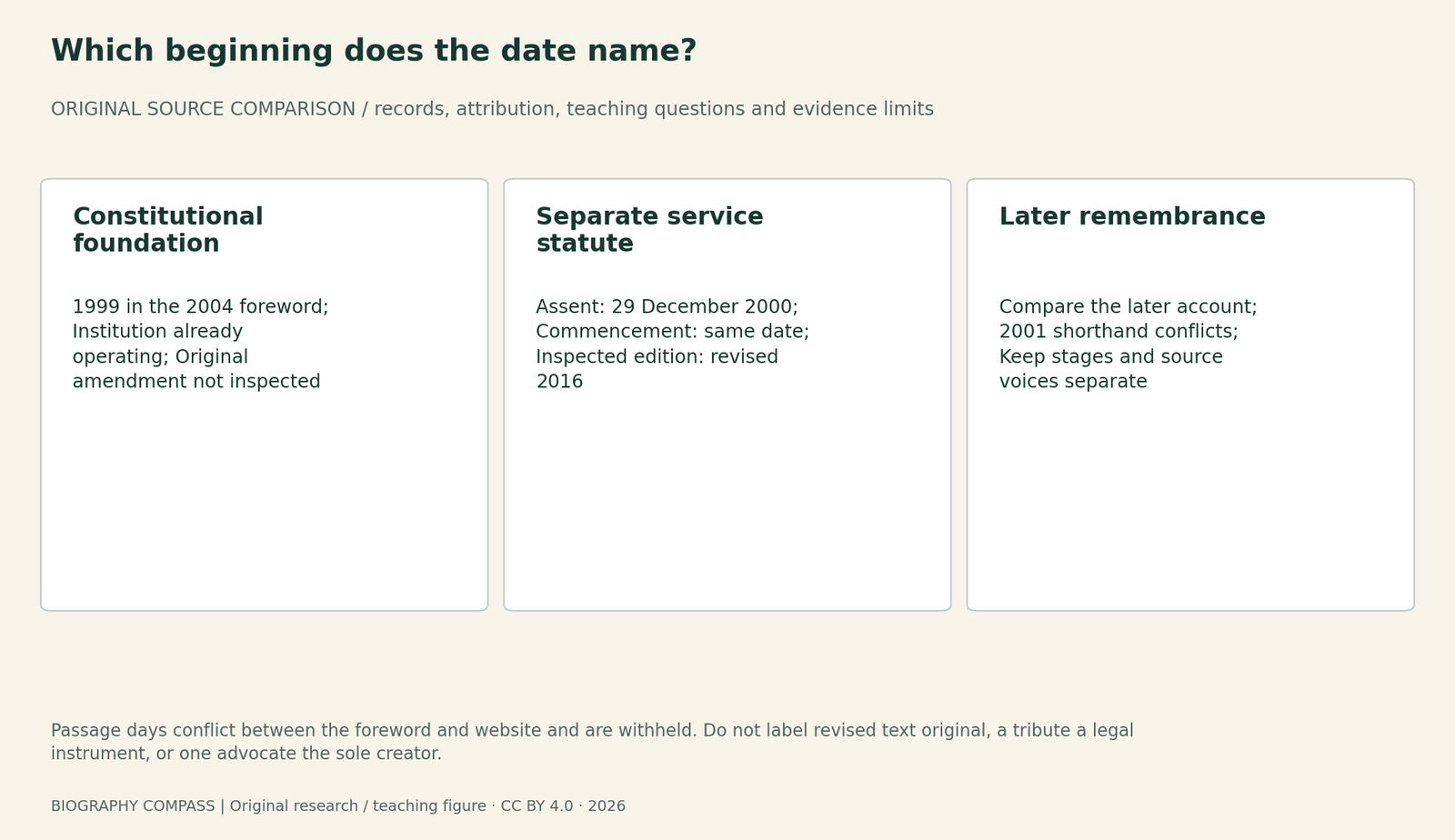
A commission can have a constitutional foundation, an implementing statute and a later institutional memory. Compare those records before assigning Kenya’s parliamentary service a single founding date.
Documentary comparison
One institution, several kinds of date
Use the label attached to a date before combining it with other evidence.
| Record or test | What it supports | What remains separate |
|---|---|---|
| June 2004 foreword | Contemporary account of foundation and operation | The original constitutional instrument |
| Revised service statute | Labelled statutory dates and edition history | An original 2000 print or present-law assurance |
| Later remembrance | Ask what this account emphasises. | An exclusive or definitive founding chronology |
Chronology
A timeline of the turning points
Constitutional foundation
The 2004 foreword records the commission’s basis in the constitutional amendment.
Assent and commencement
Both are stated in the inspected service statute’s header.
Administrative foreword
The budget document describes an already functioning commission.
Ask which beginning a date describes
A legislature’s administrative independence can develop through several events. Kenya’s June 2004 parliamentary budget foreword identifies the Parliamentary Service Commission’s foundation in a 1999 constitutional amendment and describes its work as already operating. That is a contemporary institutional account, produced for a practical budget purpose rather than a later anniversary.
The same foreword discusses the separate Parliamentary Service Act of 2000. The constitutional foundation and a law organising the service answer different questions. Calling both simply “creation” hides the relationship between an institution’s authority and the machinery through which it employs staff and carries out its responsibilities.
Sources for this section: [1]
Read the statute’s edition and its date labels
The retained Kenya Law text is marked Revised Edition 2016 [2000] and lists a 2005 amendment. Its header gives both assent and commencement as 29 December 2000. Its definitions point back to the commission’s constitutional foundation. The edition is therefore useful for these identified historical markers, but it is not an unamended original print from 2000.
A passage date is a different event from assent or commencement. The 2004 foreword and the Parliament website give conflicting days for the service law’s passage in 2000. This guide withholds that disputed day instead of choosing one silently. Agreement on some dates does not make every other date in a record equally secure. The archived statute is not presented as current law.
Compare institutional history with remembrance
The Parliament website’s establishment account also places the constitutional change in 1999 and recalls Jean-Marie Seroney’s earlier autonomy motion in 1970. The 2010 Constitution gives the commission a further constitutional setting in Article 127. These records show why the story cannot be reduced to the biography of a single campaigner.
A November 2024 parliamentary tribute credits Oloo Aringo’s advocacy but uses 2001 as commission-creation shorthand. That wording is evidence of how a colleague remembered his contribution. It cannot override the earlier records merely because it was spoken in Parliament. A tribute can be valuable for political memory while being less precise about a statutory sequence.
Exercise: reconcile an invented museum label
An invented label reads: “Aringo single-handedly created the commission in 2001; the 2016 PDF is the original law enacted that year.” Rewrite it using three evidence slots: constitutional foundation, service-law dates and later remembrance. Preserve what the tribute contributes without treating it as the only record.
Worked answer: “The commission’s constitutional foundation is recorded in 1999. A separate service statute dates from 2000, with assent and commencement shown as 29 December. The inspected PDF is a later revised edition. A 2024 tribute remembers Aringo as an important advocate but uses a different creation-year shorthand.” This corrects the date categories and the single-author claim. It does not settle the conflicting passage days or reconstruct every administrative step.
Turn disagreement into a research plan
For each date, record the verb used: proposed, passed, assented, commenced, operating or remembered. Then record whether the source is the instrument itself, a contemporary administrative explanation or a retrospective account. This small table prevents an attractive narrative from outrunning the actual evidence.
A fuller investigation would inspect the original constitutional amendment and the original service-law print, as well as the relevant House proceedings. They were not all acquired here. The comparison already produces a useful conclusion: different beginnings require different labels, and a conflict should be carried forward visibly rather than compressed into false precision.
Continue the chronology
Related history guides
Who Appointed Kenya’s Chief Justice in 2011?
Trace Kenya’s 2011 chief-justice selection through constitutional text and a committee report, distinguishing consultation, recommendation and appointment.
Read the timeline2010 text; fictional examplesDo Governors Need a Presidential Majority?
Compare Kenya’s governor and presidential vote rules in the retained 2010 text, then solve clearly fictional valid-vote and county-spread examples.
Read the timelineBiography context
Explore Kenya through connected lives
Connected biographies
People connected with these records
1941–2024
Oloo Aringo
Teacher, education minister and parliamentarianOloo Aringo moved from teaching into Parliament and government, later becoming a prominent advocate of a more autonomous parliamentary service.Read biography1945–
Anyang’ Nyong’o
Political scientist and former national ministerAnyang’ Nyong’o carried an academic career in political science into Parliament, national ministries, the Senate and Kisumu county government.Read biographyQuick answers
Common questions
- Why not use the 2024 tribute’s year alone?
- It is a retrospective shorthand that conflicts with earlier institutional records.
- Was the original 2000 statute read?
- No. Selected pages of the 2016 revised edition were read through the cached original-source PDF text.
Primary and institutional sources
How this history was checked
Compare the original institutional records with the dated biographical and retrospective accounts below. This article was reviewed on 29 October 2026.
- Parliamentary Service CommissionKenya National Assembly MTEF Budget 2004/05–2006/07, June 2004: foreword
- National Council for Law Reporting / Kenya LawParliamentary Service Act No. 10 of 2000, Revised Edition 2016 [2000]
- Parliament of KenyaThe Commission: establishment history
- Ministry of Defence, KenyaThe Constitution of Kenya, 2010: online transcription
- Parliament of KenyaNational Assembly Hansard, 5 November 2024: tribute to Peter Oloo Aringo