
The short answer
The 2011 appointment occurred during a constitutional transition. Compare the rule, the committee’s scrutiny and the record of service before deciding what each document proves.
Documentary comparison
Authority, scrutiny and completed service
A record may support a stage without being the instrument that completes it.
| Record or test | What it supports | What remains separate |
|---|---|---|
| Constitutional provisions | A checklist to test the appointment record | Proof that a particular act occurred |
| Committee recommendation | What the committee wanted the House to approve | A plenary decision or presidential instrument |
| Judiciary career account | An identified period in office | A complete contemporaneous appointment file |
Chronology
A timeline of the turning points
Constitutional transition
Identify the applicable text before placing events in order.
Trace the notice
Locate this stage in the original report.
Committee report
Compare the document’s function with an appointment instrument.
Completed period of service
The Judiciary’s retrospective records Mutunga as Chief Justice.
Read the transition as well as the ordinary article
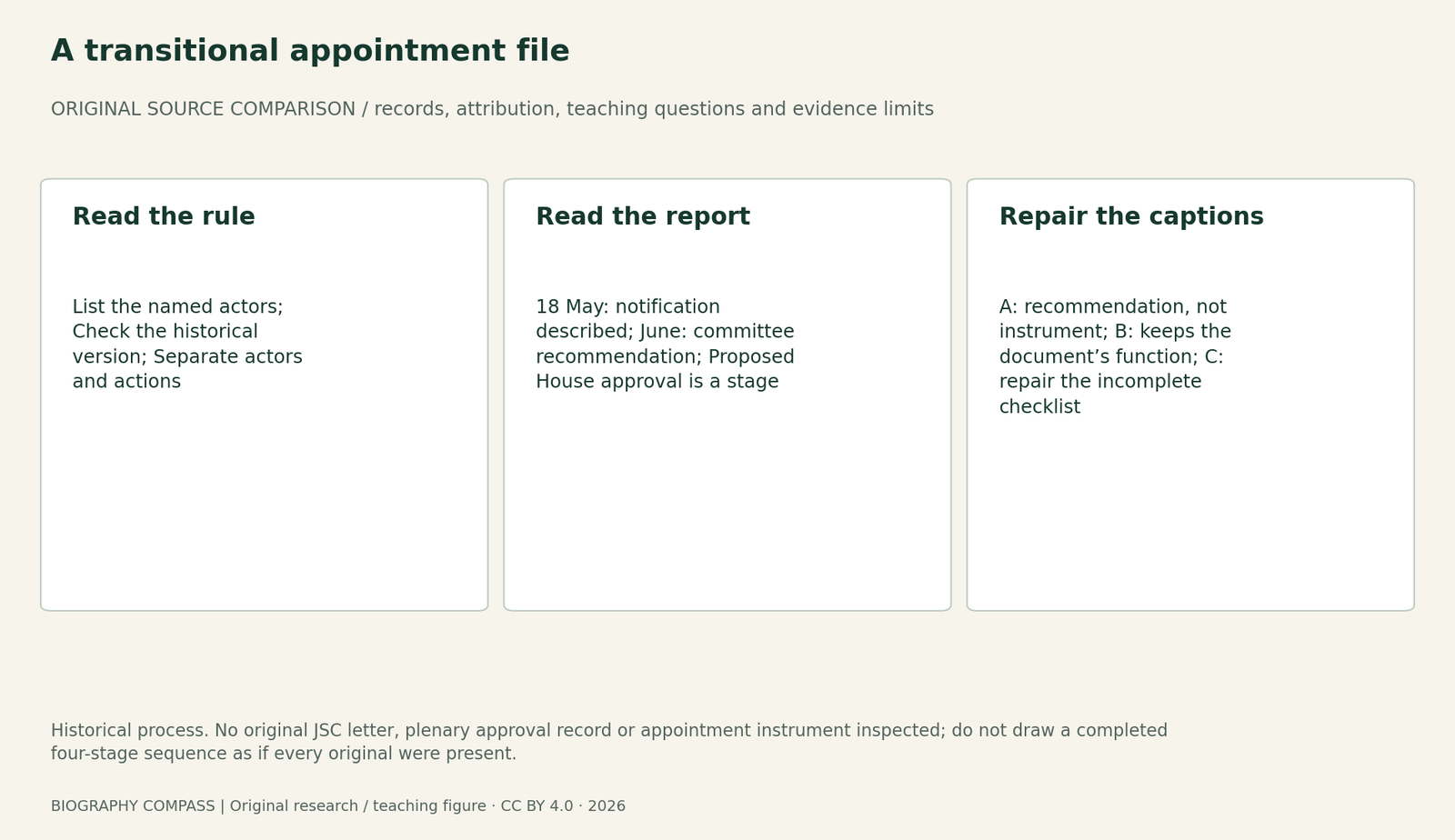
Article 166 distributes the ordinary chief-justice appointment process among the Judicial Service Commission, President and National Assembly. But the 2011 case also requires Sixth Schedule section 24: its transitional provision includes consultation with the Prime Minister under the National Accord framework. Reading only the ordinary article would lose a condition relevant to this historical appointment.
The two passages answer a question about authority, not whether every required act happened on a particular day. A legal rule supplies a checklist. A dated notification, vote or instrument supplies evidence about an event. Keeping those functions separate is the starting point for a reliable documentary chronology.
Sources for this section: [1]
What the committee report actually records
The Constitutional Implementation Oversight Committee’s report says the Speaker informed the House on 18 May 2011 of presidential nominations made after consultation with the Prime Minister. It names Willy Mutunga for Chief Justice, alongside separate nominees for Deputy Chief Justice and Director of Public Prosecutions. The report also explains a later referral to the oversight committee after operational difficulties with the initial scrutiny arrangement.
The selected committee minutes propose that the House approve Mutunga for appointment. This is a recommendation addressed to another institutional actor. Even formal wording beginning with a proposed resolution does not transform the committee’s document into a record of a subsequent plenary decision. The roles of the other two nominees should also not be imported into the chief-justice rule merely because their scrutiny appears in the same report.
Sources for this section: [2]
Use the career record for the endpoint it supplies
The Judiciary’s retrospective identifies Mutunga’s chief justiceship as 2011–2016. It supports the conclusion that he entered and later left that office. It does not, by itself, reproduce the JSC’s original recommendation, a full House voting record or the presidential appointment instrument.
Combining records can therefore strengthen a chronology without erasing the gaps between them. The report describes a proposal and a scrutiny process; the career account identifies completed service. To prove the precise legal completion sequence, a researcher would still seek the relevant contemporaneous approval record and appointment instrument. Those originals are not claimed as inspected here.
Exercise: repair a catalogue that merges the stages
An invented catalogue contains three captions. A says: “The committee minutes themselves appoint Mutunga.” B says: “The report records notification of a nomination and recommends House approval.” C says: “Because the ordinary article names three institutions, consultation with the Prime Minister was irrelevant in 2011.” Decide which caption can stand and rewrite the others.
Worked answer: B preserves both document type and procedural stage. A should say “The committee recommends approval for appointment”; the inspected minutes are not the appointment instrument. C should say “The ordinary rule must be read with the relevant transitional provision.” The error in C is an incomplete edition of the checklist, while A assigns a document an effect it does not have. These are invented captions, not quotations from a catalogue.
A practical evidence worksheet
Create four columns headed actor, action, record and remaining question. Enter each claim only once, then mark whether its source states a rule, reports another actor’s action or directly records its own decision. A committee saying that a nomination was notified is different from the original nomination document; that difference is useful even when neither account is disputed.
This worksheet helps avoid both overclaiming and unnecessary scepticism. The inspected sources establish meaningful stages and an eventual officeholder. They do not need to establish every stage in order to be useful. The comparison concerns a dated transition, not advice on how a judicial appointment must be conducted today.
Continue the chronology
Related history guides
When Did Kenya’s Parliamentary Service Begin?
Compare the records behind Kenya’s parliamentary service commission, separate constitutional creation from a service statute and correct conflicting date labels.
Read the timeline2010 text; fictional examplesDo Governors Need a Presidential Majority?
Compare Kenya’s governor and presidential vote rules in the retained 2010 text, then solve clearly fictional valid-vote and county-spread examples.
Read the timelineBiography context
Explore Kenya through connected lives
Connected biographies
People connected with these records
Birth year disputed
Willy Mutunga
Lawyer, rights advocate and former Chief JusticeWilly Mutunga moved from university teaching and human-rights organising into leadership of Kenya’s judiciary under the 2010 Constitution.Read biography1945–
Paul Muite
Advocate, former parliamentarian and political organiserPaul Muite combined legal practice, leadership of the Law Society of Kenya, parliamentary service and opposition organising across the multiparty transition.Read biographyQuick answers
Common questions
- Did the committee appoint the Chief Justice?
- No. Its selected minutes recommend approval for appointment.
- Does this establish every completion date?
- No. The original approval and appointment instruments were not inspected.
Primary and institutional sources
How this history was checked
Compare the original institutional records with the dated biographical and retrospective accounts below. This article was reviewed on 29 October 2026.
- Ministry of Defence, KenyaThe Constitution of Kenya, 2010: online transcription
- Kenya National Assembly, Constitutional Implementation Oversight CommitteeReport on nominees for Chief Justice, Deputy Chief Justice and Director of Public Prosecutions (June 2011)
- Judiciary of KenyaChief Justices: Willy Mutunga, 2011–2016