
The short answer
A company can change controlling shareholder while continuing an established assembly business. The useful question is what each record says changed, and which parts of the operation were already present.
Identify the subject
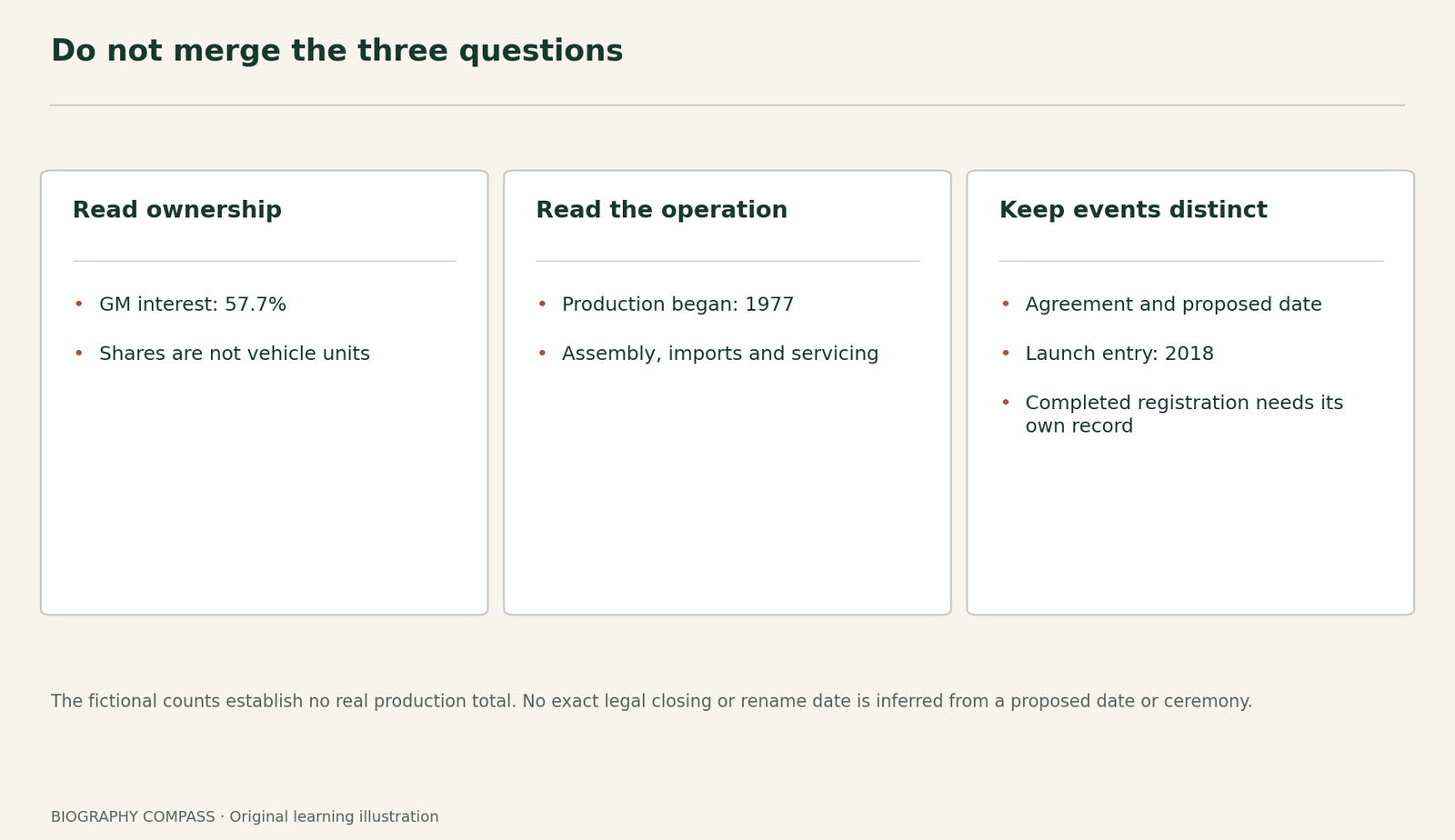
Ownership, products and events
A percentage or date is useful only when its object is clear.
| Question | Selected evidence | Boundary |
|---|---|---|
| Who buys shares? | Isuzu agrees to acquire GM’s 57.7% interest | A statement about ownership, not units produced |
| What does the operation do? | Kit-based assembly, imports, sales and servicing | Several activities, not a claim to make every component |
| Which date is this? | A proposed rename and later launch entries | Distinct events requiring distinct records |
Chronology
A timeline of the turning points
Incorporation
Company-history milestone.
First production
Different from a later ownership change.
Agreement announced
The release describes a proposed investment and name change.
Launch recorded
A separate ceremonial milestone.
An operating business before the transaction
Isuzu’s 28 February 2017 release describes GMEA as an existing business assembling and selling Isuzu trucks and buses, while importing pickups and Chevrolet passenger cars. Its outline calls truck and bus assembly CKD-kit based. This describes activities; it does not claim that every part was manufactured in Kenya.
The local company chronology separately records incorporation in 1975 and first production in 1977. Neither event waits for the later share transaction. Its timeline therefore provides a second kind of evidence: the history of the operation, rather than the terms announced by the investor.
Control, brands and a future-tense announcement
GM’s restructuring statement says Isuzu agreed to purchase GM’s 57.7% shareholding in GM East Africa, assuming management control. It separately says GM would withdraw Chevrolet sales from the market. The shareholding and the brand decision are related corporate actions, but they are not the same denominator or activity.
The Isuzu release’s shareholder outline totals 100% across Isuzu, ICDC, Centum and Itochu. It also proposes a name change in April 2017. That future wording is evidence of an announced plan, not a completed registration instrument.
The company chronology records a 2018 launch and also labels a 2019 entry as a name change. Those later labels should not be silently collapsed into the earlier proposed date. The selected records establish the broad transition; they do not settle one precise legal completion date for every milestone.
An original classification exercise
Invented company M has 100 ordinary shares. Buyer A acquires 60 existing shares from an outgoing shareholder. The factory already assembles Product P from supplied kits; 80 of its 100 units last year carried P’s brand. No other agreement is supplied. Which statements follow: A owns 60% of the shares; A manufactured 60 units; the deal created a new factory; P’s brand share proves its manufacturer owns 80% of M?
Next, suppose a notice dated 1 June announces a planned 1 August rename, while a later report describes a September launch ceremony. Arrange these as document date, planned event and reported ceremony. State which missing record would be needed to verify the completed legal rename. These dates and quantities are fictional, unrelated to the historical company.
Reference answer
Only the 60% share statement follows directly from the invented share count, assuming those are all issued ordinary shares with the stated ownership. Nothing supplied converts a share percentage into units made. The factory predates the fictional deal, and a product-brand share does not establish ownership of the assembler.
The 1 June notice, proposed 1 August event and September ceremony are three different descriptions. A completed company-registration or equivalent authoritative name-change record would answer the legal-date question. Neither a proposed date nor a launch ceremony can substitute for it. Likewise, the historical records should be cited for the event and scope they actually establish.
Continue the chronology
Related history guides
Biography context
Explore Kenya and Japan through connected lives
Connected biographies
Careers connected to these records
Birth date unverified
Rita Kavashe
Automotive business executiveRita Kavashe led an East African automotive business.Read biographyQuick answers
Common questions
- Does an investor release prove all later milestones were completed on its proposed date?
- No. Future-tense plans and completed events require different evidence.
- Can brand sales percentages be read as equity percentages?
- No. Product sales and ownership interests have different objects and denominators.
Primary and institutional sources
How this history was checked
Read the dated records in their own institutional context. Selected passages, participant accounts and original exercises are distinguished. This article was reviewed on 30 October 2026.