
The short answer
An expanding school needs money when payments fall due, not only a favourable annual total. The historical records show why an account of cash timing and a portfolio summary answer different questions.
Match record to question
Annual totals do not locate a cash gap
Use the source for what its form can establish.
| Material | Useful for | Cannot establish alone |
|---|---|---|
| Selected case narrative | Term receipts and reported financing pressures | A complete monthly bank ledger |
| Selected portfolio row | Commitment and held-investment categories | A school’s fee collection in each month |
| Original cash fixture | Testing timing under explicit assumptions | Actual historical fees, profits or credit needs |
Chronology
A timeline of the turning points
Field-research case
A narrative of expansion and cash timing.
Portfolio summary
A different record with different categories.
What the case actually describes
The 2002 Makini case describes fees arriving at term starts in January, May and September, alongside cash shortages later in a term. It distinguishes a long-term expansion loan from working-capital borrowing. It also reports a one-year principal moratorium during which interest still had to be paid.
Those are consequential distinctions. A principal-payment pause does not say that a debt disappeared or that all financing costs stopped. Nor does enrolment alone locate the date cash enters the account. The case is a field-research narrative drawing on participants, not a complete set of bank statements or a current fee schedule.
Sources for this section: [1]
What a later portfolio row can answer
IFC’s 2005 annual-report portfolio lists Makini School Limited in education services with a FY97 commitment entry. The selected table separates original commitments from investments held for IFC, in US$ millions. Its row shows 0.5 in original IFC commitments and 0.1 under loans held. These are rounded portfolio figures, not a monthly school-cash ledger.
Consequently, subtracting those two cells would not by itself establish a complete history of cash repayments. The categories differ, and the selected row does not identify every change in the exposure. It also cannot tell a reader whether one particular month’s teacher salaries or fees were paid on time.
The records therefore complement one another. The case supplies an account of how the organisation experienced timing and financing pressures; the later portfolio gives a dated institutional classification. Neither is a substitute for the underlying transaction-level records. The exercise below tests that distinction with entirely new data.
A completely fictional school budget
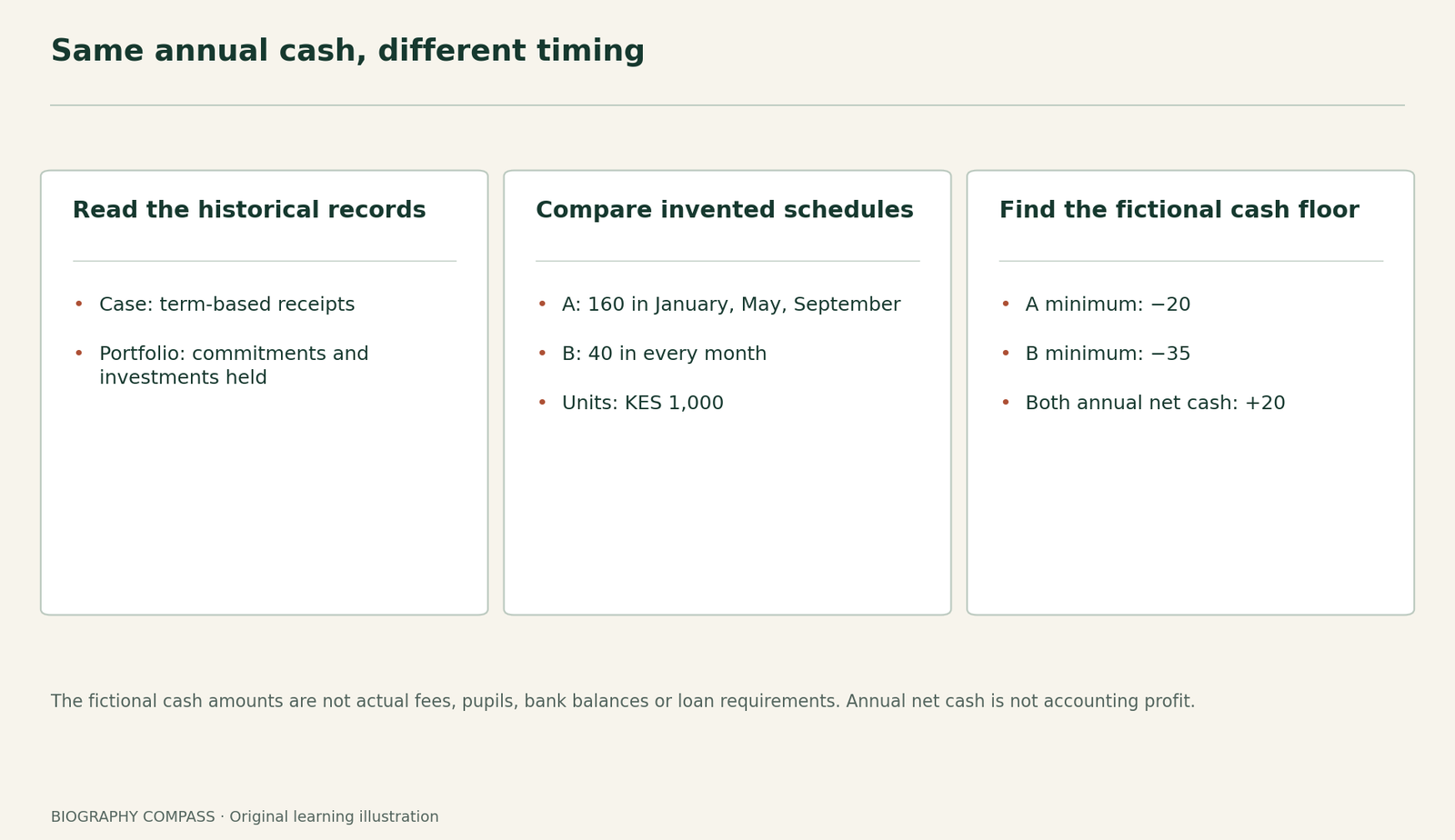
Use units of KES 1,000. The invented school starts with zero cash, has no borrowing and pays 35 every month. It also pays 40 for equipment in January. In schedule A, fee cash of 160 arrives in January, May and September. In schedule B, 40 arrives every month. Receipts arrive before payments within each month; all other cash flows, interest, tax and exchange-rate changes are excluded.
For each schedule, calculate annual receipts, annual payments and the final balance. Then roll the balance forward month by month, identify its lowest value and calculate the minimum opening cash needed to keep every month-end balance non-negative. Finally explain why that minimum is not a universal recommendation for school financing.
Worked reference answer
Both schedules receive 480 and pay 460: twelve monthly payments total 420, plus the equipment payment of 40. Each therefore ends with a net cash increase of 20. That is a cash result, not an accounting-profit calculation; the model supplies no depreciation or revenue-recognition assumptions.
Schedule A ends January at 85, February 50, March 15 and April −20. It reaches 0 in August and finishes December at 20. Its lowest month-end balance is −20, requiring 20 of opening cash under the stated assumptions. Schedule B begins at −35 in January and improves by 5 each month, finishing at 20; its corresponding opening requirement is 35.
Thus identical annual receipts and payments conceal different timing requirements. These answers depend on the fictional receipt dates and within-month ordering. Different payment dates, delayed fees or a reserve requirement could change the result. They do not reconstruct Makini’s actual cash account, establish historical loan terms beyond the selected narrative or prescribe a present financing product.
Continue the chronology
Related history guides
Biography context
Explore Kenya through connected lives
Connected biographies
Careers connected to these records
Birth date unverified
Mary Okelo
Banker and education entrepreneurMary Okelo built a career across banking, women’s finance and private education.Read biographyQuick answers
Common questions
- Does the model calculate accounting profit?
- No. It tracks cash receipts and payments, including an equipment payment; accounting recognition is unspecified.
- Does a principal moratorium necessarily eliminate interest?
- No. In the selected case, interest remained payable during the principal pause. The fictional model is separate.
Primary and institutional sources
How this history was checked
Read the dated records in their own institutional context. Selected passages, participant accounts and original exercises are distinguished. This article was reviewed on 30 October 2026.