
The short answer
The historical question is about an institution’s permission, rather than its reputation or the date a familiar name appeared. Read the holder, action and document date together.
Read the action
Three records, different evidential jobs
Keep the document’s claim distinct from conclusions it does not state.
| Record | Established in the selected text | Not established by that item alone |
|---|---|---|
| Earlier supervision report | A letter of intent and an expected next step | That all requirements had already been met |
| Dated public release | The named institution received deposit-taking permission | Every earlier date was also a licence date |
| Later directory | A licence date of 31 March 2010 | The date every borrower first used a savings product |
Chronology
A timeline of the turning points
Intermediate approval
The 2009 report records a letter of intent.
Licence date
Recorded separately from the announcement.
Public announcement
The release reports the grant and its scope.
What the earlier report had not yet established
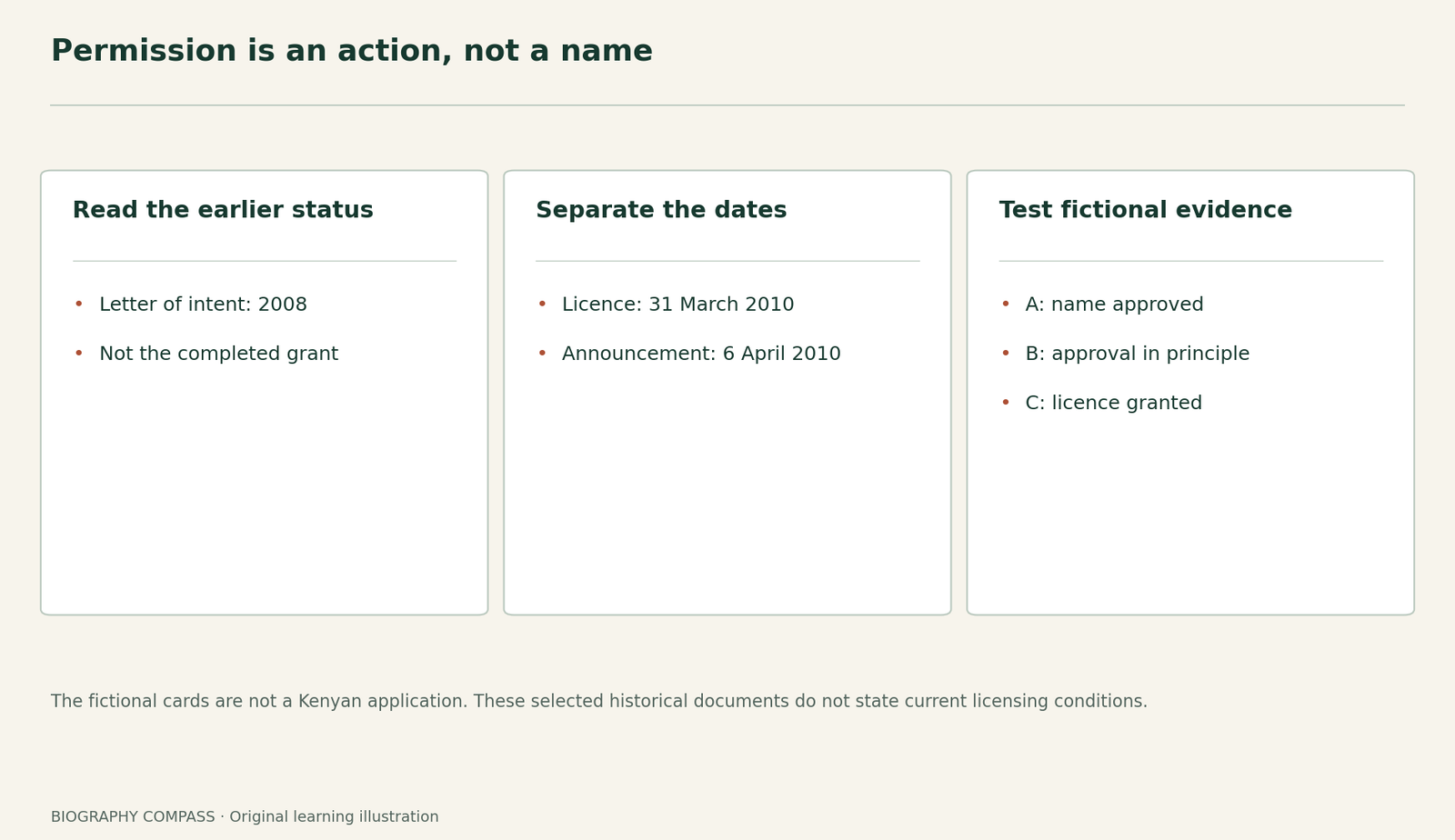
CBK’s 2009 supervision report says KWFT-DTM had received a letter of intent in 2008 and was expected to meet licensing requirements in early 2010. Approval in principle was therefore not described as the completed licence. The same section distinguishes credit-only institutions from deposit-takers and prohibits the former from intermediating clients’ cash collateral.
This provides an answer to a common reading error: an application milestone is evidence of that milestone. It does not acquire the meaning of the next document merely because the same institution later appears in both. Track the action, rather than assuming every official reference is equivalent.
Sources for this section: [1]
The licence and the announcement are different dates
The release dated 6 April 2010 names Kenya Women Finance Trust Deposit Taking Microfinance Limited and announces nationwide deposit-taking permission. It explains the addition of savings products to lending.
The 2023 supervisory directory gives 31 March 2010 as the licence date for the later-named Kenya Women Microfinance Bank. The two dates answer different questions: the directory records licensing, while the release is the public announcement.
That distinction also keeps the permission attached to the named entity. A leader’s appointment, a programme’s earlier history and a company’s later branding cannot be substituted for the authorisation record. These selected historical records do not establish today’s permissions for a new applicant.
An invented evidence file
Imagine three fictional documents about Acacia Finance: A approves a business name; B grants approval in principle; C states that a licence has been granted to a named company for a specified activity. Classify each document’s strongest established action. Then consider a proposed sentence: “A and B together prove C.” What is missing?
For a second question, imagine that Acacia is still credit-only and holds borrower collateral in a separate trust account. Can the 2009 description be read as permission to lend that collateral onward? Explain from the selected paragraph, without treating the invented company as an actual licence applicant.
Reference answer and limits
A establishes name approval; B establishes the intermediate approval; C establishes the stated grant and scope. A and B cannot substitute for C. The missing evidence is the completed grant, not a more persuasive description of the organisation. Do not infer an effective date absent from the fictional record.
For the collateral question, the selected 2009 report prohibits on-lending cash collateral by credit-only institutions. Account separation is not a permission to intermediate the funds. This is a reading of that historical report, not a checklist for operating a financial institution under current law.
Continue the chronology
Related history guides
Biography context
Explore Kenya through connected lives
Connected biographies
Careers connected to these records
Birth date unverified
Jennifer Riria
Microfinance and development leaderJennifer Riria connected microfinance management with women’s economic participation.Read biographyBirth date unverified
Mary Okelo
Banker and education entrepreneurMary Okelo built a career across banking, women’s finance and private education.Read biographyQuick answers
Common questions
- Does a public announcement have to share the licence date?
- No. A record can announce an action taken earlier; read the date attached to each event.
- Does a borrower count prove regulatory permission?
- No. Activity and authorisation are different questions; identify the grant and its scope.
Primary and institutional sources
How this history was checked
Read the dated records in their own institutional context. Selected passages, participant accounts and original exercises are distinguished. This article was reviewed on 30 October 2026.