
The short answer
The reading question is what information is preserved, and over what domain. An elementary warm-up first shows why a tangent at one point loses information; the research statements then require much more structured data.
Read the evidence
Keep the mathematical objects in the statement
Separate the record’s objects and observations from the conclusion being tested.
| Item | What is being compared | Limit |
|---|---|---|
| Warm-up | One point and one slope | Insufficient to identify arbitrary curves |
| 2001 exposition | Additional finite-Gauss-map condition | Read the stated setting as well |
| 2008 account | Structured tangent families and a preserving map | Not unrestricted local-to-global inference |
Chronology
A timeline of the turning points
Earlier exposition
The selected theorem includes a Gauss-map condition.
Later account
The selected discussion explains the removed condition.
A family of directions, not a single slope
Mok’s 2008 introduction describes a chosen component of minimal rational curves and their variety of tangent directions at a general point. The programme examines this information across a manifold.
For reading purposes, distinguish a curve, its direction at a point, the collection of relevant directions there, and the way those collections vary. Replacing the last two objects with one local slope discards part of what the research is examining.
Sources for this section: [2]
The hypotheses do mathematical work
Hwang’s 2001 exposition includes positive dimension and a finite-Gauss-map condition. Mok’s 2008 Theorem 9 assumes two Fano manifolds of Picard number 1, a non-linear positive-dimensional variety of minimal rational tangents at a general point, and a biholomorphism of connected open sets whose differential maps the relevant irreducible components biholomorphically.
Mok explicitly explains removal of the earlier Gauss-map condition. The conclusion extends the specified map globally; it does not say that any pair of spaces sharing one tangent are identical.
An original elementary warm-up
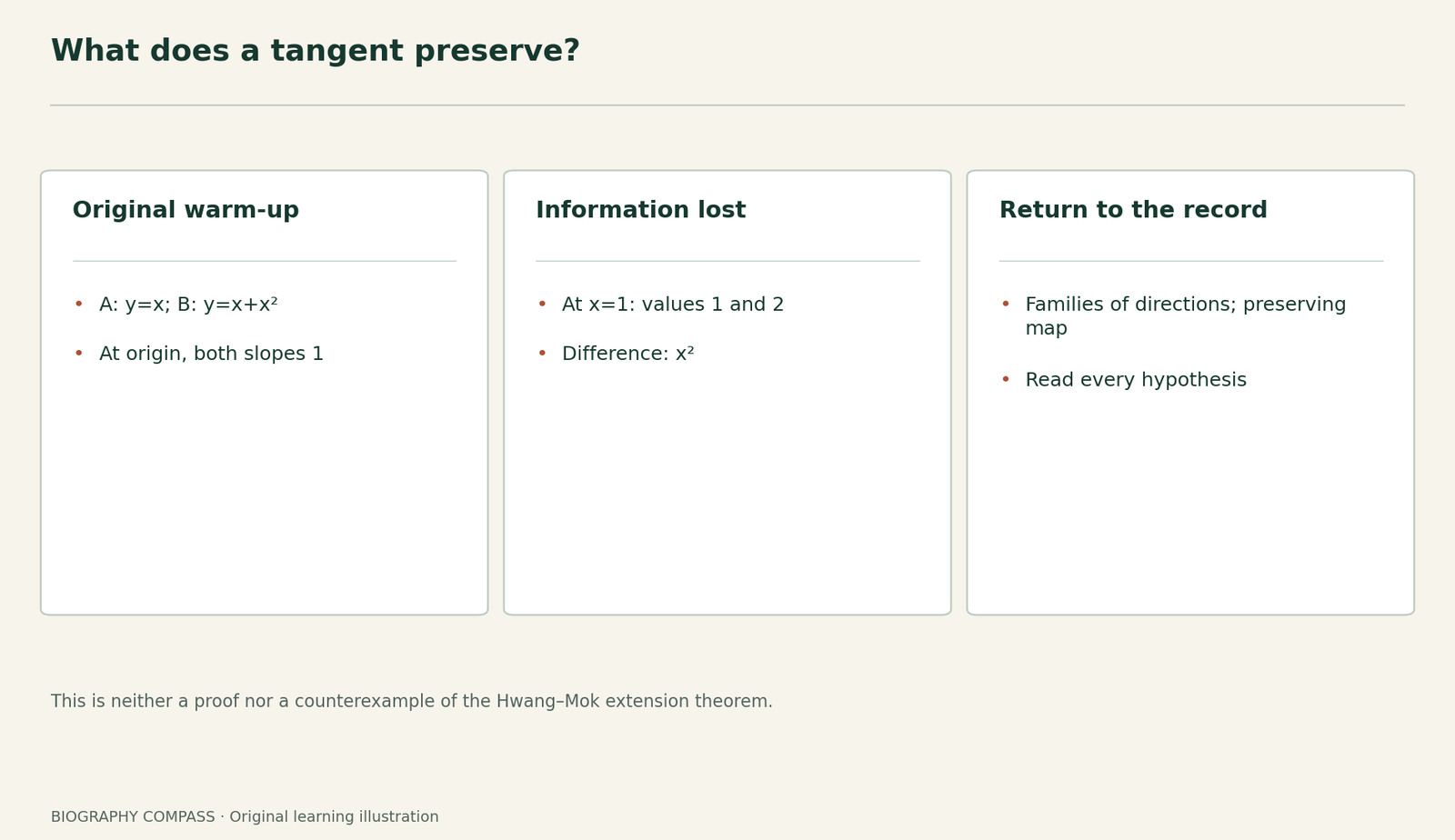
In the real coordinate plane compare curve A: y=x and curve B: y=x+x² near the origin. Compute their slopes at x=0, their values at x=1, and the difference between them at a general x. Does equality of the slopes at the origin establish equality of the curves?
Now compare A with the family y=x+c×x² for arbitrary real c. How many different curves can share the same value and tangent at the origin? This is an exercise about elementary information loss, not a model of a minimal rational component on a Fano manifold.
Reference answer and the boundary of the analogy
The derivatives are 1 and 1+2x, so both slopes are 1 at the origin. At x=1 the values are 1 and 2. Their difference is x². Every real value of c gives the same value 0 and slope 1 at the origin, yet distinct nonzero choices change the curve away from that point.
A single tangent therefore does not identify an arbitrary curve. This does not refute, prove or approximate the extension theorem. The research statements impose particular geometric objects, a map on an open set and preservation conditions. The warm-up only explains why the reader must not delete those conditions when paraphrasing the result.
Continue the chronology
Related history guides
Drosha–DGCR8: What Did Add-Back Show?
Compare another selected research record and an explicitly bounded learning example.
Read the timeline2009 record and an original learning exerciseZeolite Nanosheets: What Does 2 nm Measure?
Compare another selected research record and an explicitly bounded learning example.
Read the timelineBiography context
Explore Worldwide through connected lives
Connected biographies
Researchers connected with these records

Birth date unverified
Jun-Muk Hwang
Complex geometerHwang studies families of minimal rational curves.Read biographyQuick answers
Common questions
- Does the warm-up use the same objects as the research theorem?
- No. The warm-up uses real plane curves and is not a proof of either research statement.
Primary and institutional sources
How this history was checked
The earlier exposition was read through indexed passages; two selected pages of the later account were visually inspected. The warm-up is not a proof. This article was reviewed on 30 October 2026.