
The short answer
A small dimension is useful only when the reader knows what was measured. This record makes two length scales consequential for different reasons; neither can stand in for a quantitative performance test.
Read the evidence
Architecture and performance must keep their own units
Separate the record’s objects and observations from the conclusion being tested.
| Item | What is being compared | Limit |
|---|---|---|
| Channel opening | Aperture below 1 nm | Not the crystal thickness |
| Sheet dimension | Thickness 2 nm | Not a channel diameter |
| Teaching calculation | Time ratio 0.01 | Not an observed deactivation ratio |
Chronology
A timeline of the turning points
Nanosheet report
The author abstract distinguishes aperture and thickness.
Hold assumptions fixed
The slab model compares path length under an expressly assumed law.
The two lengths belong to different objects
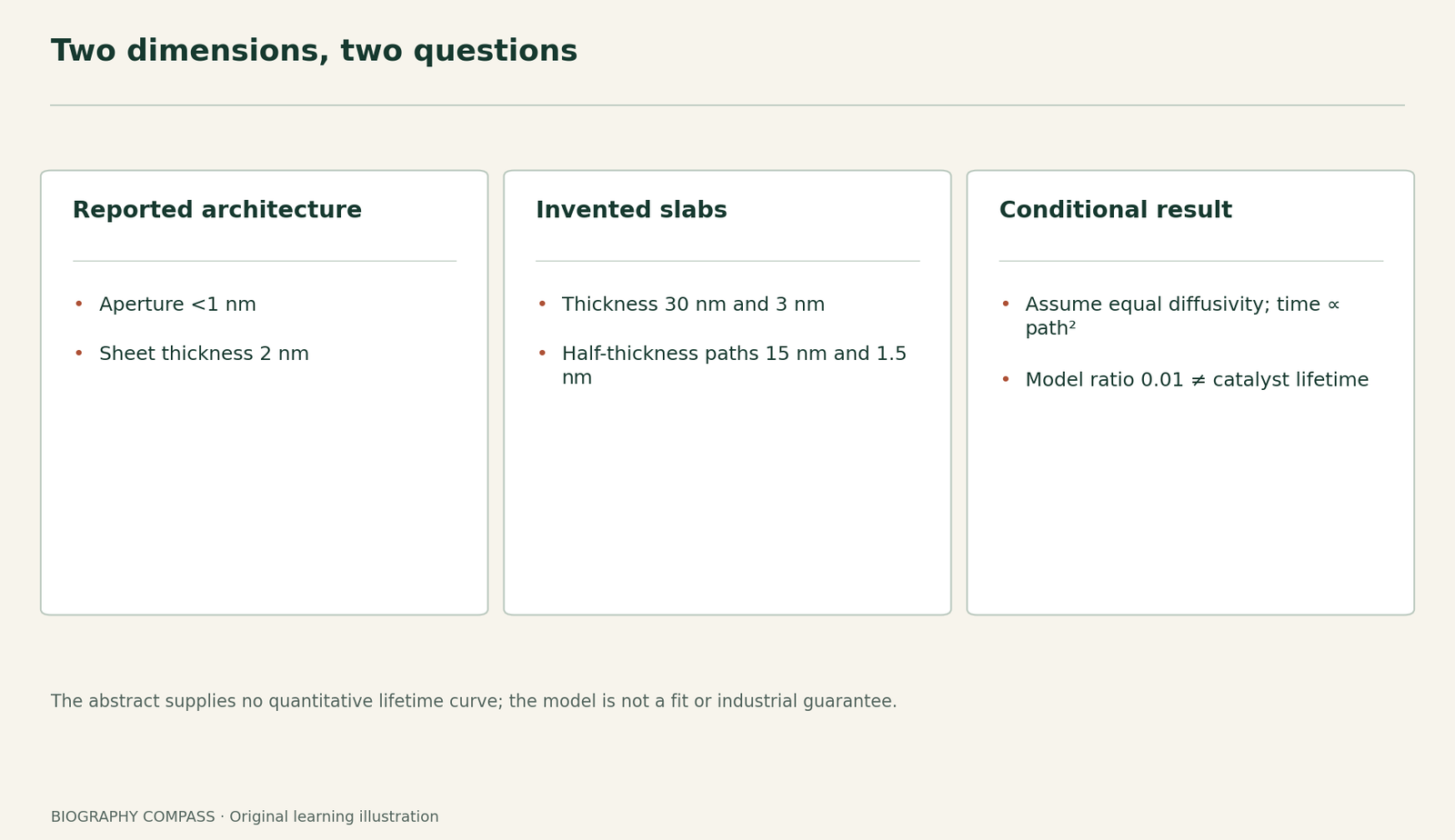
Choi and colleagues’ abstract describes micropore apertures below one nanometre and MFI nanosheets two nanometres thick, a unit-cell dimension along the b-axis. Thickness is not a channel opening.
This matters when comparing claims about entry into a channel with claims about the distance travelled through a solid. A thinner object need not have a wider internal opening. Keeping the object attached to the unit prevents the two statements being silently exchanged.
Sources for this section: [1]
What the authors reported about catalysis
The authors connect external acid sites with conversion of large organic molecules and reduced thickness with diffusion. They report suppressed coke-related deactivation during methanol-to-gasoline conversion. The selected abstract supplies no numerical lifetime curve.
The historical answer is therefore specific but bounded: architecture is linked to reported catalytic behaviour, while a numerical performance multiplier cannot be recovered from this reading. A quantitative claim would require the actual testing conditions, comparison material and observation interval.
Sources for this section: [1]
A conditional model, not a fitted result
Invent two homogeneous slabs, A and B, with thicknesses 30 nm and 3 nm. Assume entry from either face and define the longest path to the centre as half the thickness. Assume the same effective diffusion coefficient and, solely for this exercise, characteristic time proportional to path length squared. Find the path lengths and the ratio of B’s characteristic time to A’s.
Now ask whether the result establishes a hundredfold increase in catalyst lifetime. Explain which link between movement and performance the model has not supplied. The dimensions are invented slab inputs; they are not a reconstruction of the study’s control catalyst.
Sources for this section: [1]
Reference answer and limits
The centre paths are 15 nm and 1.5 nm. Under the stated model, timeB/timeA=(1.5/15)²=0.01. That is a hundredfold difference in the model’s characteristic transport time. It is not a measured lifetime ratio.
The exercise contains no model of reaction rate, site accessibility, coke formation or changing structure during use. It also assumes comparable transport behaviour in the two slabs. The historical authors’ qualitative report and this deliberately simplified calculation answer different questions; neither should be turned into an industrial guarantee.
Sources for this section: [1]
Continue the chronology
Related history guides
Drosha–DGCR8: What Did Add-Back Show?
Compare another selected research record and an explicitly bounded learning example.
Read the timeline2004 record and an original learning exerciseNanocrystal Size: Counting or Weighing Particles?
Compare another selected research record and an explicitly bounded learning example.
Read the timelineBiography context
Explore Worldwide through connected lives
Connected biographies
Researchers connected with these records
Birth date unverified
Ryong Ryoo
Porous-materials chemistRyoo researches porous catalytic materials.Read biographyQuick answers
Common questions
- Was the complete experimental article read?
- No. This guide uses the author abstract and makes no claim to have inspected its full methods, micrographs or catalytic curves.
Primary and institutional sources
How this history was checked
The author abstract was read; the full experimental body was inaccessible. The conditional slab model is original and is not a fit to reported catalyst performance. This article was reviewed on 30 October 2026.