
The short answer
A protein can be found beside another protein without being required for its activity. This guide follows the different jobs performed by the selected experiments, then asks what an invented evidence file would justify.
Read the evidence
Different experiments, different evidential jobs
Separate the record’s objects and observations from the conclusion being tested.
| Item | What is being compared | Limit |
|---|---|---|
| Association | Proteins found together | Does not alone establish a required activity |
| Add-back | Processing restored in the combination | Trace cofactors not formally excluded |
| Cellular depletion | Primary and downstream RNA change differently | Not a clinical outcome |
Chronology
A timeline of the turning points
A combined study
Three complementary experimental approaches.
Separate the controls
Change the preparation while keeping the invented readout comparable.
Association was the start of the question
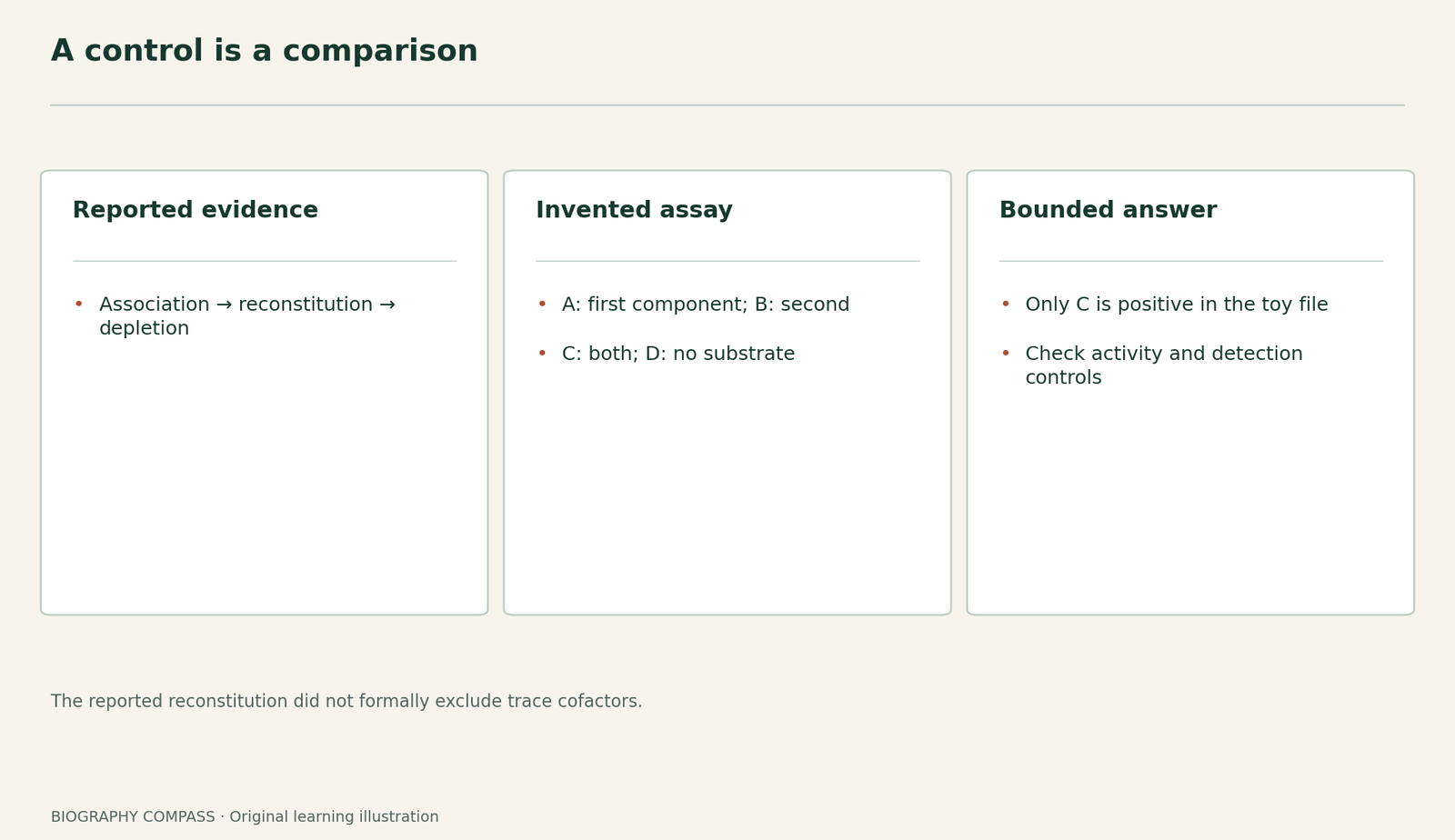
Han and colleagues showed that DGCR8 associated with Drosha. Association alone did not establish a catalytic role. Their processing tests therefore compared purified Drosha, DGCR8 and their combination.
The important comparison is between experimental states. A positive signal in a mixed preparation leaves open which component matters; removing or supplying a component changes the question that can be answered.
Sources for this section: [1]
Reconstitution and depletion answered different questions
Intensively washed Drosha did not process the tested primary RNA. Adding bacterially produced GST-DGCR8 restored processing, whereas DGCR8 alone lacked activity. The authors nevertheless retained the possibility of residual cofactors. Cellular depletion separately produced accumulated primary transcripts and reduced downstream products.
Together these observations support a role in the processing step more strongly than association alone. The stated caveat limits a claim of complete biochemical sufficiency: a successful reconstitution can be informative without proving that no unmeasured trace component remains.
Sources for this section: [1]
An original qualitative evidence exercise
Consider a fictional assay with equal input RNA and the same detection threshold in every tube. Tube A contains washed Drosha; B contains DGCR8 alone; C combines the two; D combines both but contains no substrate. Suppose only C produces the expected cleavage product. None of these labels is a measurement reproduced from the paper.
What does A versus C test? What does B rule out under these conditions? Why include D? Now imagine every tube is negative. Name two checks needed before claiming that the proposed partnership is irrelevant.
Sources for this section: [1]
Reference answer and the remaining uncertainty
A versus C tests the consequence of adding the second component to that preparation. B tests whether that component alone generates the readout. D helps detect a product-like signal that does not depend on the supplied substrate. These comparisons support the combination in this fictional assay; they do not establish direct binding, universal sufficiency or a cellular outcome.
If all tubes are negative, first check that the substrate and detection method work, and that the protein preparations retain activity. A failed assay cannot automatically separate an incorrect biological model from damaged reagents. The historical cellular experiment is an additional line of evidence, not an invented result for these four tubes.
Sources for this section: [1]
Continue the chronology
Related history guides
Zeolite Nanosheets: What Does 2 nm Measure?
Compare another selected research record and an explicitly bounded learning example.
Read the timeline2004 record and an original learning exerciseNanocrystal Size: Counting or Weighing Particles?
Compare another selected research record and an explicitly bounded learning example.
Read the timelineBiography context
Explore Worldwide through connected lives
Connected biographies
Researchers connected with these records

Birth date unverified
V. Narry Kim
RNA biologistV. Narry Kim studies how cells process and regulate RNA.Read biographyQuick answers
Common questions
- Does the original fixture reproduce a published gel?
- No. It is a qualitative teaching example with invented tube labels and outcomes.
Primary and institutional sources
How this history was checked
Selected Results paragraphs were read. The original teaching fixture is not a reconstruction of a published gel. This article was reviewed on 30 October 2026.