
The short answer
How did RNase P show that RNA could catalyse a reaction?
Evidence comparison
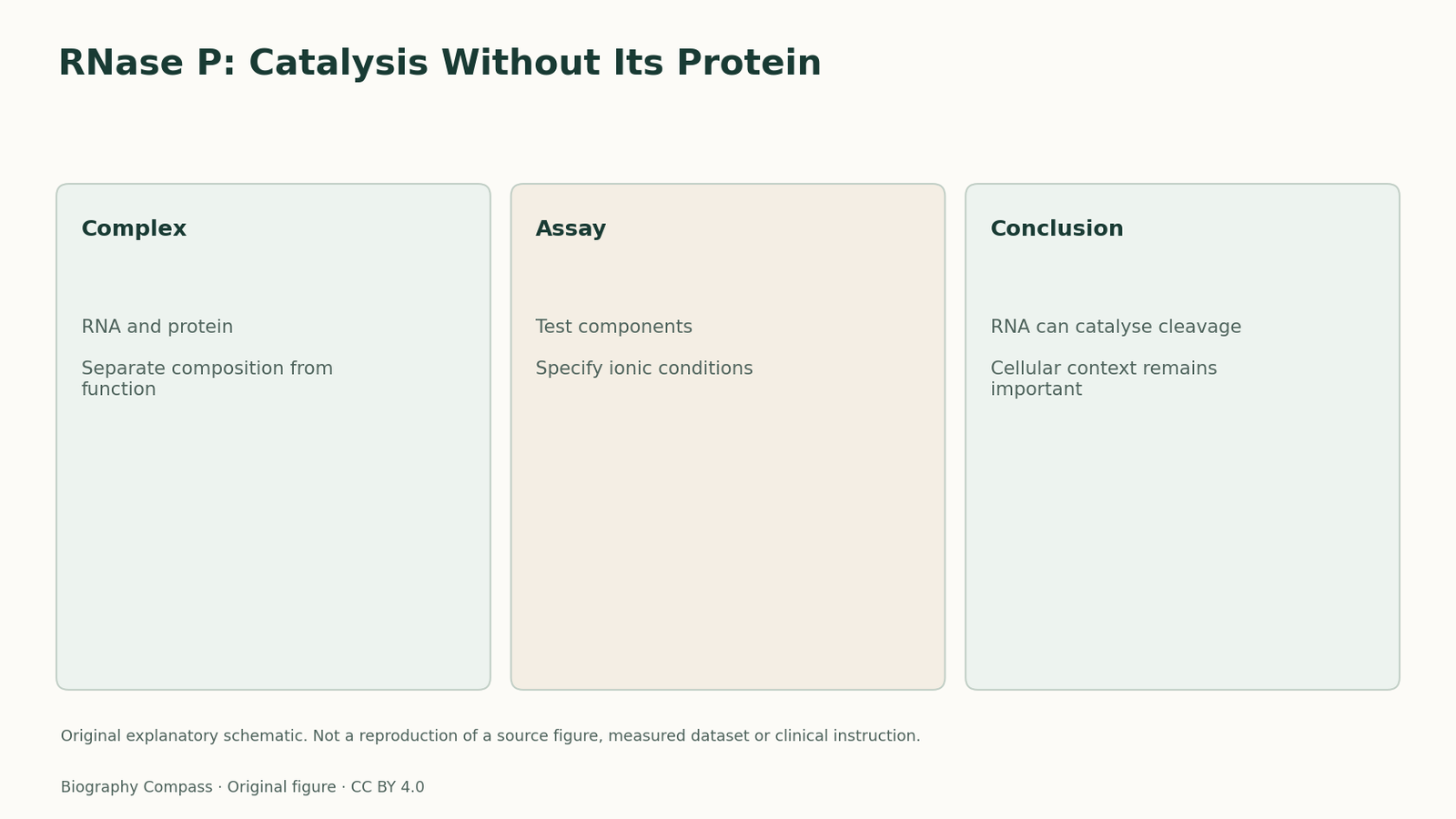
RNase P: Catalysis Without Its Protein
Compare the observations with the narrower conclusions they support.
| Record or observation | What it supports | What remains separate |
|---|---|---|
| RNA detected in a complex | Establishes composition | Does not identify the catalytic component |
| RNA-alone cleavage in defined conditions | Demonstrates catalytic capability | Does not make its protein partner universally unnecessary |
A complex can contain more than one functional contribution
RNase P is a ribonucleoprotein involved in processing transfer-RNA precursors. Finding RNA within the complex did not automatically prove that RNA performed catalysis. It could initially have been a structural component supporting a protein enzyme. Altman's research programme separated the components and examined their activities, turning a compositional observation into a question about which component could carry out the chemical reaction.
Conditions are part of the result
Altman's lecture describes RNA-alone activity under particular ionic conditions, including elevated magnesium compared with some earlier assays. It also reports that the protein component could improve reaction behaviour. A 1984 study showed catalytic cleavage by an RNA transcript prepared in vitro. Together these observations support RNA's catalytic capability without implying that the protein is dispensable under every cellular condition. Capability in a defined assay and normal physiological performance are different claims.
A component-by-condition matrix
Make an original matrix with rows for RNA alone, protein alone and the combined complex, and columns for two unspecified buffer conditions. Ask which cells need measurements before an inactive RNA-alone result can justify the claim that RNA never catalyses the reaction. The answer is that a single negative cell cannot support such a universal claim. Then ask what a positive RNA-alone cell establishes: catalytic capability under the measured conditions, with purity and substrate controls still relevant.
Sources for this section: [4]
Compare catalytic RNA systems carefully
This question differs from simply asking whether RNA carries genetic information. It also differs from Cech's self-splicing example, where the reacting RNA initially rearranges itself. The comparison helps preserve the particular reaction, substrate and conditions behind the general phrase RNA catalysis.
Continue the chronology
Related history guides
Biography context
Explore Canada through connected lives
Connected biographies
Researchers and related questions
1939–2022
Sidney Altman
Molecular biologist and RNA-catalysis researcherRNase P contains RNA and protein components.Read biography
1947–
Thomas R. Cech
Biochemist and RNA-catalysis researcherCech's group found that an intervening RNA sequence could be removed and the remaining RNA joined without an added protein catalyst.Read biography1922–1993
Robert W. Holley
Biochemist and transfer-RNA researcherA sabbatical with James Bonner at Caltech helped focus Holley's interest on protein synthesis.Read biographyQuick answers
Common questions
- How did RNase P show that RNA could catalyse a reaction?
- Establishes composition. Does not identify the catalytic component.
- Are the classroom examples historical measurements?
- No. Invented examples are labelled as classroom models; the source-based discussion identifies the historical evidence separately.
Primary and institutional sources
How this history was checked
Official biographical and award records are read alongside the researcher’s technical account. Source scope and hypothetical examples remain distinct. This article was reviewed on 7 November 2026.