
The short answer
Why must both a comb’s repetition spacing and offset be known to determine an optical frequency?
Read the evidence
Different records within the same investigation
The following comparison distinguishes the specific questions answered by the inspected records.
| Record or test | What it establishes | What remains different |
|---|---|---|
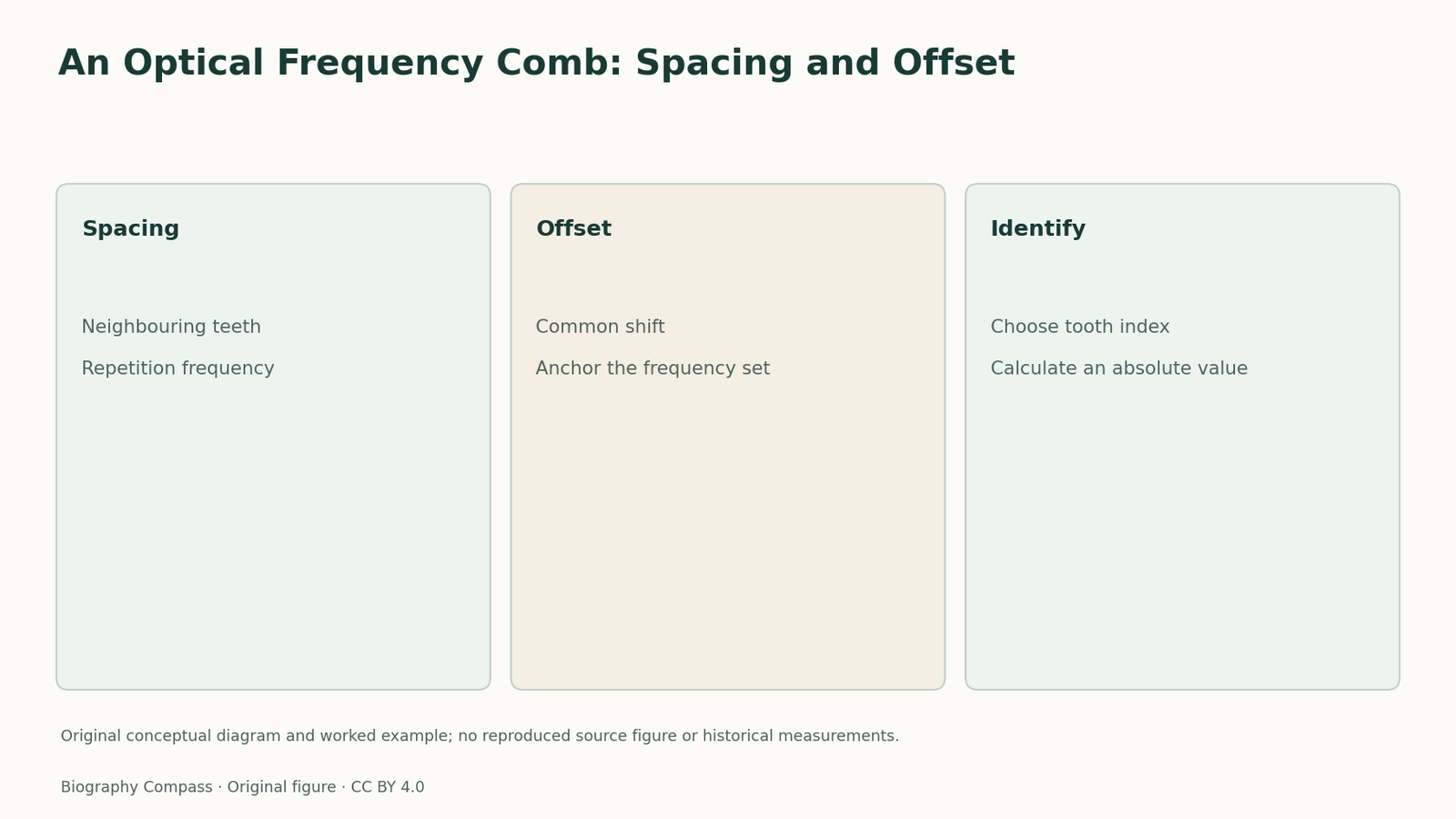
| Tooth spacing | Sets the interval between neighbouring components. | Does not locate the complete comb absolutely. |
| Common offset | Locates the shifted set relative to the frequency origin. | Does not identify an unknown tooth index. |
| Index and calibrated quantities | Specify an individual tooth’s frequency. | Require experimental control and identification. |
Two quantities locate a tooth
The Ye–Hall–Diddams paper describes a comb through its repetition frequency and an offset: a tooth frequency can be expressed as an integer multiple of the spacing plus that common offset. The integer identifies which tooth is being considered. This is why absolute measurement needs more information than a photograph of equally spaced spectral lines. Controlling or measuring both radio-frequency quantities, together with the appropriate tooth identification, gives a route from a repeating pattern to an optical-frequency value.
Sources for this section: [2]
The historical advance was a controlled connection
Hall’s lecture describes a synthesis of ultrastable lasers, ultrafast pulses, nonlinear materials and sensitive spectroscopy around 1999–2000. These contributions made it possible to use the comb as a measurement bridge. A regular pattern is a useful starting point, but the published precision work concerns how that pattern is anchored and used. Reading the technical paper alongside the lecture separates the mathematical description from the experimental methods needed to make its quantities stable and traceable. It also preserves the collaborative character of the work.
An original ruler-calibration exercise
Imagine a fictional frequency ruler whose teeth are separated by ten arbitrary units and whose offset is three. Tooth number seven lies at seven times ten plus three, or seventy-three. A second ruler has the same spacing but offset eight, placing tooth seven at seventy-eight. Are the rulers identical because their tooth spacing agrees? No: every corresponding tooth differs by five units. These small invented numbers are not optical-frequency measurements or specifications of Hall’s apparatus. They isolate the roles of spacing, offset and index. If the index were unknown, even perfect knowledge of spacing and offset would not identify which tooth an observed signal matched. The supported answer therefore lists all three pieces of information before claiming an absolute frequency.
Continue the chronology
Related history guides
Photon Correlations: Intensity Versus Coherence
Use Glauber’s optical-coherence framework to distinguish brightness, interference and photon coincidences through an original equal-count example.
Read the timeline1978–2012Laser-Cooled Ions 1978: Temperature and Motion
Read the 1978 trapped-ion cooling abstract precisely, separating measured temperatures from proposed limits and cooling from later quantum-control experiments.
Read the timelineBiography context
Explore United States through connected lives
Connected biographies
Researchers and related approaches
1934–
John L. Hall
Experimental physicist and laser-spectroscopy researcherJohn L. Hall developed precision laser spectroscopy and helped connect optical frequencies with countable radio-frequency references through frequency combs.Read biography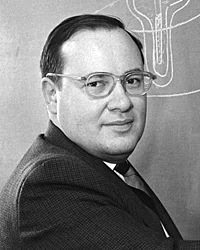
1921–1999
Arthur Schawlow
Physicist and laser spectroscopistArthur Schawlow moved from Toronto spectroscopy to Columbia, Bell Laboratories and Stanford, linking an optical-maser proposal with later precision measurements.Read biographyQuick answers
Common questions
- Does equal comb spacing imply equal absolute frequencies?
- No. Different offsets can shift otherwise equally spaced combs.
- Why does the tooth number matter?
- Spacing and offset describe a family of frequencies; the integer index identifies one member.
Primary and institutional sources
How this history was checked
The references below distinguish the original study from later explanations. The worked exercise and comparison are newly written for this article. This article was reviewed on 8 November 2026.
- Physical Review Letters, 2000Direct Link between Microwave and Optical Frequencies with a300 THz Femtosecond Laser Comb
- Ye, Hall and Diddams, Optics Letters, 2000Precision phase control of an ultrawide-bandwidth femtosecond laser: a network of ultrastable frequency marks across the visible spectrum
- Nobel Prize OutreachJohn L. Hall — Nobel lecture
- Nobel Prize OutreachJohn L. Hall — Facts
- Nobel Prize OutreachJohn L. Hall — Biographical