
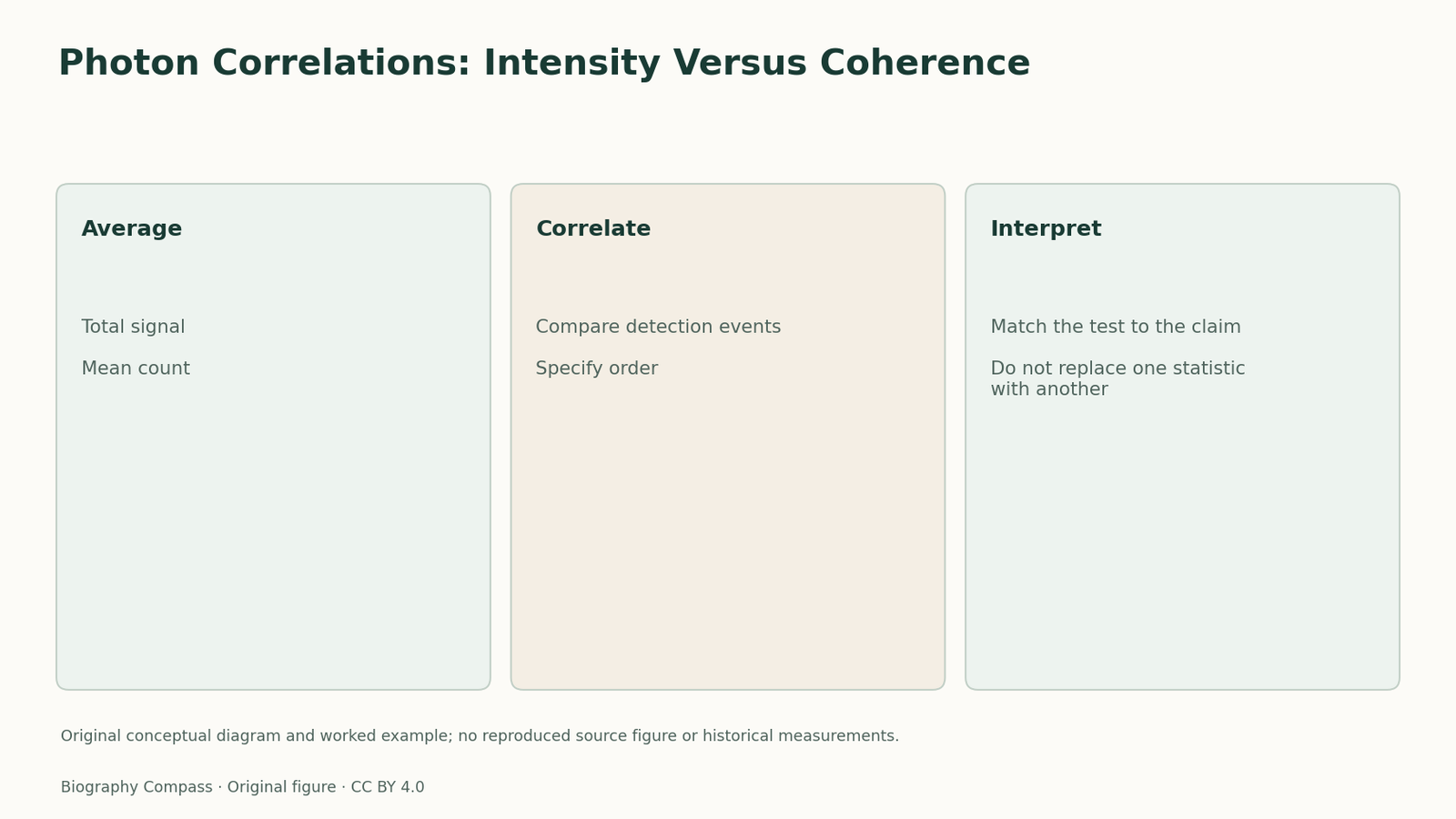
The short answer
Why can light sources with similar average intensity have different photon-count correlations?
Read the evidence
Different records within the same investigation
The following comparison distinguishes the specific questions answered by the inspected records.
| Record or test | What it establishes | What remains different |
|---|---|---|
| Mean intensity | Characterises an average signal. | Does not determine all joint-event statistics. |
| First-order interference | Tests field relationships relevant to fringe formation. | Does not alone establish every higher-order coherence property. |
| Coincidence information | Adds relationships between detection events. | Requires an explicitly defined detection test. |
Average intensity leaves information unspecified
Glauber’s 1963 paper organised optical coherence using a hierarchy of correlation functions. Average intensity is one accessible property, but successive detection events can contain relationships that an average suppresses. Two sources can therefore give the same mean count without sharing all their detection statistics. The point is not that intensity becomes useless. It is that a particular measurement answers a particular question, and the statistics needed for a different question may require a higher-order correlation.
Sources for this section: [1]
Interference and coincidences probe different relationships
In his Nobel lecture, Glauber discusses two-pinhole interference through first-order field correlations. The cross terms describe the interference contribution in addition to the separate intensities. Coincidence experiments instead ask about joint detection behaviour. These are related parts of one optical description, but an interference result does not automatically determine every joint-count statistic. Calling a source coherent without specifying the intended order or measurement can hide exactly the distinction the theory was designed to express.
The measurement must match the proposed claim
A claim about equal average brightness can be tested by comparing averages. A claim about temporal clustering requires information on which events occur together or near one another. Glauber’s framework makes that difference systematic rather than relying on visual impressions of a beam. Monochromaticity also is not a substitute for every coherence condition. Reading the original theoretical statement alongside the later lecture reveals a useful progression: define the detection question first, then identify the correlation required to answer it.
An original equal-total exercise
Imagine two invented counters observed in four equal time windows. Counter A records two, two, two and two events; counter B records zero, four, zero and four. Both totals are eight, and both averages are two per window. Does that establish identical fluctuations? No. Their window-to-window distributions differ, even though their means agree. The example is a simple illustration of information lost through averaging; it is not a simulation of a quantum optical state or a historical photon experiment. To infer a real second-order optical correlation, a researcher would need the appropriate detection arrangement and analysis. The supported answer is narrower: matching one summary statistic does not force all other statistics to match. Changing the window size could also change the displayed pattern, so the measurement definition belongs in the conclusion.
Continue the chronology
Related history guides
Biography context
Explore United States through connected lives
Connected biographies
Researchers and related approaches
1925–2018
Roy Glauber
Theoretical physicist and quantum-optics researcherRoy Glauber developed quantum optical coherence theory, showing why average brightness, interference and photon correlations answer different questions.Read biography1902–1984
Paul Dirac
Theoretical physicistPaul Dirac developed mathematical foundations of quantum mechanics, linking a Bristol engineering education with Cambridge research and a prediction tested by particle experiments.Read biographyQuick answers
Common questions
- Does equal brightness imply equal photon statistics?
- No. A mean intensity leaves other detection relationships unspecified.
- Is the four-window exercise quantum data?
- No. It is an invented illustration of the information lost in an average.
Primary and institutional sources
How this history was checked
The references below distinguish the original study from later explanations. The worked exercise and comparison are newly written for this article. This article was reviewed on 8 November 2026.