
The short answer
What did the 1978 ion-cooling experiment measure, and why is confinement different from low motional energy?
Read the evidence
Different records within the same investigation
The following comparison distinguishes the specific questions answered by the inspected records.
| Record or test | What it establishes | What remains different |
|---|---|---|
| Confinement | Keeps ions within a trap. | Does not imply zero motion. |
| 1978 cooling report | Establishes the reported experimental temperature bound. | A prospective lower limit is not a measured result. |
| Later quantum control | Adds experiments on internal states and motion. | Cannot be silently assigned to the earlier apparatus. |
A trapped absorber still had motion
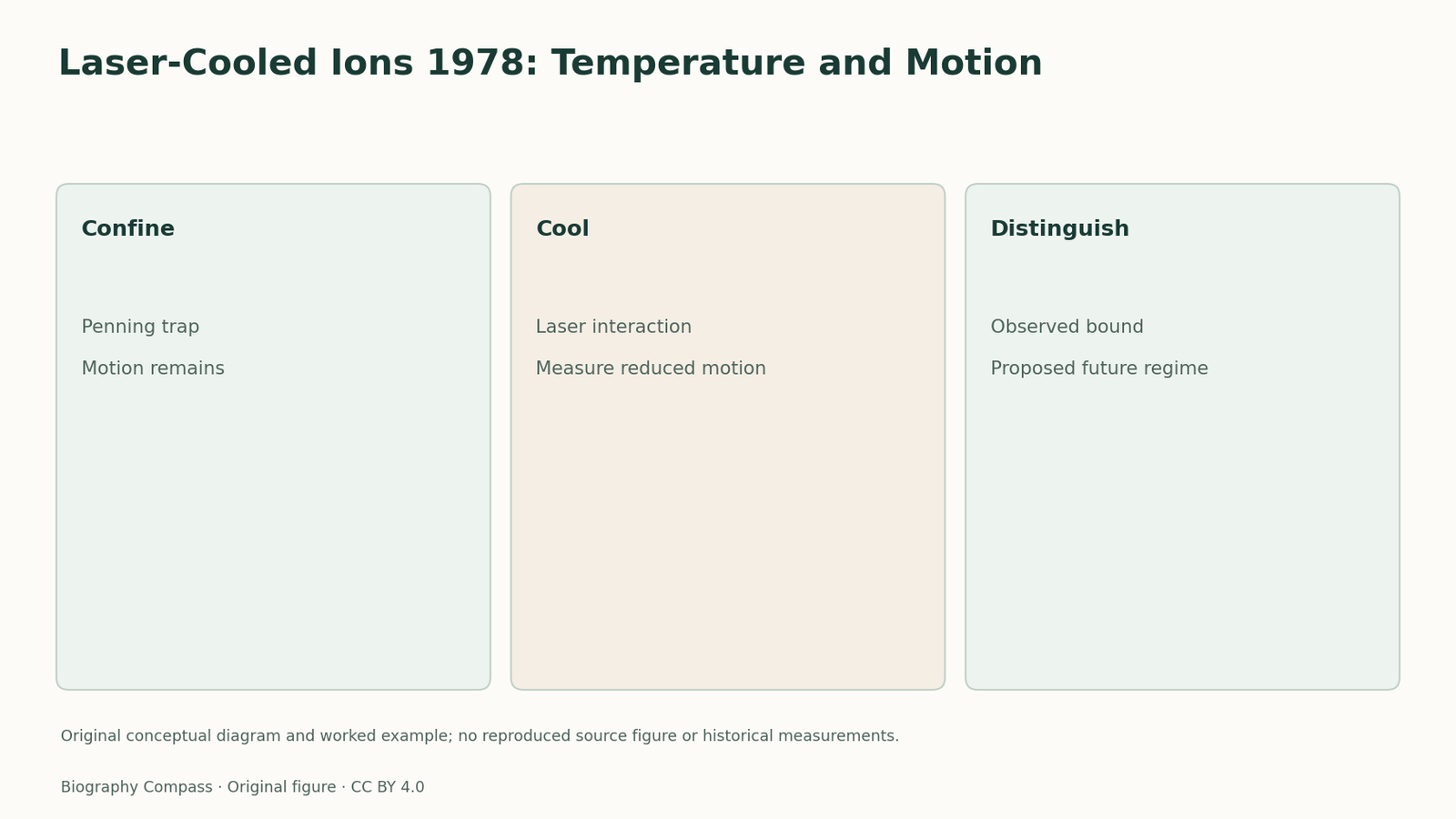
Wineland, Drullinger and Walls studied magnesium ions confined in a Penning trap. Holding charged particles in a region did not mean their motion had vanished. Their 1978 paper used radiation pressure from laser light to reduce that motion, with the laser placed on the low-frequency side of the relevant resonance. The experiment connected controlled interaction with light to a measurable reduction in the motion of already trapped particles. Trapping and cooling were complementary operations rather than interchangeable descriptions.
Sources for this section: [1]
The measured bound was not the proposed limit
The primary abstract reported cooling below forty kelvin and discussed the possibility of reaching substantially lower temperatures. A proposed future limit is not an additional measurement. That distinction is especially important when a short historical summary compresses the abstract into a single number. The later Nobel lecture places this demonstration within a longer experimental sequence, including individually observed ions and more refined control. Those later records should not be backdated into the 1978 result.
Cooling supported other measurements without replacing them
Wineland’s lecture separately presents fluorescence changes associated with internal-state transitions and the quantised motion of trapped ions. Cooling made such systems more manageable, but an observation of reduced motion is not by itself a complete account of a quantum state. The experimental question determines the needed readout. This separation also clarifies the historical sequence: a useful cooling demonstration can be an enabling achievement even when the apparatus does not yet perform every task of a later precision clock or quantum-information experiment.
Sources for this section: [2]
An original three-statement exercise
A fictional laboratory note says: “Particles remain confined; the temperature measurement gives an upper bound; a model suggests a colder regime may be reachable.” Which statements describe observations and which describe a prospect? Confinement and the measured bound are experimental reports; the colder regime is a proposal until tested. Now suppose a later experiment reaches that regime using changed equipment. It strengthens the history of the programme, but it does not alter what the earlier apparatus measured. This exercise uses no invented historical temperature, uncertainty or timeline. Its purpose is to keep the grammar of a scientific claim attached to its evidence. The supported answer distinguishes a condition established by measurement, the range that measurement resolves and a prediction about what a future implementation could do.
Biography context
Explore United States through connected lives
Connected biographies
Researchers and related approaches
1944–
David Wineland
Experimental physicist and trapped-ion researcherDavid Wineland developed trapped-ion experiments at NBS and NIST, connecting laser cooling with precision measurement and control of individual quantum systems.Read biography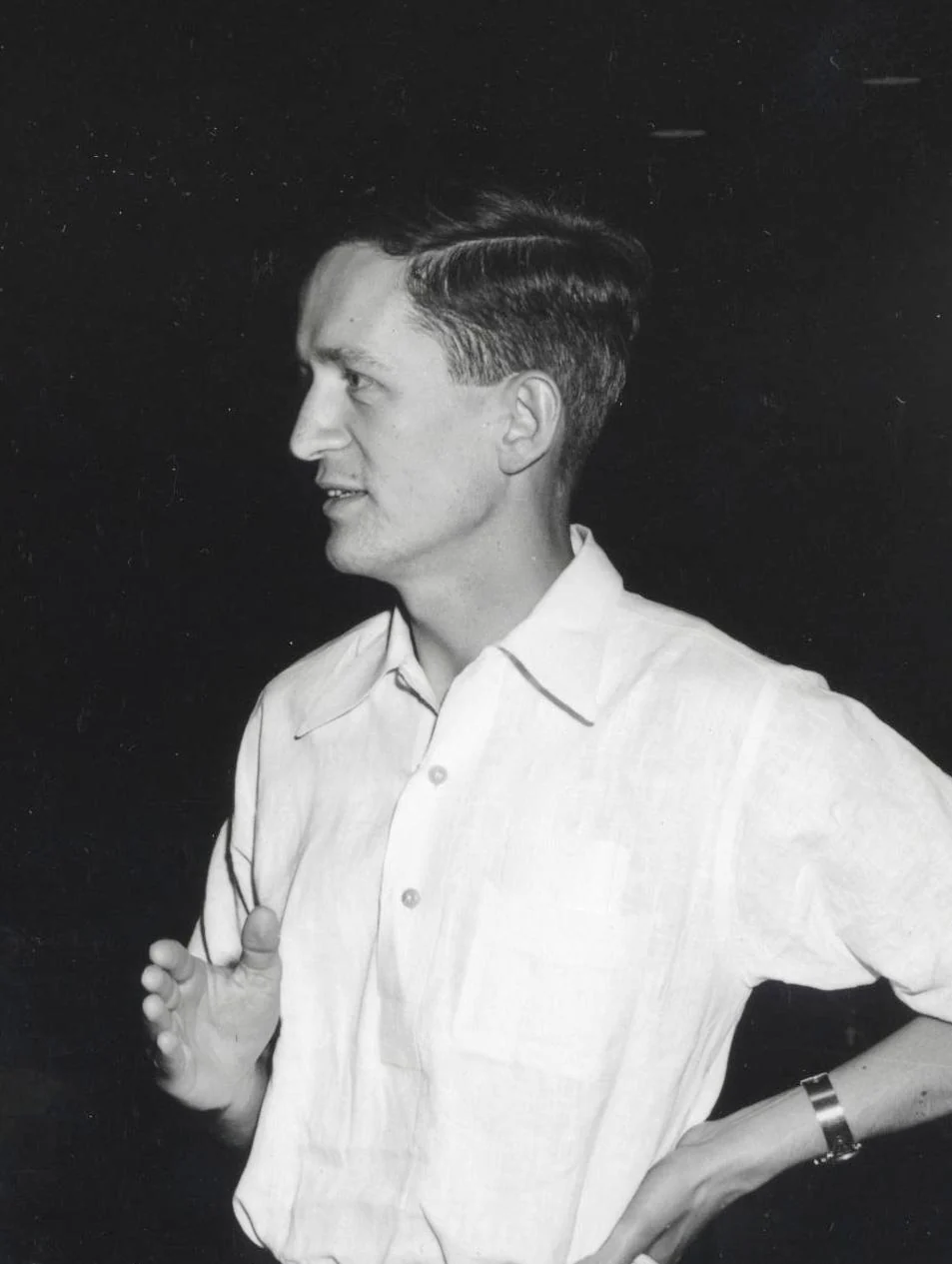
1915–2011
Norman Ramsey
Experimental physicist and scientific institution builderNorman Ramsey moved from mathematics into atomic physics, developing precision measurements at Harvard while helping build major research institutions.Read biographyQuick answers
Common questions
- Did the 1978 paper measure its lowest suggested temperature?
- No. The abstract distinguishes a measured bound from a much lower prospective regime.
- Are trapping and cooling the same?
- No. Confinement and reduction of particle motion are separate operations.
Primary and institutional sources
How this history was checked
The references below distinguish the original study from later explanations. The worked exercise and comparison are newly written for this article. This article was reviewed on 8 November 2026.