
The short answer
Why did a layered oxide improve the cathode of a lithium-ion battery?
Evidence comparison
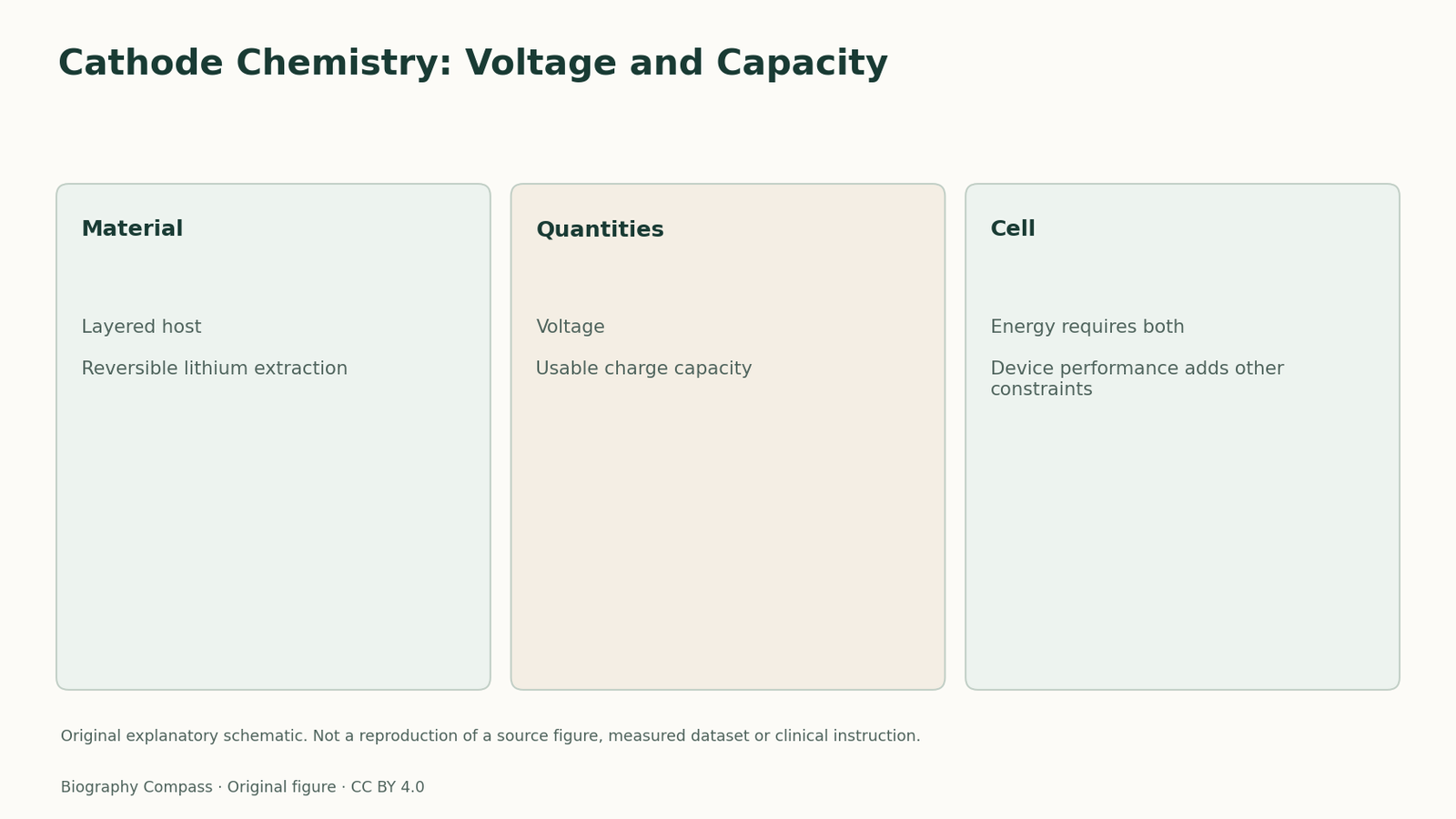
Cathode Chemistry: Voltage and Capacity
Compare the observations with the narrower conclusions they support.
| Record or observation | What it supports | What remains separate |
|---|---|---|
| Cathode voltage relative to a reference | Describes an electrochemical potential difference | Does not alone give complete-cell energy |
| Voltage combined with usable capacity | Supports an energy estimate under stated assumptions | Real curves, inactive mass and operating conditions still matter |
Voltage is only part of stored energy
Goodenough's 2019 lecture material connects stored energy with both cell voltage and the amount of charge that can be transferred. The 1980 cobalt-oxide paper reported a higher voltage relative to lithium metal than the earlier sulphide comparison. That was an important cathode result. It does not mean that any battery with the larger voltage necessarily stores more energy, because usable capacity and the rest of the cell still matter.
A host structure must accommodate a change
The cobalt-oxide system was investigated through extraction of lithium from its parent structure. Reversibility mattered because a rechargeable material must support more than one isolated discharge event. Goodenough's autobiographical account places the work in a search for suitable layered oxides and names the researchers involved. A structural host, a voltage and a reversible process are connected pieces of evidence; they do not constitute a complete commercial-cell specification.
An original units comparison
Compare two hypothetical cells: one at 2 volts with 100 milliamp-hours of capacity, the other at 4 volts with 50 milliamp-hours. Treat voltage as constant for this simplified exercise. Both give 0.2 watt-hours when volts are multiplied by amp-hours. The answer shows why doubling voltage does not necessarily double energy when capacity also changes. These numbers are invented and ignore real discharge curves; they are not measurements of the 1980 material or a basis for selecting a battery.
Sources for this section: [4]
Keep material and device claims separate
A theoretical material-level energy figure can omit packaging, electrolyte and other inactive mass. A finished battery's performance requires those additional contributions and operating conditions to be included. Compare the existing Yoshino guide for the later distinction between prototype, patent and commercial launch; this guide concerns the electrochemical quantities behind a cathode claim.
Continue the chronology
Related history guides
Biography context
Explore United States through connected lives
Connected biographies
Researchers and related questions

1922–2023
John B. Goodenough
Solid-state physicist and materials chemistAt Oxford, Goodenough worked with Koichi Mizushima, Phillip Wiseman and Peter Jones on lithium extraction from layered cobalt oxide.Read biography1968–
David W. C. MacMillan
Organic chemist and asymmetric-organocatalysis researcherIn a 2000 paper, Kateri Ahrendt, Christopher Borths and MacMillan investigated asymmetric Diels–Alder reactions promoted by an organic catalyst.Read biography1966–
Carolyn R. Bertozzi
Chemist and chemical-biology researcherA 2000 paper with Eliana Saxon adapted the Staudinger reaction to connect deliberately introduced chemical partners on cell surfaces.Read biographyQuick answers
Common questions
- Why did a layered oxide improve the cathode of a lithium-ion battery?
- Describes an electrochemical potential difference. Does not alone give complete-cell energy.
- Are the classroom examples historical measurements?
- No. Invented examples are labelled as classroom models; the source-based discussion identifies the historical evidence separately.
Primary and institutional sources
How this history was checked
Official biographical and award records are read alongside the researcher’s technical account. Source scope and hypothetical examples remain distinct. This article was reviewed on 7 November 2026.