
The short answer
How can a small organic catalyst select one mirror-image product?
Evidence comparison
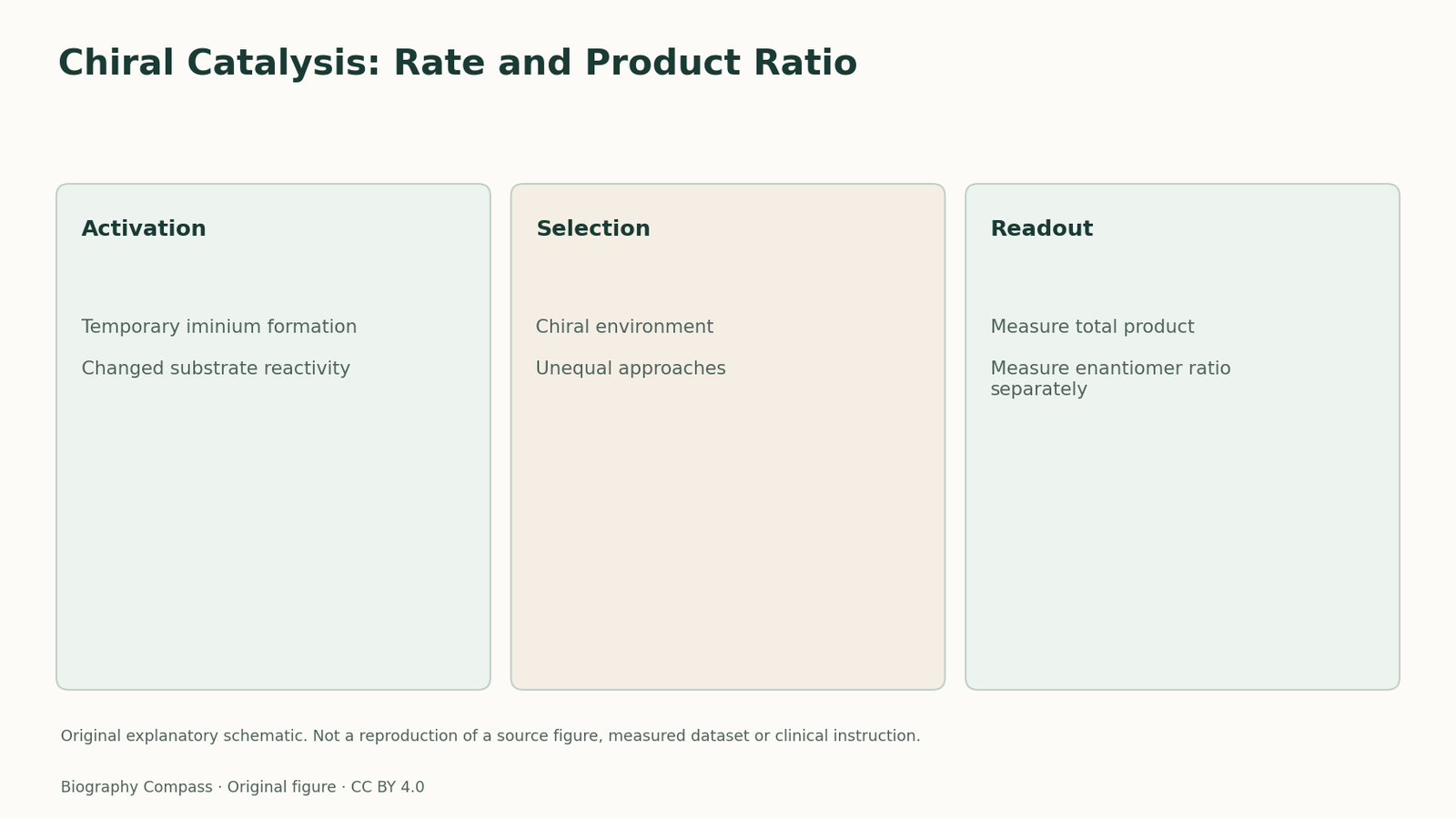
Chiral Catalysis: Rate and Product Ratio
Compare the observations with the narrower conclusions they support.
| Record or observation | What it supports | What remains separate |
|---|---|---|
| Product quantity | Describes how much material formed | Does not specify its enantiomeric balance |
| Product ratio | Describes stereochemical preference | Does not alone establish an iminium mechanism |
Ask two questions about a catalyst
A catalyst can influence reaction behaviour without necessarily producing a useful preference between mirror-related products. Ahrendt, Borths and MacMillan's 2000 paper addressed both activation and asymmetric selection. Their iminium strategy used a reversible interaction with an unsaturated aldehyde to alter reactivity. A chiral amine also supplied an unequal three-dimensional environment around the reacting substrate. The activation proposal and the product preference therefore answer connected but different questions.
Sources for this section: [3]
An intermediate is not a final ingredient
The proposed cycle involves formation of the iminium species, a cycloaddition and release of product with regeneration of the amine. This makes the temporary association central to the explanation. Merely finding an amine somewhere in a reaction mixture would not establish this complete cycle. Likewise, measuring how much product forms cannot by itself identify the balance between its mirror-related forms. The historical paper should be read as a particular reaction design, not as a universal recipe.
A product-ratio exercise
Consider an invented classroom result of eighty units of one enantiomer and twenty of its partner. The total product is one hundred units, while the imbalance is sixty units, giving sixty percent enantiomeric excess. Now imagine a second reaction producing forty units and ten units respectively. The second has the same ratio and excess but half the total product. These numbers are original teaching examples, not values taken from the 2000 experiments. They show why product quantity and stereochemical preference need separate measurements.
Sources for this section: [3]
Keep mechanism and performance distinct
A product ratio describes an outcome. Evidence about intermediates and regeneration supports a mechanistic account. Connecting the two is more informative than treating a large product quantity, a preferred enantiomer and a catalytic cycle as interchangeable observations.
Continue the chronology
Related history guides
Biography context
Explore United Kingdom through connected lives
Connected biographies
Researchers and related questions
1968–
David W. C. MacMillan
Organic chemist and asymmetric-organocatalysis researcherIn a 2000 paper, Kateri Ahrendt, Christopher Borths and MacMillan investigated asymmetric Diels–Alder reactions promoted by an organic catalyst.Read biography
1951–
Gregory P. Winter
Biochemist and antibody-engineering researcherIn 1990 John McCafferty, Andrew Griffiths, Winter and David Chiswell reported antibody variable domains displayed on filamentous bacteriophage.Read biography1966–
Carolyn R. Bertozzi
Chemist and chemical-biology researcherA 2000 paper with Eliana Saxon adapted the Staudinger reaction to connect deliberately introduced chemical partners on cell surfaces.Read biographyQuick answers
Common questions
- How can a small organic catalyst select one mirror-image product?
- Describes how much material formed. Does not specify its enantiomeric balance.
- Are the classroom examples historical measurements?
- No. Invented examples are labelled as classroom models; the source-based discussion identifies the historical evidence separately.
Primary and institutional sources
How this history was checked
Official biographical and award records are read alongside the researcher’s technical account. Source scope and hypothetical examples remain distinct. This article was reviewed on 7 November 2026.