
The short answer
What makes a chemical reaction bioorthogonal rather than merely selective?
Evidence comparison
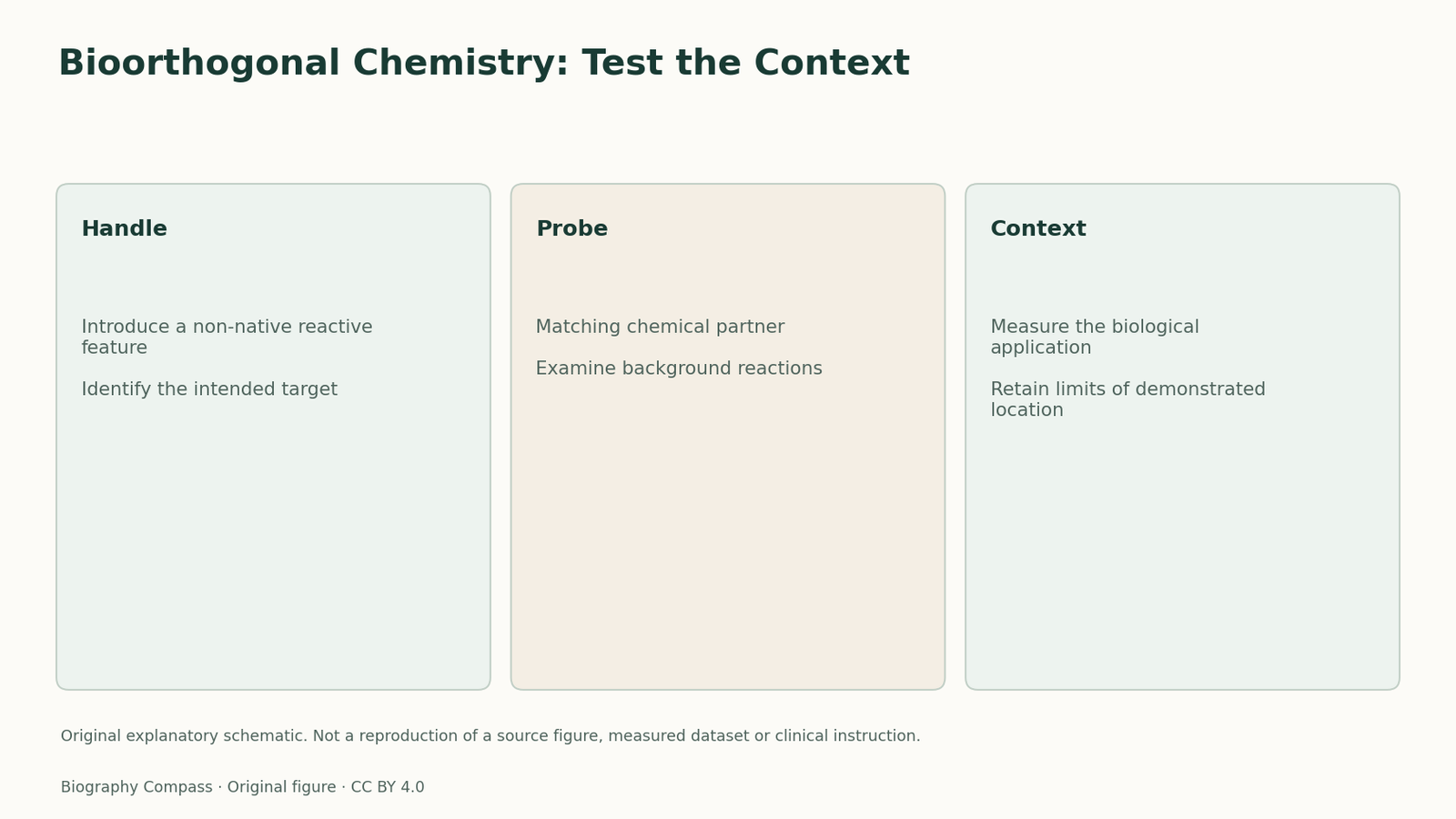
Bioorthogonal Chemistry: Test the Context
Compare the observations with the narrower conclusions they support.
| Record or observation | What it supports | What remains separate |
|---|---|---|
| Selective reaction in a simple mixture | Shows chemical discrimination in that mixture | Does not establish compatibility in a living system |
| Cell-surface ligation with background comparisons | Tests a defined biological application | Does not automatically demonstrate every intracellular use |
Selectivity depends on what else is present
A reaction can be selective between two purified reagents and still react undesirably in a cell's crowded chemical environment. Bioorthogonal chemistry adds that biological context to the design problem. Bertozzi's research asks whether a chosen pair can be joined while avoiding interference from native components and excessive disruption of the system. The word therefore describes more than an attractive reaction drawn on an otherwise empty page.
Use an abiotic handle deliberately
Saxon and Bertozzi's 2000 paper installed azide-containing components at the cell surface and used an engineered phosphine partner for a modified Staudinger ligation. The introduced partners supplied a chemical distinction from surrounding cellular material. The paper's abstract demonstrated cell-surface adducts while discussing intracellular possibilities prospectively. A reader should preserve that boundary: a proposed use inside a cell is not identical to an application already demonstrated there.
Sources for this section: [3]
A background-control exercise
Draw a fictional cell surface with one introduced triangle among many native circles. Add a probe that should attach to the triangle. Ask what comparison is needed before interpreting a signal as successful labelling. A useful answer includes a preparation without the introduced triangle, to examine background, and a separate check that the biological system remains suitable for the intended observation. The geometry is an original analogy, not a molecular reaction mechanism or a claim that absence of visible injury proves complete biological neutrality.
Sources for this section: [3]
A capability claim remains contextual
A useful report names the reaction, biological setting and observation. Neither a bright signal nor a clean reaction in a simple solution establishes every aspect of performance in an organism. That distinction makes the historical achievement more exact and helps readers evaluate later applications without treating bioorthogonality as an unrestricted guarantee.
Continue the chronology
Related history guides
Biography context
Explore United States through connected lives
Connected biographies
Researchers and related questions
1966–
Carolyn R. Bertozzi
Chemist and chemical-biology researcherA 2000 paper with Eliana Saxon adapted the Staudinger reaction to connect deliberately introduced chemical partners on cell surfaces.Read biography1968–
David W. C. MacMillan
Organic chemist and asymmetric-organocatalysis researcherIn a 2000 paper, Kateri Ahrendt, Christopher Borths and MacMillan investigated asymmetric Diels–Alder reactions promoted by an organic catalyst.Read biography
1947–
Thomas R. Cech
Biochemist and RNA-catalysis researcherCech's group found that an intervening RNA sequence could be removed and the remaining RNA joined without an added protein catalyst.Read biographyQuick answers
Common questions
- What makes a chemical reaction bioorthogonal rather than merely selective?
- Shows chemical discrimination in that mixture. Does not establish compatibility in a living system.
- Are the classroom examples historical measurements?
- No. Invented examples are labelled as classroom models; the source-based discussion identifies the historical evidence separately.
Primary and institutional sources
How this history was checked
Official biographical and award records are read alongside the researcher’s technical account. Source scope and hypothetical examples remain distinct. This article was reviewed on 7 November 2026.