
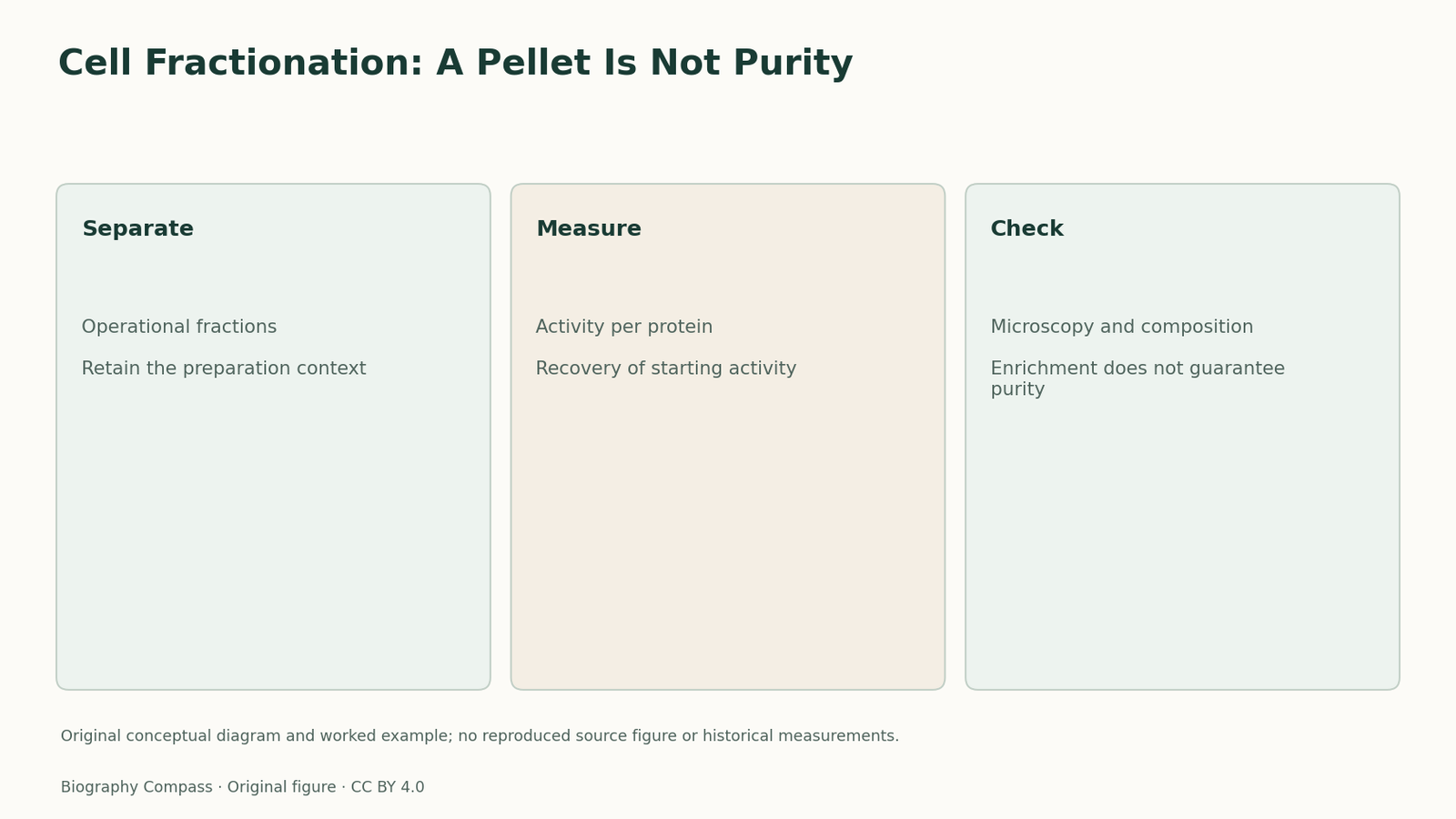
The short answer
How did differential centrifugation and microscopy relate biochemical activities to cell components while exposing fraction contamination?
Read the evidence
Different records within the same investigation
The following comparison distinguishes the specific questions answered by the inspected records.
| Record or test | What it establishes | What remains different |
|---|---|---|
| Fraction collection | Provides separated material for analysis. | Does not guarantee a single component. |
| Enrichment | Compares activity relative to a reference quantity. | Is distinct from purity and recovery. |
| Microscopy | Adds structural information about a preparation. | Does not replace biochemical characterisation. |
The separation created a measurable experimental object
Claude’s 1946 report described major fractions obtained from mammalian liver suspensions: large granules, microsomes and soluble material. These categories referred to the behaviour and contents of a preparation. The concrete question is what a collected fraction establishes about the original cell. Separation can make material available for chemical study, but its name should not silently become a guarantee that it contains just one biological structure. The sample has been disrupted, and the relation between isolated material and intact organisation still needs evidence.
Sources for this section: [1]
Distribution of activity connected chemistry with the fractions
The primary report used fractionation to investigate chemical constitution and the distribution of biochemical activities. Finding a particular activity enriched in one fraction is informative because it narrows where the responsible material is recovered. It is different from proving that every particle in that fraction is identical or that the activity belongs exclusively to one organelle. A pellet can be useful without being pure. The distinction becomes especially important when interpreting a negative result in another fraction or comparing experiments with different recovery losses.
Sources for this section: [1]
Microscopy supplied a different kind of check
The Nobel facts identify Claude’s use of electron microscopy alongside separation methods. A micrograph can help assess the particles and structures in a preparation, while an activity measurement addresses a biochemical property. Their combination offers a stronger interpretation than either a purely visual name or an unexplained assay signal. Claude’s institutional career also linked tissue culture with the emerging experimental cell. This is not a claim that every image provides an exhaustive count or that a biochemical marker is absolutely unique under all possible conditions.
Preparation categories should retain their operational meaning
Claude’s papers belonged to an early stage of cell biology in which methods and cellular assignments developed together. His medical training and later Belgian research appointments place those methods within a wider programme, rather than a single universal centrifugation recipe. When reading the work, distinguish what was collected, what activity was measured and what structural interpretation was proposed. The historical result is valuable precisely because it opened those comparisons. It does not require retroactively describing every early fraction as a fully resolved modern organelle preparation.
An original enrichment exercise and answer
Imagine a fictional extract with ten activity units per one hundred units of total protein. A separated fraction has five activity units in ten protein units. Its activity per protein unit has increased fivefold. Does that make it chemically pure? No. The calculation establishes enrichment relative to the starting material, assuming comparable measurement, but the ten protein units can still include unrelated components. These invented numbers are not Claude’s data or a laboratory procedure. The answer should also report that only half the initial activity was recovered in this fraction; high enrichment and high recovery are different properties. An independent structural or compositional check would address questions that the activity-to-protein ratio alone leaves unresolved.
Continue the chronology
Related history guides
Secretory Traffic: Following a Label in Time
Follow Jamieson and Palade’s pancreatic studies through labelled cohorts, compartments and timing, with an exercise distinguishing a pathway from a live film.
Read the timeline1951–1974Lysosomes 1955: Why Enzyme Activity Was Hidden
Examine de Duve’s lysosome inference through latent activity, distribution patterns and later structural evidence, with an original accessibility-versus-absence exercise.
Read the timelineBiography context
Explore United States through connected lives
Connected biographies
Researchers and related approaches
1898/1899–1983
Albert Claude
Cell biologist and fractionation pioneerAlbert Claude helped make the cell experimentally accessible through fractionation and electron microscopy, linking separated material with cellular structure.Read biography
1930–2025
George E. Smith
Applied physicist and semiconductor-device researcherInvention of the charge-coupled device with Willard Boyle.Read biographyQuick answers
Common questions
- Does an enriched fraction have to be pure?
- No. Enrichment concerns a relative measurement.
- Is recovery the same as enrichment?
- No. Recovery concerns how much of the original activity was retained.
Primary and institutional sources
How this history was checked
The references below distinguish the original study from later explanations. The worked exercise and comparison are newly written for this article. This article was reviewed on 8 November 2026.
- Albert Claude, Journal of Experimental Medicine, 1946Fractionation of mammalian liver cells by differential centrifugation. II. Experimental procedures and results
- University of Liège, institutional biographyAlbert Claude
- Nobel Prize OutreachAlbert Claude — Biographical
- Nobel Prize OutreachAlbert Claude — Facts