
The short answer
Who designed, supplied and supervised the Crystal Palace, and what was Cubitt’s role?
Read the records together
Contributions,evidence and scope
Different records illuminate different parts of this particular undertaking.
| Record | What the record establishes | What remains distinct |
|---|---|---|
| V&A construction account | Separates design, contractor and assembly. | Does not identify the maker of every individual part. |
| Cubitt’s historical biography | Records supervision and professional responsibilities. | A supervisor credit is not sole architectural authorship. |
| November 1851 catalogue record | Identifies a financial review and its authors. | Does not disclose all manuscript findings. |
An exhibition building required several decisions
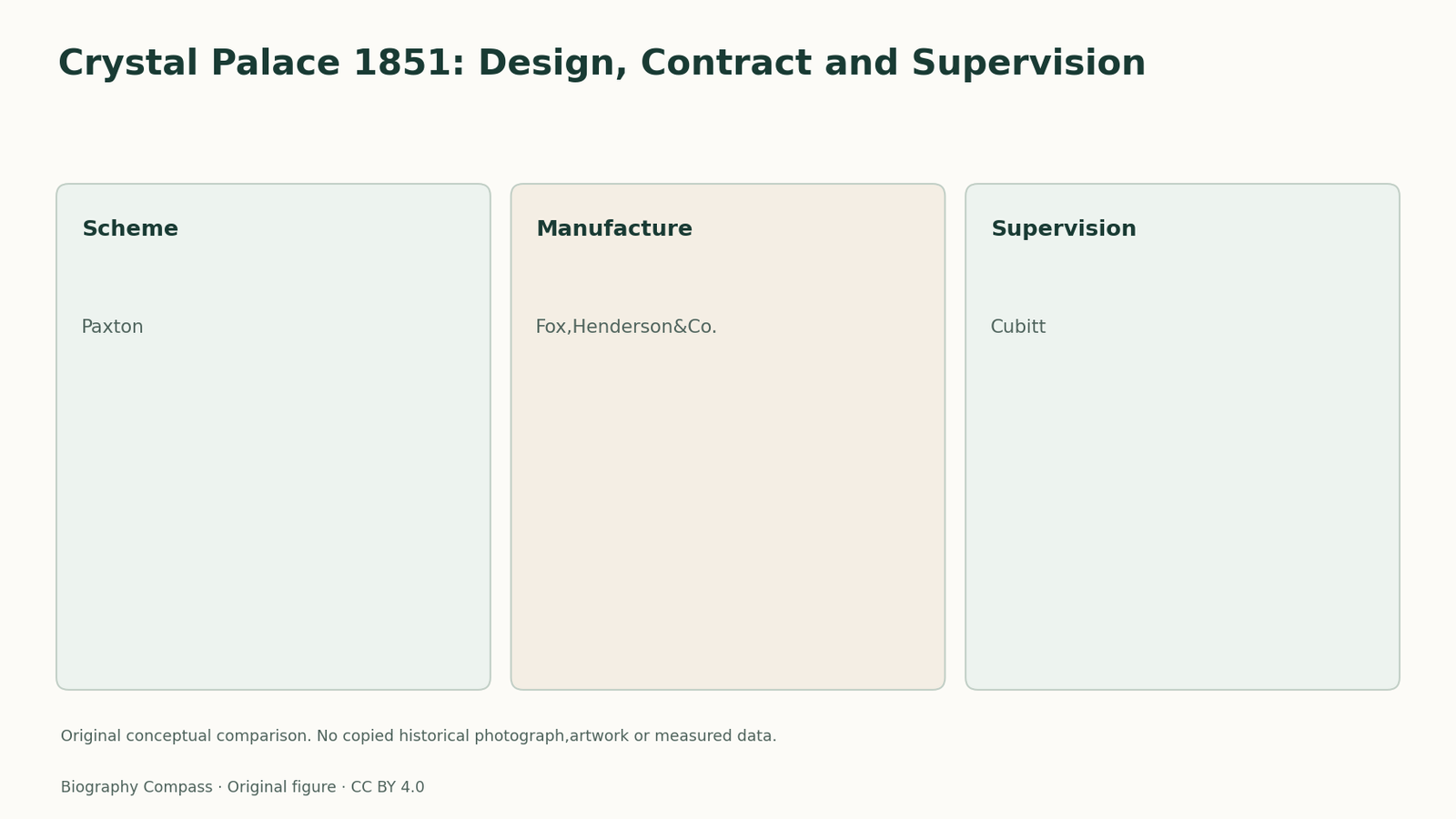
The Crystal Palace emerged from a selection process, a manufacturing proposal and a programme of assembly. The V&A’s account distinguishes Paxton’s scheme from the work of Fox, Henderson & Co., who helped develop it and built the structure. Cubitt’s supervisory position belonged to the commissioning side of that undertaking. These were overlapping responsibilities but not interchangeable job descriptions: selecting a scheme was different from preparing each component, and checking construction was different from conceiving the initial building. A useful credit map therefore begins with tasks rather than choosing a single name to stand for the whole project.
Standard parts did not assemble themselves
The building’s iron, timber and glazing were coordinated through prefabricated elements and intensive site work. The V&A describes a production-line approach and a large workforce assembling standardised parts. This helps explain why the building could be completed rapidly without implying that modular design removed the need for skilled labour, sequencing or supervision. Supply and erection had to meet at the site: a component arriving late could delay a later operation even when its dimensions were correct. That last point is an organisational inference from the documented assembly method, not a newly discovered incident in the construction diary.
Sources for this section: [4]
A contract and a later review are different records
The Royal Collection Trust catalogues a 6 November 1851 report by Lord Granville and Cubitt concerning Fox, Henderson & Co.’s position under their building contract. The record establishes that their financial position was reviewed; it is not a substitute for reading the report’s nine manuscript pages. It also changes the questions a reader can ask. A completed and admired building could still leave unresolved questions about expenditure or contractual terms. Architectural authorship, supervisory authority and an assessment of a contractor’s finances consequently belong in different columns, even where a person contributed to more than one.
Build a responsibility map
Create four cards: initial building scheme, manufacture and assembly, supervision, and review of the contractor’s position. Match Paxton to the scheme; Fox, Henderson & Co. to manufacture and construction; Cubitt to supervision; and Granville with Cubitt to the catalogued financial review. Now test the claim that a supervisor must have designed every prefabricated part. The answer is no: the records describe a division of work and do not transfer authorship between roles. This original exercise deliberately does not calculate a project profit or loss, because the underlying financial report has not been inspected here. Its result is a task-based credit map that can be checked against the cited records.
Continue the chronology
Related history guides
Portsmouth Block Mills: Design and Production Roles
Map the shared expertise behind Portsmouth Block Mills, separating naval planning, machine design, manufacture, power and management of production.
Read the timeline1898–1902Aswan 1902: Dam, Contract and Water Release
Explore the original Aswan Low Dam of 1902, separating sluice operation, engineering design and contracting from the later High Dam undertaking.
Read the timelineBiography context
Explore United Kingdom through connected lives
Connected biographies
People behind this work
1785–1861
William Cubitt
Civil engineer and millwrightWilliam Cubitt is remembered for moving from millwrighting and agricultural machinery to canals, railways and supervision of the Great Exhibition building.Read biography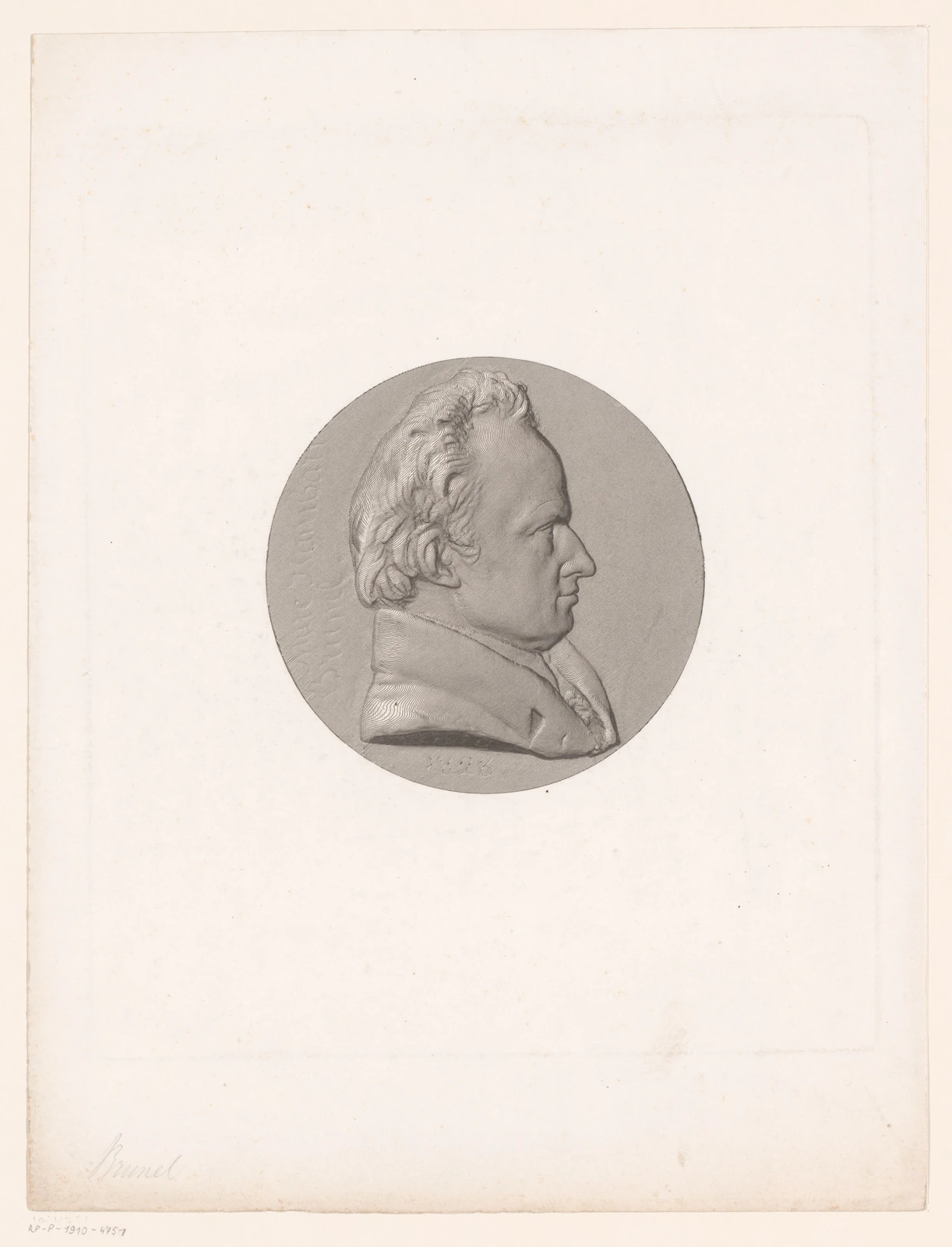
1769–1849
Marc Isambard Brunel
Engineer of production machinery and the Thames TunnelMarc Isambard Brunel developed machinery for naval supplies before leading the difficult construction of London’s Thames Tunnel.Read biography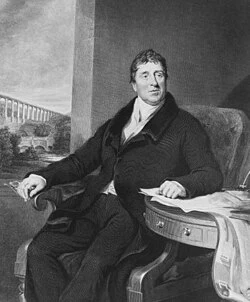
1757–1834
Thomas Telford
Civil engineer, surveyor and infrastructure organiserThomas Telford rose from stonemasonry to direct major roads, canals and bridges across Britain. His work joined design, surveying, public finance and construction management, relying on resident engineers, contractors and labourers as well as his own practical judgement.Read biographyQuick answers
Common questions
- Who designed and who supervised the Crystal Palace?
- Paxton supplied the initial scheme, Fox, Henderson & Co.helped develop and build it, and Cubitt supervised the undertaking.
Primary and institutional sources
How this history was checked
The cited records distinguish contemporary accounts,official catalogues and later institutional or scholarly interpretation. The comparison and worked exercise are original editorial material. This article was reviewed on 7 November 2026.