
The short answer
What did nuclear transfer test about specialised cell nuclei?
Evidence comparison
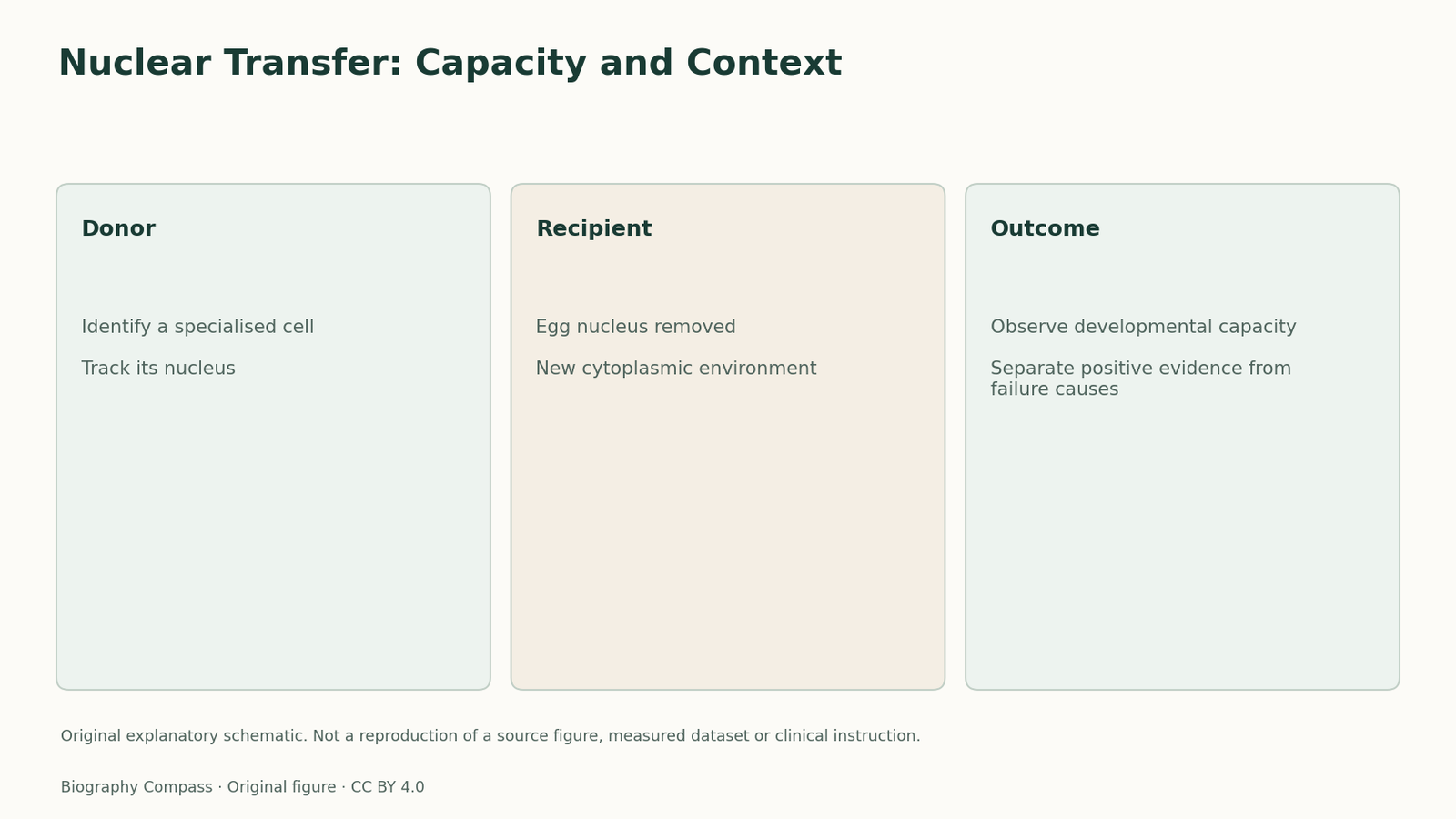
Nuclear Transfer: Capacity and Context
Compare the observations with the narrower conclusions they support.
| Record or observation | What it supports | What remains separate |
|---|---|---|
| Verified differentiated donor plus broader development | Challenges necessary loss of developmental information | Does not establish equal success for every nucleus |
| Failed initial transfer | Records a limited outcome in that attempt | Does not uniquely prove genes were absent |
The donor cell must be identified
Gurdon's 1962 paper used nuclei from intestinal epithelium of feeding Xenopus tadpoles and compared their developmental performance with control transfers. Identifying a differentiated donor was essential: a result obtained from an undifferentiated embryonic cell would answer a different question. The experiment asked whether a nucleus associated with one specialised cell type still possessed information capable of supporting the development of other tissues in a new context.
Failure does not uniquely identify lost information
Many transfers produced abnormal or limited development. Gurdon's paper discusses technical and cell-cycle-related reasons why some nuclei might not be effectively exposed to egg cytoplasm or transferred at a suitable stage. Serial transfers also revealed further potential. A failed first transfer therefore could not automatically be read as proof that the nucleus lacked the genes required for later development. The competing explanations mattered to the interpretation of the denominator.
Sources for this section: [4]
Test a universal claim with a counterexample
Give students the proposed rule that no differentiated intestinal nucleus can support other cell types. Then supply one verified case that does. Ask whether the rule survives. The answer is no: a genuine positive counterexample defeats that universal statement. Next ask whether the positive case proves every nucleus will succeed. It does not. The two conclusions are logically different, even before considering experimental efficiency, controls and the quality of the donor identification.
Sources for this section: [4]
The egg is part of the experiment
The result concerns a nucleus in a recipient egg, not a nucleus changing its developmental programme in isolation. Keeping the new cellular environment visible makes reprogramming a mechanistic research question. It also helps distinguish this experiment from later factor-based approaches to induced pluripotency.
Continue the chronology
Related history guides
Biography context
Explore United Kingdom through connected lives
Connected biographies
Researchers and related questions
1933–2025
John B. Gurdon
Developmental biologist and nuclear-reprogramming researcherGurdon's 1962 study transplanted nuclei from differentiated intestinal epithelium of feeding tadpoles into eggs whose own nuclei had been removed.Read biography
1937–
Mario R. Capecchi
Molecular geneticist and gene-targeting researcherIn 1987 Kirk Thomas and Capecchi reported gene targeting in mouse embryo-derived stem cells.Read biography
1960–
Craig C. Mello
Molecular geneticist and RNA-interference researcherMello's account describes effects that could spread from an injection site and appear in progeny.Read biographyQuick answers
Common questions
- What did nuclear transfer test about specialised cell nuclei?
- Challenges necessary loss of developmental information. Does not establish equal success for every nucleus.
- Are the classroom examples historical measurements?
- No. Invented examples are labelled as classroom models; the source-based discussion identifies the historical evidence separately.
Primary and institutional sources
How this history was checked
Official biographical and award records are read alongside the researcher’s technical account. Source scope and hypothetical examples remain distinct. This article was reviewed on 7 November 2026.