
The short answer
How should a researcher credit Burj Khalifa when the design firm, specialist steel contractor and decking supplier describe different contributions to the same project?
Compare the evidence
A field, a method and a supported conclusion
Retain the object, assumptions and scope behind each statement.
| Record or example | What it supplies | What it does not establish |
|---|---|---|
| SOM project record | Overall architectural and structural design context. | Every subcontractor package or a full as-built contract file. |
| Eversendai chronology | A dated spire-erection award. | Sole design or construction of the full tower. |
| Tata Steel case study | Decking solution, named roles and fabrication coordination. | An exhaustive allocation of all engineering authority. |
Chronology
A timeline of the turning points
Earlier contractor development
Eversendai chronology records Tower 2 work and an engineering department.
Design finish
SOM’s project-fact field.
Specialist award
Eversendai records the spire-erection package.
Tower completion
SOM’s separately labelled completion field.
Start with the design firm’s project record
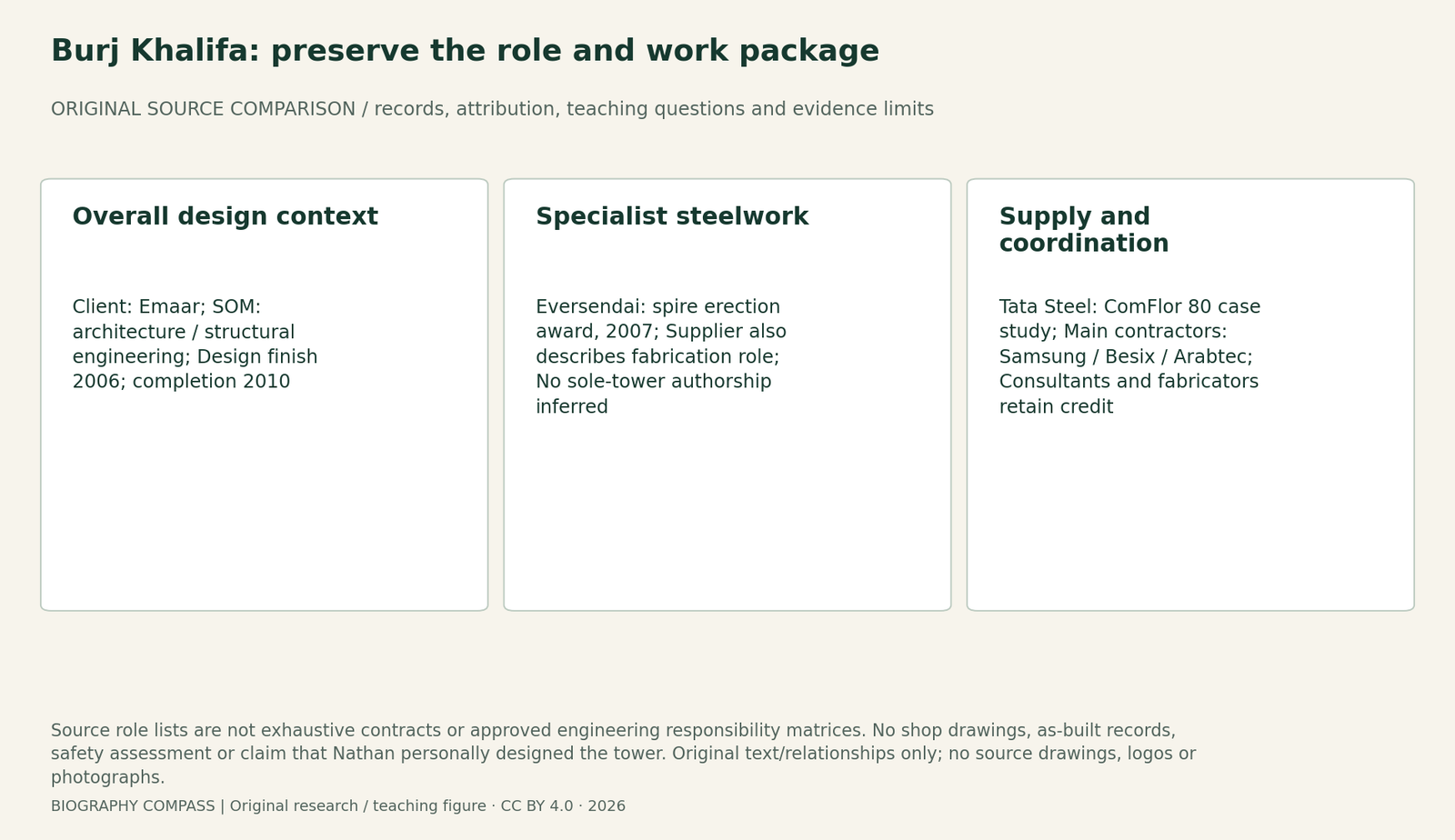
SOM identifies Emaar Properties as client and describes the architectural and structural development of Burj Khalifa. Its project facts give a height of 828 metres, design finish in 2006 and completion in 2010. The structural narrative describes wings organised around a central buttressed core and a tower shape that changes with height. These are claims about the overall design and project, not a list of every fabrication or installation package.
The height is likewise a building dimension. It does not establish how many metres of the tower any particular subcontractor designed, fabricated or erected. A complete credit record needs activities and scopes, not just a landmark name beside a company logo.
Sources for this section: [1]
A specialist chronology identifies a narrower package
Eversendai’s corporate milestones record a 2007 award for structural-steel erection works on Burj Khalifa’s spire. The wording matters: an award is a contract milestone, and erection of a specified package is not the same as sole design or construction of the entire tower. Other entries in its chronology expressly include design, supply and fabrication, showing that the publisher does distinguish scopes.
A founder’s leadership of the contractor does not transfer all project roles to that individual. The engineering, fabrication and site teams still need their own organisational credit. The milestone is evidence of an important specialist contribution while remaining narrower than the building’s complete architectural and structural authorship.
Sources for this section: [3]
The supplier’s account reveals another part of the work
Tata Steel’s case study identifies SOM as architect; Samsung Engineering & Construction, Besix and Arabtec as main contractors; Hyder Consulting and GHD as consulting engineers; and Eversendai Engineering as steel subcontractor. It describes ComFlor 80 decking and cooperation between the supplier, fabricators and consulting engineers. Its own emphasis is the product and installation problem at the top of the tower.
This commercial role list is useful, but it is not necessarily exhaustive. In particular, a supplier’s consulting-engineer field does not negate SOM’s separate structural-engineering record. The sources describe overlapping layers of project responsibility. An editor can preserve each named contribution without pretending every organisation performed the same task or that one summary contains all contractual details.
Exercise: repair a fictional sole-credit caption
A fictional display reads: “A. K. Nathan designed and built all 828 metres of Burj Khalifa; the steel supplier was the main contractor.” Replace it with a short record using only the inspected sources. Identify the overall design organisation, the client, the main-contractor team, Eversendai’s recorded specialist role and the decking supplier’s contribution. Which date belongs to the spire award, and which belongs to the completed tower?
A supported answer credits SOM’s architectural and structural project work, Emaar as client, the named main-contractor team, Eversendai Engineering’s specialist steelwork and Tata Steel’s ComFlor decking account. It keeps 2007 as the recorded spire-erection award and 2010 as the completion year supplied by SOM. Neither date assigns personal engineering authorship to a company founder.
Build a role map without inventing contract authority
A practical record can have separate fields for organisation, activity, work package, date and source. For example, a row for Eversendai can retain the spire-erection wording and its corporate chronology, while another row records the supplier’s description of fabrication cooperation. The two rows need not be collapsed into an unsupported claim about the entire structure.
Further precision would require the underlying contracts, approved design responsibilities, shop drawings and as-built records, none of which were inspected. This comparison is a documentary credit exercise, not a new structural assessment. Its original diagram should use text and relationships only: design context, specialist package, and supply/coordination. It should not reproduce architects’ drawings, proprietary details, photographs or imply a safety conclusion from a marketing case study.
Continue the chronology
Related history guides
Does an AQL field guarantee a defect-free lot?
Compare Hartalega’s AQL field with NIST sampling definitions, then calculate an explicitly fictional acceptance probability without inventing a lot guarantee.
Read the timeline2021 final order · original contract-reading exerciseWhen does a buying share become a condition?
Read the Broadcom order’s customer and purchase definitions, compare actual share with imposed conditions, and work through two fictional rebate calculations.
Read the timelineBiography context
Explore Dubai through connected lives
Connected biographies
People connected with these records
Enterprise from 1984
A. K. Nathan
Eversendai founder and structural-steel business organiserA. K. Nathan, also identified as Nathan Elumalay, built Eversendai around structural-steel work and expanded its engineering and fabrication capabilities.Read biographyQuick answers
Common questions
- Does a contractor’s project list make it the sole designer?
- No. The activity and package wording must be retained beside the project name.
- Were drawings or the tower itself inspected?
- No. The guide compares selected project records; it is not a structural inspection or a complete contract-authority assessment.
Primary and institutional sources
How this history was checked
Selected institutional, technical and participant records support the comparison. Fictional examples retain their stated assumptions and do not substitute for actual operating or compliance evidence. This article was reviewed on 29 October 2026.