
The short answer
How does Broadcom’s 2021 consent order distinguish an imposed purchase condition from a customer’s actual buying share, including purchases shaped through device makers and service providers?
Compare the evidence
A field, a method and a supported conclusion
Retain the object, assumptions and scope behind each statement.
| Record or example | What it supplies | What it does not establish |
|---|---|---|
| Complaint summary | Alleged conduct and markets. | A personal conviction or admission of every alleged fact. |
| Final order | Defined parties, restrictions and express qualifications. | A rule that every purchase above fifty percent is unlawful. |
| Fictional offers | Explicit commitments or benefit structures. | Actual Broadcom customer terms or a current compliance finding. |
Chronology
A timeline of the turning points
Complaint and proposed settlement
Allegations and proposed restrictions entered the public record.
Final consent order
The final announcement and operative order are distinct from complaint allegations.
Conditions and rebates
Three fictional files and a supplied price model illustrate selected definitions.
A complaint, a settlement and an operative order
The FTC’s November 2021 announcement records approval of a final order concerning Broadcom’s semiconductor sales arrangements. Its summary describes charges involving exclusivity and loyalty conditions in television and broadband-device chips. The order’s preamble separately states that the settlement is not an admission of the alleged substantive violation.
A reader should therefore distinguish allegations, settlement language and obligations actually ordered. The respondent is Broadcom Inc., a corporation. Neither the complaint summary nor the consent order is a personal criminal conviction of its chief executive. The exercise below reads selected provisions of that historical order; it does not determine present compliance or resolve a new contract dispute.
The definitions reach beyond an ordinary purchase invoice
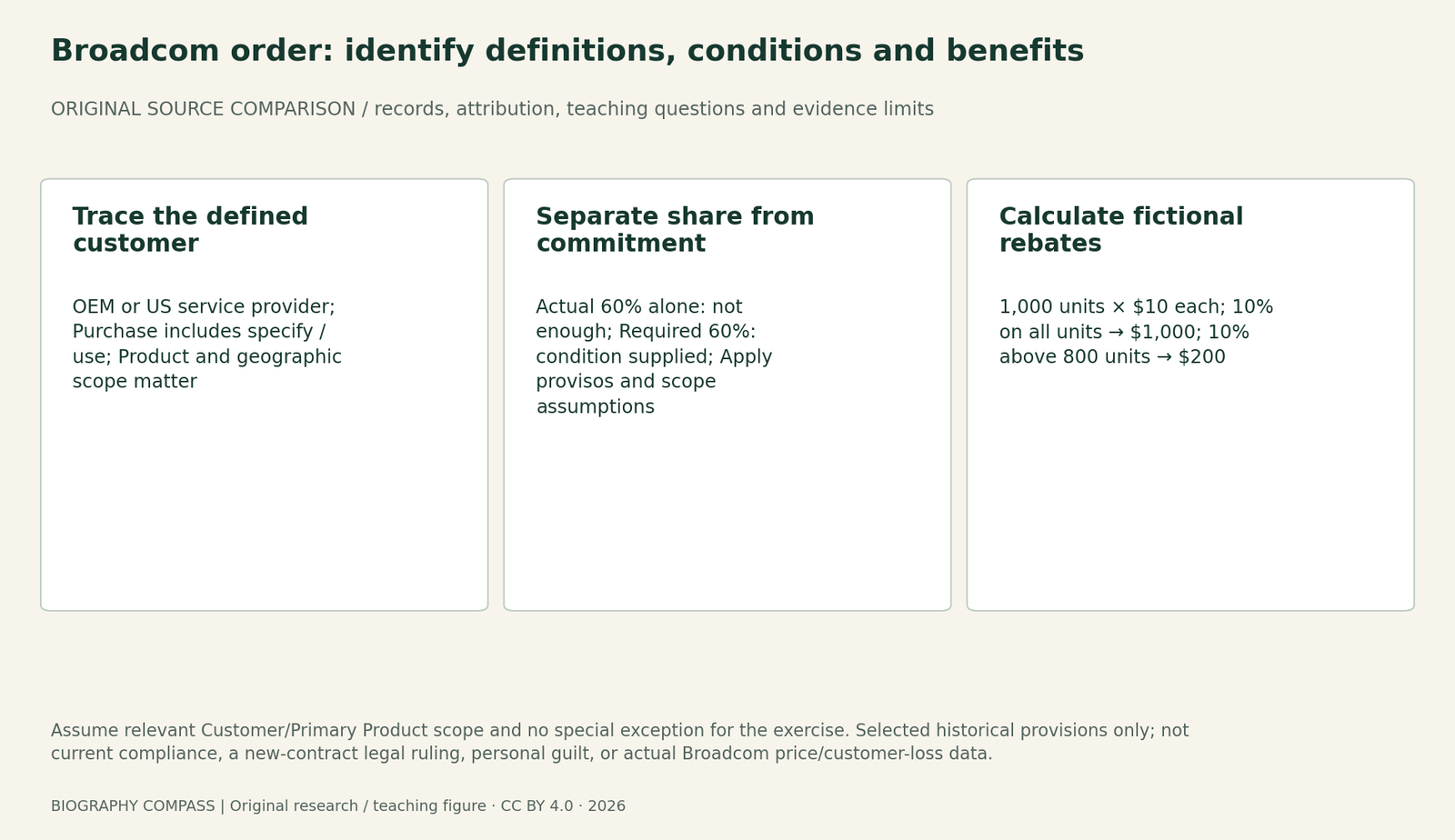
The order defines Customer to include an OEM or a US service provider. An OEM designs or manufactures customer devices; a service provider supplies subscription video or internet connectivity. Its defined Purchase includes activities such as specifying and using, as well as buying. A provider can therefore influence which chips are inside equipment obtained from a device maker.
These are definitions within this order, not universal meanings for every contract. Product classes and geographic terms are also defined, and the order contains provisos and exceptions. In each fictional example, assume the relevant customer and primary-product scope is met and no special exception applies. Without those assumptions, a bare percentage would be insufficient for classification.
Sources for this section: [1]
A requirement differs from a customer’s independent choice
Paragraph I.Q describes majority-share requirements, including formal or informal conditions exceeding fifty percent of specified requirements. Paragraph II.A addresses imposing or committing a customer to such a requirement for primary products. Its provisos explicitly say that actual purchasing above fifty percent, without more, does not establish a violation of that paragraph. Preferred-provider language and certain non-retroactive volume discounts also receive qualifications.
This is why two records showing sixty percent can have different meanings. One might describe the customer’s independent buying pattern; another might be the share it must award to obtain a benefit. The legal reading question concerns the condition and the applicable provision, rather than a percentage stripped of context.
Sources for this section: [1]
Exercise: distinguish three fictional offers
File A shows a customer independently buying sixty percent from Broadcom, with no commitment, exclusivity condition or other relevant conduct evidenced. File B offers a primary-product benefit only if the customer commits sixty percent of its requirements. File C offers a ten-percent rebate only on units above a volume threshold, without a share commitment or any other supplied restriction. Which feature in each file matters?
A does not, by itself, establish a II.A violation. B supplies the majority-share condition addressed by the stated definitions and restriction, subject to the exercise’s scope assumptions. C describes an incremental volume benefit, which the selected proviso says is not prohibited by II.A without more. The answers do not make every actual supplier arrangement lawful or unlawful: omitted provisions and facts could change an assessment.
Sources for this section: [1]
Worked arithmetic: retroactive and incremental benefits
For a second fictional comparison, price one thousand units at ten dollars each. One offer gives ten percent back on all units once purchases exceed eight hundred units. Another gives ten percent back only on units above eight hundred. The first rebate is 1,000 × 10 × 0.10 = 1,000 dollars. The second is 200 × 10 × 0.10 = 200 dollars.
The order’s retroactive-advantage definition distinguishes an all-units threshold benefit from an advantage applying only beyond the threshold. Arithmetic makes that distinction visible, but it does not replace the legal scope. These invented offers are not quoted Broadcom contracts, and neither calculation establishes a historical price, a customer loss or present compliance. The useful result is a better reading method: identify the defined parties and product, the condition, the benefit and the applicable qualification.
Sources for this section: [1]
Continue the chronology
Related history guides
Does an AQL field guarantee a defect-free lot?
Compare Hartalega’s AQL field with NIST sampling definitions, then calculate an explicitly fictional acceptance probability without inventing a lot guarantee.
Read the timeline1994–2010 context · selected project recordsWho did which part of Burj Khalifa’s steelwork?
Compare SOM, Eversendai and Tata Steel project records, then repair a fictional credit line without confusing tower design with specialist steelwork roles.
Read the timelineBiography context
Explore United States through connected lives
Connected biographies
People connected with these records
Career from the 1970s
Hock Tan
International technology manager and semiconductor executiveHock Tan’s career moved from Malaysian origins and American engineering education through finance and management into international semiconductor leadership.Read biographyQuick answers
Common questions
- Is buying sixty percent automatically an order violation?
- The selected proviso explicitly says actual purchasing above fifty percent, without more, does not establish a violation of paragraph II.A.
- Are all volume rebates treated identically?
- No. The order distinguishes defined retroactive advantages and includes qualifications for non-retroactive volume benefits; complete analysis still requires scope and facts.
Primary and institutional sources
How this history was checked
Selected institutional, technical and participant records support the comparison. Fictional examples retain their stated assumptions and do not substitute for actual operating or compliance evidence. This article was reviewed on 29 October 2026.