
The short answer
What can a reader infer from Hartalega’s stated AQL 1.5, and why is acceptance under a sampling plan different from proving every item in a lot is conforming?
Compare the evidence
A field, a method and a supported conclusion
Retain the object, assumptions and scope behind each statement.
| Record or example | What it supplies | What it does not establish |
|---|---|---|
| Manufacturer’s product table | A stated AQL field and product attributes. | Actual shipment defect rate or a complete sampling procedure. |
| NIST method records | Decision rules, quality levels and acceptance risks. | The manufacturer’s undisclosed n/c settings. |
| Fictional model | n = 20, c = 1 and two assumed probabilities. | Observed quality, compliance or medical efficacy of real gloves. |
Chronology
A timeline of the turning points
AQL field
Retain the specification and the absence of a particular lot test.
Single versus other sampling plans
NIST defines the decision structure and its risk terms.
Explicit model
Independent binomial assumptions are teaching inputs, not a manufacturer’s procedure.
Begin with the field actually published
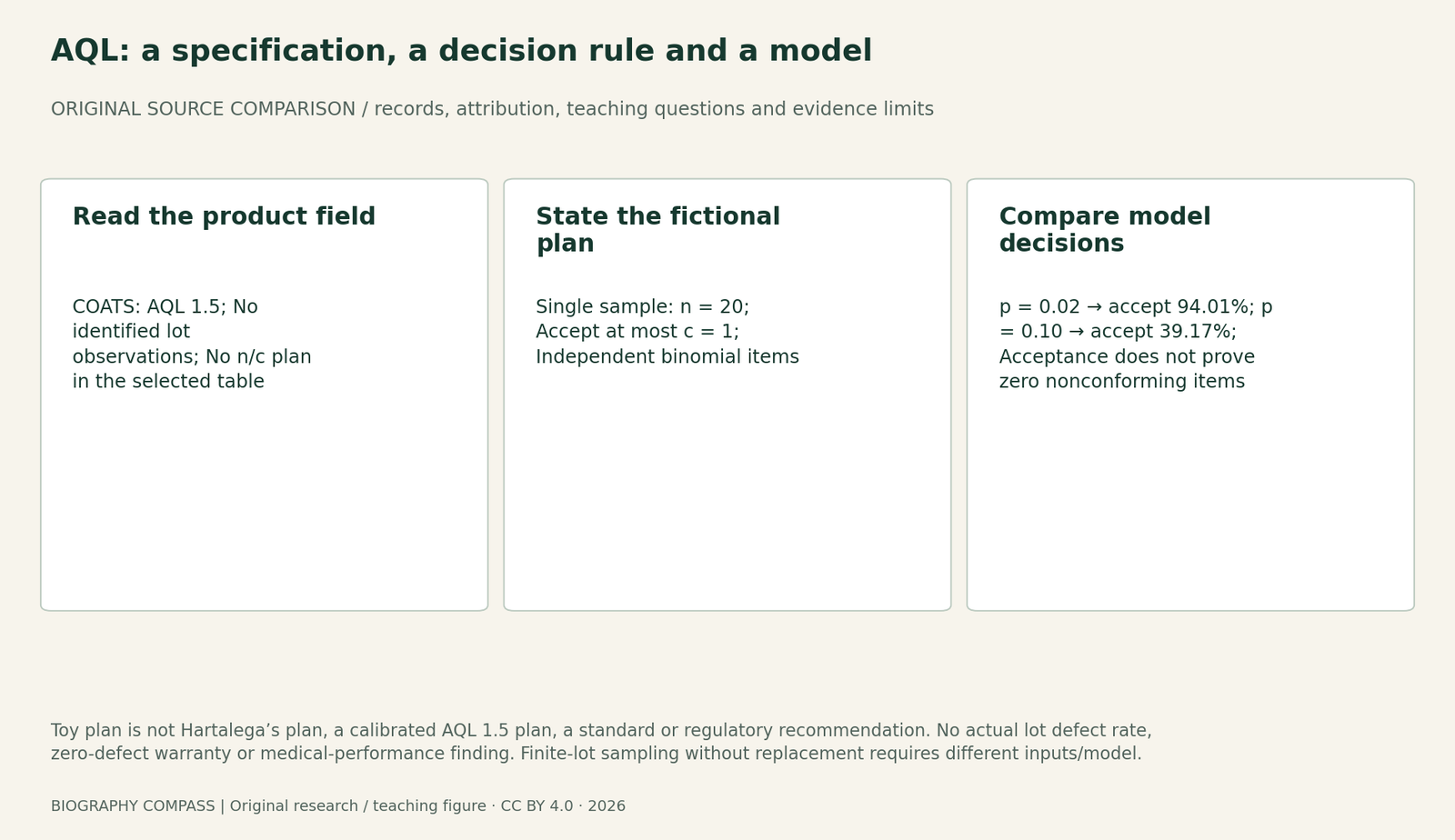
Hartalega’s COATS product page places AQL 1.5 alongside fields such as examination type and non-sterile status. This is a manufacturer’s product specification. The selected table does not give a particular shipment’s test results, the sample size, acceptance number or a certificate for an identified production lot. It also does not make a claim that every glove in a shipment has been individually tested.
The number should therefore remain a labelled specification field. It is not an observed defect percentage for a lot that the reader has inspected. Nor does the AQL field independently establish clinical performance, suitability for a particular procedure or the truth of every medical statement elsewhere in the marketing page. This guide examines sampling language, not a choice of protective equipment.
Sources for this section: [1]
A sampling plan needs a decision rule
NIST describes a single-sample plan using two values: n, the number sampled, and c, the largest number of nonconforming items that can be observed before rejecting the lot. In that form, reject when the sample contains more than c nonconforming items. Double and sequential plans use different decision structures, so their sample counts cannot be silently substituted for a single plan.
NIST describes AQL as a baseline quality level at which the producer wants a high probability of acceptance. It separately identifies a worse quality level of concern to the consumer and the risk of accepting at that level. Acceptance is consequently a decision made under uncertainty. A high chance of accepting good production is not a guarantee that an accepted lot contains no nonconforming items.
Choose and label a probability model
For an original teaching model, suppose twenty independent items are sampled and acceptance allows at most one nonconforming item. Let p be the stipulated probability that each sampled item is nonconforming. Under an independent binomial model, acceptance occurs with zero or one such item: P(accept) = (1 − p)^20 + 20p(1 − p)^19.
This is a fictional n = 20, c = 1 plan. It is not identified as Hartalega’s plan, an ISO plan or a regulated glove-inspection procedure, and it is not calibrated to the product’s AQL 1.5. For sampling without replacement from a finite lot, the lot size and composition matter; a hypergeometric model may be appropriate. Independence is a supplied assumption here, not a fact established about a real shipment.
Exercise and worked probabilities
Evaluate the fictional plan at p = 0.02 and p = 0.10. At 0.02, the two terms sum to approximately 0.940101, so about 94.01% of samples would lead to acceptance under repeated use of this model. At 0.10, the sum is approximately 0.391747, or 39.17%. Keep the assumed item probability and the probability of an acceptance decision in different columns.
Now assess the sentence “The sample was accepted, therefore the lot has zero nonconforming items.” It does not follow. The plan explicitly accepts a sample with one nonconforming item, and an accepted sample does not reveal every unsampled item. Even a zero count in the sample would not prove zero in the lot. The probabilities describe a model’s repeated decisions, not an independently measured Hartalega defect rate.
What further record would answer a shipment question?
To investigate a particular lot, request its identity, applicable test and standard, sampling type, sample size, acceptance criterion and actual observations. Any subsequent inference also depends on whether the sampling and test conditions justify the chosen statistical model. The manufacturer’s product field alone does not provide those records.
The comparison gives a useful division of labour between sources. The product page supplies the stated specification. NIST supplies definitions and decision structures. The original exercise supplies explicit mathematical assumptions. Keeping those three layers visible prevents a specification number from becoming an invented shipment statistic, a zero-defect warranty or a medical-performance conclusion.
Continue the chronology
Related history guides
When does a buying share become a condition?
Read the Broadcom order’s customer and purchase definitions, compare actual share with imposed conditions, and work through two fictional rebate calculations.
Read the timeline1994–2010 context · selected project recordsWho did which part of Burj Khalifa’s steelwork?
Compare SOM, Eversendai and Tata Steel project records, then repair a fictional credit line without confusing tower design with specialist steelwork roles.
Read the timelineBiography context
Explore Malaysia through connected lives
Connected biographies
People connected with these records
Career from 1969
Kuan Kam Hon
Hartalega founder and manufacturing organiserKuan Kam Hon moved from family construction work into manufacturing, founding Hartalega and helping organise its development in examination gloves.Read biographyQuick answers
Common questions
- Is AQL 1.5 the observed defect rate of a shipment?
- The inspected product table does not establish that. A stated AQL and an observed lot defect rate are different kinds of information.
- Are the exercise’s twenty samples a recommended inspection plan?
- No. This is an explicitly fictional independent-binomial model, not a manufacturer, ISO or regulatory plan.
Primary and institutional sources
How this history was checked
Selected institutional, technical and participant records support the comparison. Fictional examples retain their stated assumptions and do not substitute for actual operating or compliance evidence. This article was reviewed on 29 October 2026.