
The short answer
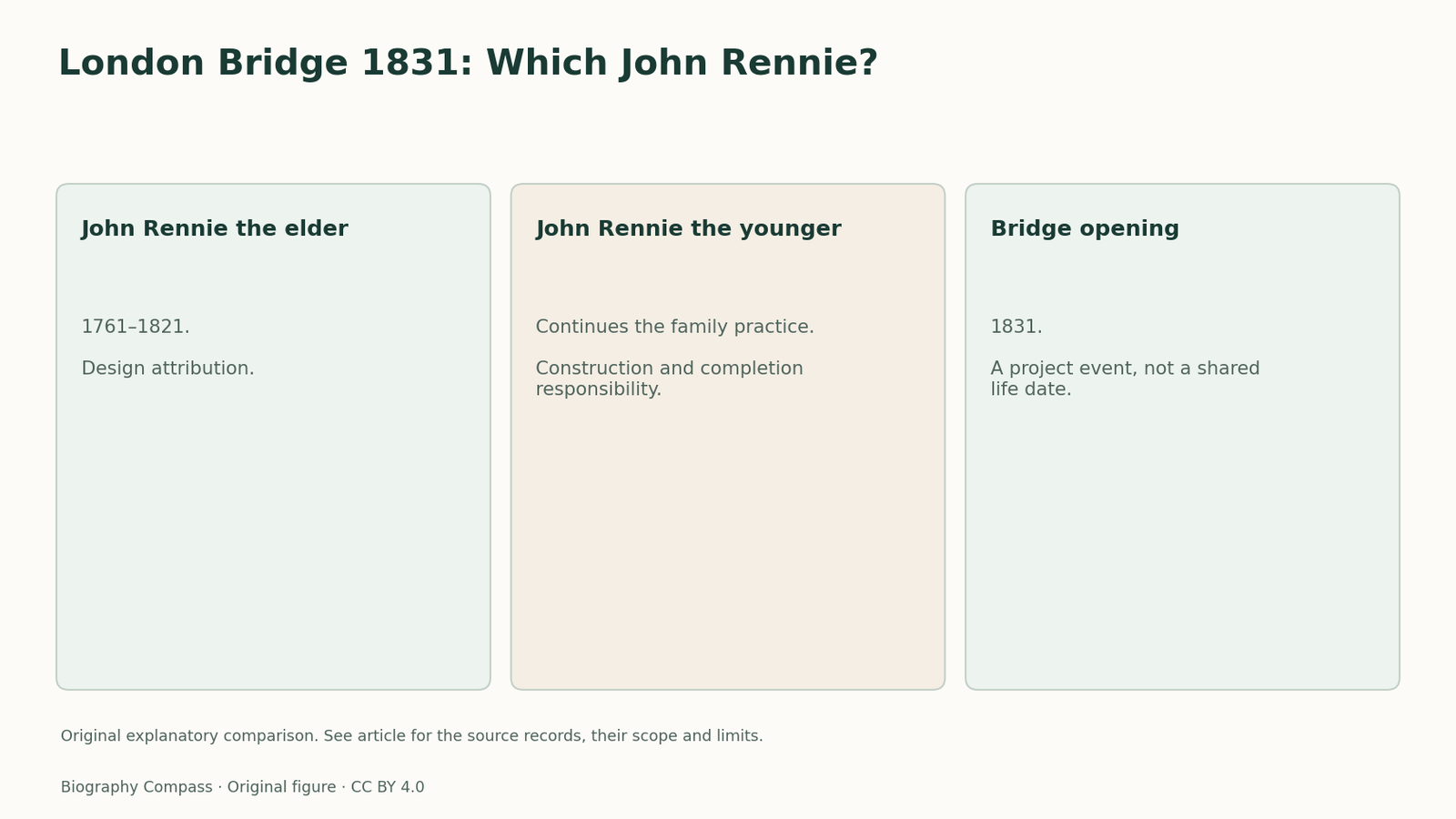
The1831 bridge belongs to the work of two men with the same name. Design, construction and public opening occurred at different points in their lives.
Compare the evidence
London Bridge 1831: Which John Rennie?
Keep the observations and the conclusions they support together.
| Record | What it supports | What it does not establish |
|---|---|---|
| Royal Society father record | The elder engineer designed London Bridge and died in 1821. | The1831 opening cannot be a personal event in his life. |
| DIB and ICE family accounts | The younger John completed projects based on his father’s designs. | One surname does not erase distinct construction responsibility. |
Start with the lifetimes
The Royal Society record identifies John Rennie the elder as the engineer who lived from1761 to 1821. Its career account includes the design of London Bridge and states that his son completed it. This immediately rules out a simple caption saying that the elder engineer opened the bridge in 1831. A project can be completed after its designer’s death, and a familiar surname does not make the people involved interchangeable.
Sources for this section: [1]
Distinguish design from construction responsibility
The Dictionary of Irish Biography describes the younger John’s completion of London Bridge to his father’s design. ICE likewise explains how the sons continued the elder Rennie’s projects. The younger engineer’s work was not merely attendance at a ceremony. Taking a design through construction creates a separate responsibility, even where the intended form remains associated with an earlier designer. A sound attribution can name both roles without treating one as a substitute for the other.
Build a two-person project timeline
Draw one line for the elder Rennie and another for his son. Mark the father’s death in 1821 and the bridge’s opening in 1831, then place design and construction labels on the appropriate line. The answer should retain the father’s design attribution and the son’s completion role. Do not infer the date of a surviving drawing simply from the opening year; the drawing needs its own catalogue record. This small exercise explains why bridge histories need both project dates and clearly identified people, especially in practices where relatives shared a name and continued one another’s work.
Continue the chronology
Related history guides
Thames Tunnel: Shield, Face and Lining
Understand how the Thames Tunnel shield supported excavation, how brick lining followed it, and why the mechanism did not eliminate flooding.
Read the timeline1845–1849Britannia Tube Tests: Wrinkling and Tearing
Examine the Britannia tube experiments through Hodgkinson’s1849 report: top-plate wrinkling, bottom-plate tearing, and the limits of small models.
Read the timelineBiography context
Explore United Kingdom through connected lives
Connected biographies
People behind the records
1761–1821
John Rennie
Civil engineer and millwrightJohn Rennie the elder developed a broad civil engineering practice; several major projects, including London Bridge, were completed after his death by his sons.Read biography1724–1792
John Smeaton
Instrument maker and civil engineerJohn Smeaton combined instrument making, measured experiments and consulting work on lighthouses, mills, waterways and other civil engineering projects.Read biography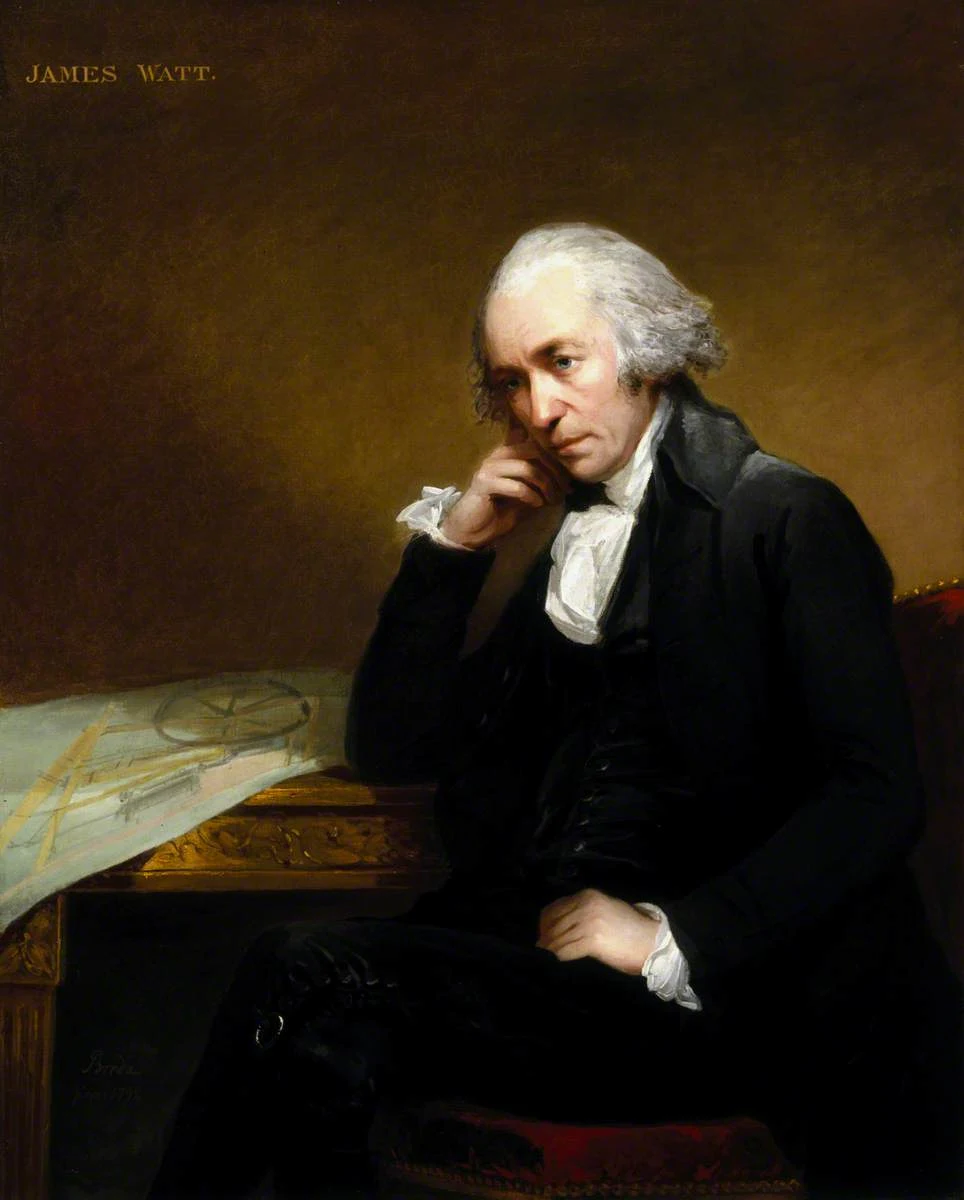
1736–1819
James Watt
Engineer, instrument maker and steam-power entrepreneurJames Watt made existing steam-engine technology substantially more efficient and helped turn it into an industrial business. His achievements depended on scientific exchange, skilled collaborators and Matthew Boulton’s commercial organisation; his life also had documented connections to slavery.Read biographyQuick answers
Common questions
- Which John Rennie designed and which completed the 1831 London Bridge?
- John Rennie the elder designed the bridge and died in 1821. His son John directed its completion, and the new bridge opened in 1831. Design and construction responsibility therefore belong to distinct men.
Primary and institutional sources
How this history was checked
The sources distinguish institutional biographies, participant accounts and records of individual objects. The related biography gives context for their use. This article was reviewed on 7 November 2026.