
The short answer
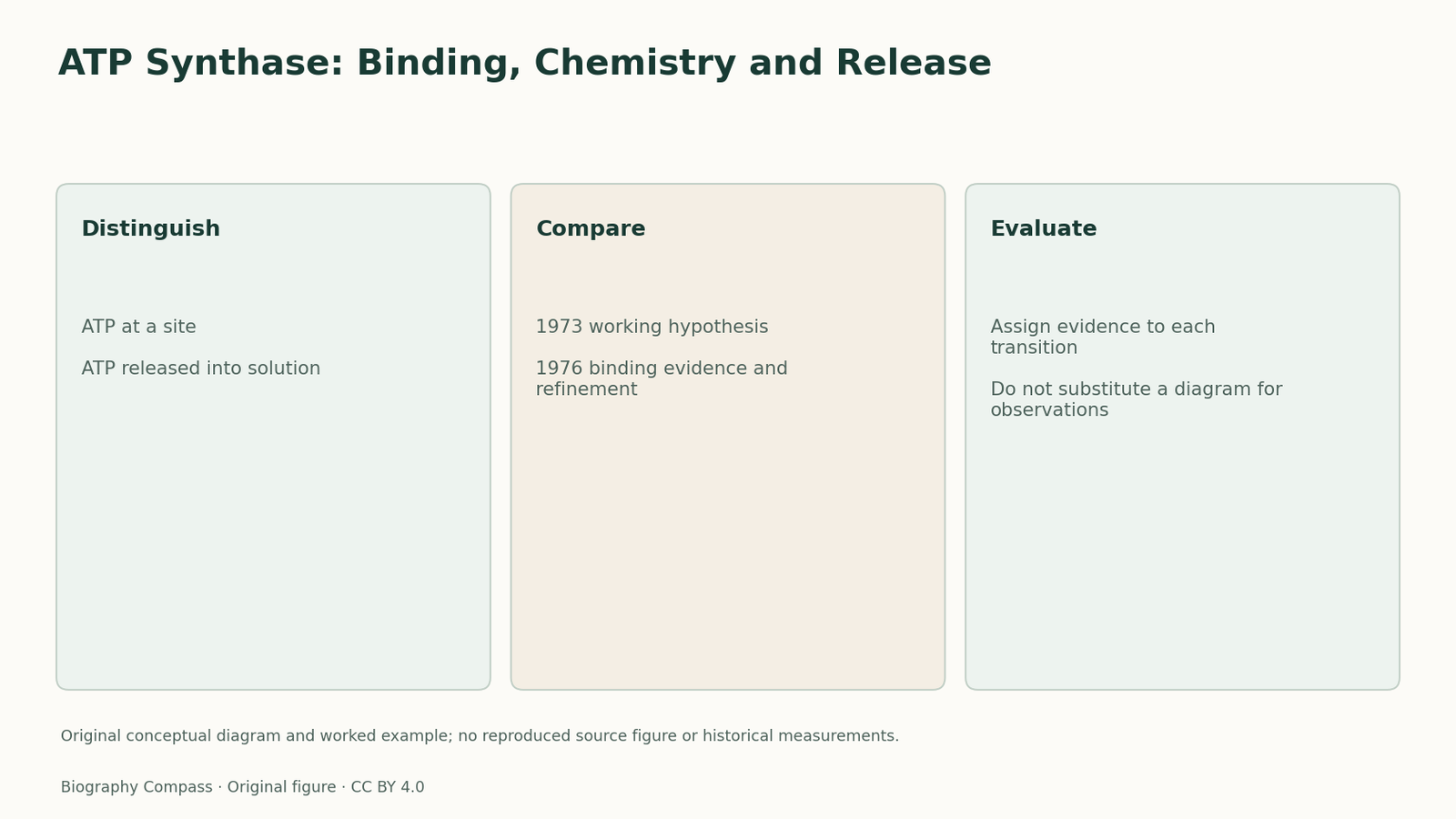
How did the binding-change mechanism distinguish ATP formation at a site from energy needed for coordinated release?
Read the evidence
Different records within the same investigation
The following comparison distinguishes the specific questions answered by the inspected records.
| Record or test | What it establishes | What remains different |
|---|---|---|
| Bound ATP | A product can occupy a catalytic site. | Its detection is not the same as release to solution. |
| Exchange evidence | Constrains chemical relationships and model choices. | Is not a direct movie of conformational motion. |
| Alternating-site interpretation | Connects changes in binding and release. | The historical model was refined after the 1973 proposal. |
Where in a catalytic sequence is energy required?
A statement that ATP synthesis requires energy does not by itself identify which event receives that input. Boyer, Cross and Momsen’s 1973 paper proposed a more specific possibility: tightly bound ATP could exist at a catalytic site, while energy-dependent conformational change promoted its release. The question shifts from whether energy matters to how the enzyme distributes energetic demands across a sequence. A bound chemical product and a freely available product are experimentally and conceptually different states.
Sources for this section: [1]
Exchange reactions supplied indirect constraints
The 1973 abstract distinguishes phosphate–water exchange from other exchanges and describes tightly bound ATP under particular conditions. These observations supported a working hypothesis, not a complete movie of a rotating enzyme. An exchange signal records chemical relationships within the preparation; interpreting it requires a model of the underlying steps. The paper’s proposed release mechanism was therefore an explanation of combined observations. It should not be enlarged into a claim that this single report directly visualised every conformational state or established the final three-site model in all details.
Sources for this section: [1]
The 1976 study refined the interpretation
Smith and Boyer’s chloroplast work reported evidence that tightly bound ATP was a transient catalytic intermediate and that much bound phosphate and ADP was committed to ATP formation. Its opening also corrected the earlier interpretation: the uncoupler-insensitive exchange concerned medium rather than intermediate phosphate. The authors supported an alternating-site sequence in which conformational change affected binding at one site and release at another. Preserving this refinement makes the history more informative than presenting a perfectly finished mechanism that never needed revision.
Sources for this section: [2]
A biochemical model differs from a structural snapshot
Boyer’s programme used chemical and binding evidence to ask what catalytic sites were doing. Walker’s later structural work addressed their spatial organisation and different conformations. Their shared Nobel recognition connects those contributions without making their measurements interchangeable. A static structure can support distinctions between sites, while exchange and binding studies constrain reaction events. Neither label alone tells a reader exactly what was observed. The useful comparison asks how separately obtained kinds of evidence can support a common mechanism while retaining their own temporal and interpretive limits.
An original bound-product exercise and answer
Imagine a fictional enzyme preparation in which a product is detected on the enzyme even when little product appears in solution. A student concludes that product formation and product availability are identical, so the measurement must be contradictory. What is missing? The model needs separate formation, binding and release states. Product could form and remain tightly associated until another event changes its affinity. This invented example contains no historical measurements or laboratory instructions. It does not prove that release is the only energy-dependent event in a real system. The supported answer identifies an overlooked distinction and then asks which observations constrain each proposed transition, rather than treating a plausible diagram as sufficient proof of the complete enzyme mechanism.
Continue the chronology
Related history guides
F1 ATPase 1994: Three Sites, One Snapshot
Examine Walker and colleagues’ 1994 F1 structure, comparing three catalytic conformations with the separate claims of rotation and a complete ATP-synthase model.
Read the timeline1961–1978Chemiosmosis: More Than a Proton Count
Examine Mitchell’s chemiosmotic framework through chemical and electrical contributions, with a worked exercise separating a pH difference from total driving force.
Read the timelineBiography context
Explore United States through connected lives
Connected biographies
Researchers and related approaches
1918–2018
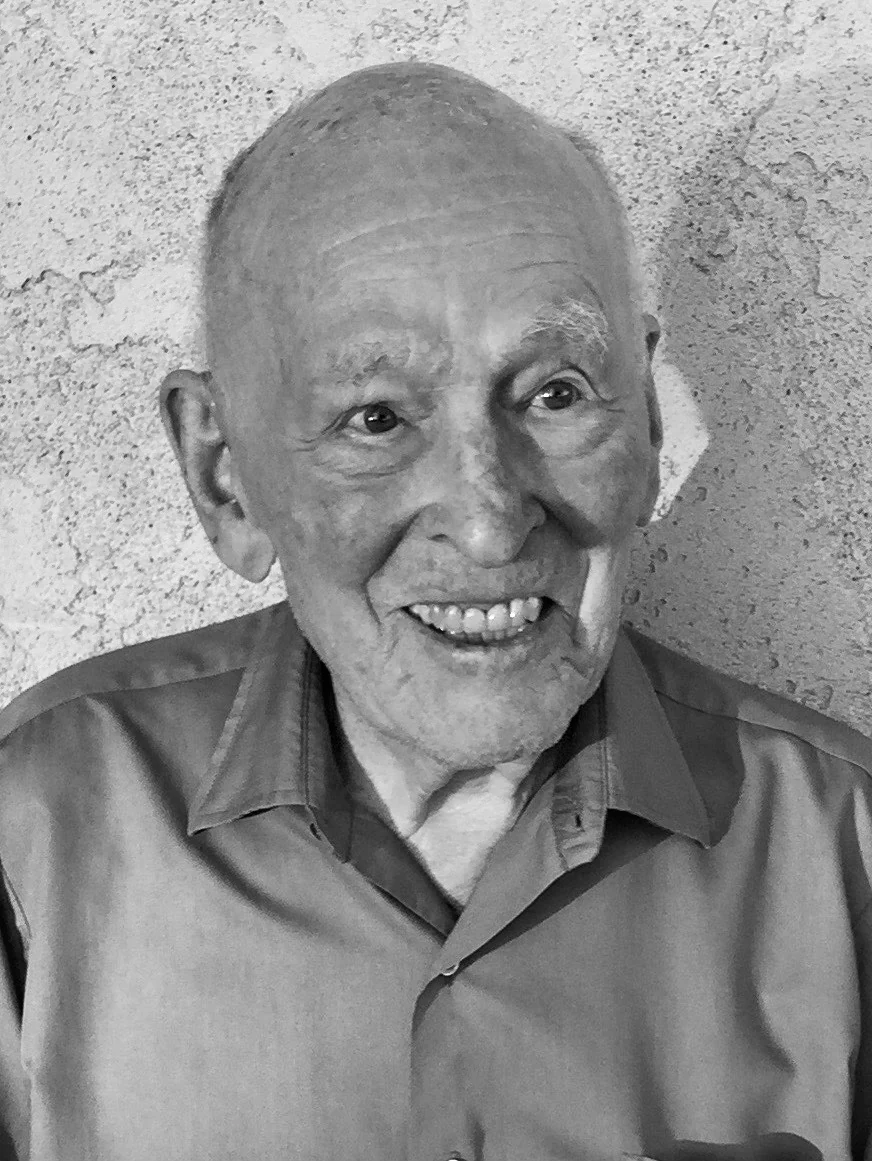
Paul D. Boyer
Biochemist and enzyme-mechanism researcherPaul Boyer investigated how ATP synthase couples energy to catalytic changes, developing binding-change ideas through isotope exchange and nucleotide-binding studies.Read biography1918–2007
Arthur Kornberg
Biochemist and DNA-replication researcherKornberg's group isolated DNA polymerase from bacteria in 1956.Read biographyQuick answers
Common questions
- Was the 1973 proposal already the complete final mechanism?
- No. It was a working hypothesis followed by further evidence and refinement.
- Can bound and released ATP be different experimental states?
- Yes. Formation at a site and release from it need to be distinguished.
Primary and institutional sources
How this history was checked
The references below distinguish the original study from later explanations. The worked exercise and comparison are newly written for this article. This article was reviewed on 8 November 2026.
- Boyer, Cross and Momsen, PNAS, 1973A new concept for energy coupling in oxidative phosphorylation based on a molecular explanation of the oxygen exchange reactions
- Daniel J. Smith and Paul D. Boyer, PNAS, 1976Demonstration of a transitory tight binding of ATP and of committed Pi and ADP during ATP synthesis by chloroplasts
- Nobel Prize OutreachPaul D. Boyer — Facts
- Nobel Prize OutreachPaul D. Boyer — Biographical