In this biography
Quick facts
- Born
- 18 January 1921
- Died
- 5 July 2015
- Birthplace
- Tokyo, Japan
- Country
- Japan
- Nationality
- Not independently established
- Known for
- Spontaneous symmetry breaking in subatomic physics
- Doctorate
- University of Tokyo,1952
- Chicago connection
- From 1954
- US citizenship
- 1970
- Nobel share
- One half of the 2008 Physics Prize
Why this life matters
He helped explain how a theory’s symmetries can coexist with a physical state that does not display all of them, opening a productive route between different fields.
Timeline
Key moments
Birth
Born in Tokyo and grew up in Fukui.
University study
Completed physics study in Tokyo before military service.
Doctorate and Princeton
Earned a doctorate and moved to the Institute for Advanced Study.
Chicago
Began a long university association.
Symmetry research
Applied ideas from superconductivity to particle physics with collaborators.
Citizenship
Became a US citizen.
Emeritus
Retired from his professorship while continuing scientific work.
Nobel Prize
Recognised for spontaneous broken symmetry.
Death
Died in Osaka on 5 July.
Training in Japan crossed more than one field
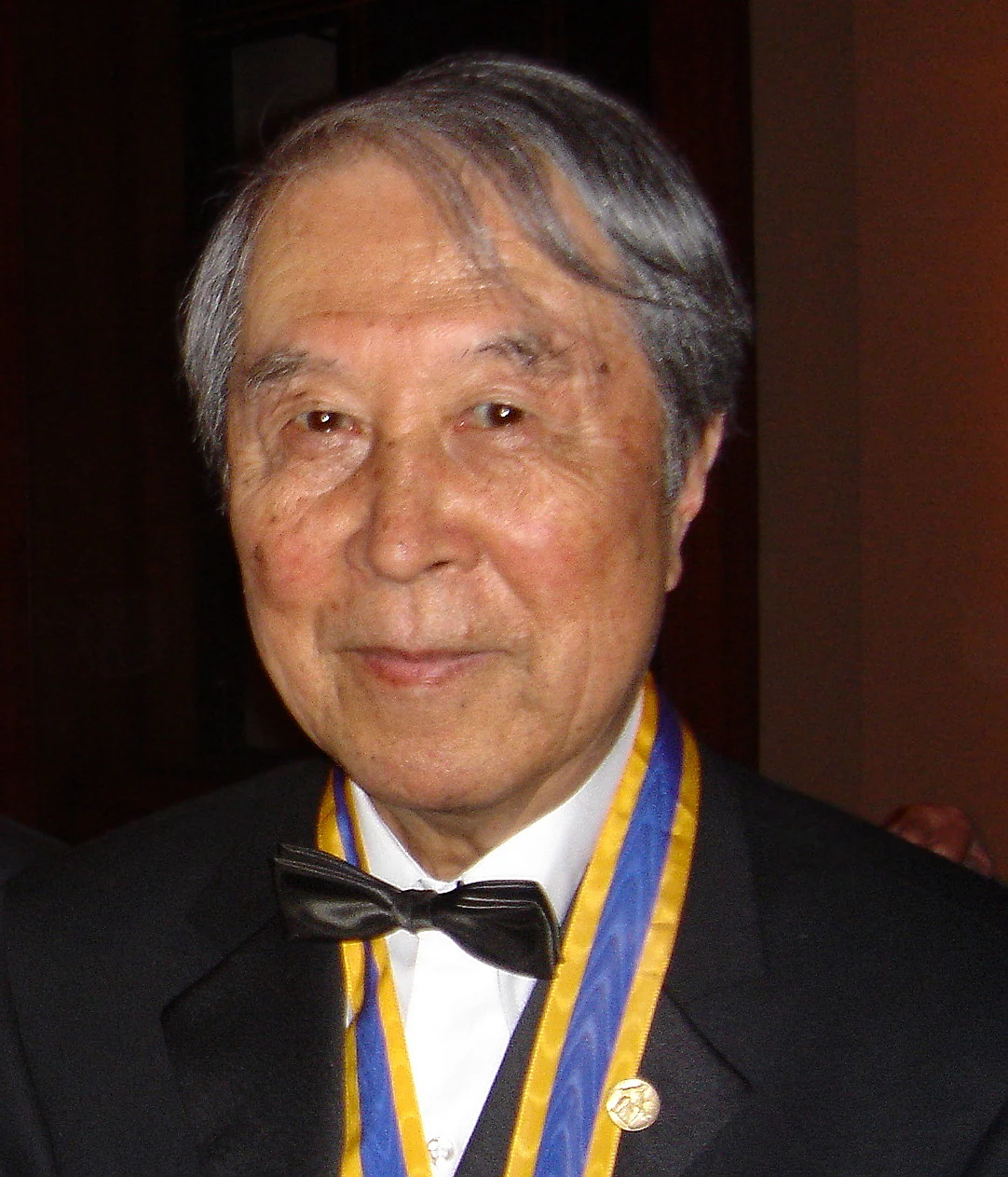
Nambu was born in Tokyo on 18 January 1921 and grew up in Fukui. He studied physics in Tokyo from 1940 to 1942, then served in a military radar laboratory. After the war he returned to university research and completed a doctorate in 1952. In his own account, his interests in particle physics developed through contact with the work and seminars of figures including Nishina and Tomonaga, while Tokyo offered strong exposure to condensed-matter physics. That combination matters to the later research. It supplied more than one way of thinking about physical systems, rather than a fixed disciplinary path followed without interruption.
An international career took shape in stages
He held a position at Osaka City University before spending 1952–1954 at the Institute for Advanced Study in Princeton. In 1954 he moved to Chicago as a research associate, becoming an associate professor in 1956 and professor in 1958. He became a US citizen in 1970. His Japanese origins and American academic career are both relevant; placement in Japan’s archive does not erase that later nationality. The Chicago institutional obituary describes a long, collegial research setting rather than a succession of discoveries made in isolation. This biography omits exact department-chair years because the participant biography and university obituary differ on that administrative chronology.
Superconductivity prompted a question about symmetry
The Bardeen–Cooper–Schrieffer theory of superconductivity raised questions about how a successful description could preserve the relevant symmetry principles. Nambu’s Nobel lecture traces his effort to understand that issue and the importance of collective behaviour. He then carried the reasoning into particle physics. The Academy’s scientific background explains the central distinction: the equations can retain a symmetry even when the lowest-energy state does not exhibit it. Nambu did not invent every earlier example of ordered matter. His distinctive contribution involved developing and applying this reasoning within a field-theoretic framework.
Jona-Lasinio and the particle-physics model
Work with Giovanni Jona-Lasinio developed the application to particle physics in influential papers. The model explored the relationship between symmetry, the state of a system and dynamically generated mass. It should not be recast as the complete present-day theory of every particle mass. The consulted lecture discusses chiral symmetry and pions within the historical development, while acknowledging other contributors and later work. The accompanying learning guide uses a deliberately simpler mathematical potential to teach the law-versus-state distinction. That example is not a calculation from the Nambu–Jona-Lasinio model and does not reproduce an experiment on elementary particles.
Other theoretical programmes extended the legacy
Chicago’s account identifies contributions to colour gauge theory with Moo-Young Han and to the development of string theory. These belong to different research programmes; a name appearing in several foundational histories does not mean that one idea established all of them at once. The same caution applies to experimental status. A theoretical framework can organise questions and calculations without every proposed application having been verified. Nambu’s career is therefore best followed through the particular problems he addressed, the collaborators involved and the records for each result, rather than by turning a list of fields into a claim of universal authorship.
Nobel recognition and the record of a lifetime
In 2008 Nambu received half of the Physics Prize; the other half was divided between Makoto Kobayashi and Toshihide Maskawa for a related but distinct contribution concerning broken symmetry. Nambu’s lecture was presented by Jona-Lasinio, a detail identified in the published text. He had become professor emeritus in 1991 and continued engaging with theoretical physics. He died in Osaka on 5 July 2015. The prize, the papers and the recollections serve different purposes: one records recognition, another develops an argument, and another describes a research community. Together they show why the movement of an idea between disciplines can matter as much as the creation of a new label.
Quick answers
Frequently asked questions about Yoichiro Nambu
- Does spontaneous symmetry breaking mean that the equations lose their symmetry?
- The important distinction is that the equations can remain symmetric while a selected physical state is not. Explicitly changing the equations is a different operation.
- Did Nambu receive one third of the2008 Physics Prize?
- No. He received one half; Kobayashi and Maskawa shared the other half.
Keep exploring
Lives connected to this story
- Hideki Yukawa
Read about an earlier Japanese particle physicist whose work formed part of Nambu’s intellectual setting.
- Sin-Itiro Tomonaga
Follow the theorist whose research and recommendations helped shape Nambu’s route.
- Leo Esaki
Compare theoretical reasoning about collective states with an experimental semiconductor investigation.
- Makoto Kobayashi
Distinguish the other theoretical mechanism recognised in the2008Physics Prize.
- Toshihide Maskawa
Read Maskawa’s field-theory training and collaboration with Kobayashi.
Sources and further reading
Explore the evidence
These references support the biography and offer further reading. Official records, first-person accounts and independent reporting provide different perspectives; image records document attribution and licensing.
- 1. Yoichiro Nambu; Nobel FoundationYoichiro Nambu: autobiographical account,2008
Participant education/migration/SSB passages read.1942 degree level and exactchair/distinguished-title years differ from Chicago; level/year conflicts not forced into false agreement.
- 2. Nobel FoundationYoichiro Nambu: prize facts
Read exact birth/death fields, 2008 Physics prize motivation and one-half share. Shared prize recognition does not imply equal thirds.
- 3. Yoichiro Nambu; lecture presented by Giovanni Jona-Lasinio; Nobel FoundationSpontaneous Symmetry Breaking in Particle Physics: A Case of Cross Fertilization,8 December 2008,57–63
Actual 7 page Nobel lecture acquired; printed 57,59–61 andclosing references inspected; equations have hidden correction/OCR layers, so not retranscribed. First-page footnote identifies Jona-Lasinio as presenter.
- 4. Steve Koppes; University of ChicagoYoichiro Nambu, Nobel-winning theoretical physicist,1921–2015,17 July 2015
Substantive university obituary read.5 Julydeath distinguished from 17 Julyannouncement. Named historical contributions retained; its simplified mass-language not used to credit Nambu with the entire Higgs mechanism.
- 5. Royal Swedish Academy of SciencesBroken Symmetries: Scientific Background on the Nobel Prize in Physics 2008
Actual 20 page Academy background acquired; selectedPDF 7–8 read for field-theory/ground-state distinction and collaboration, not full mathematical derivations.