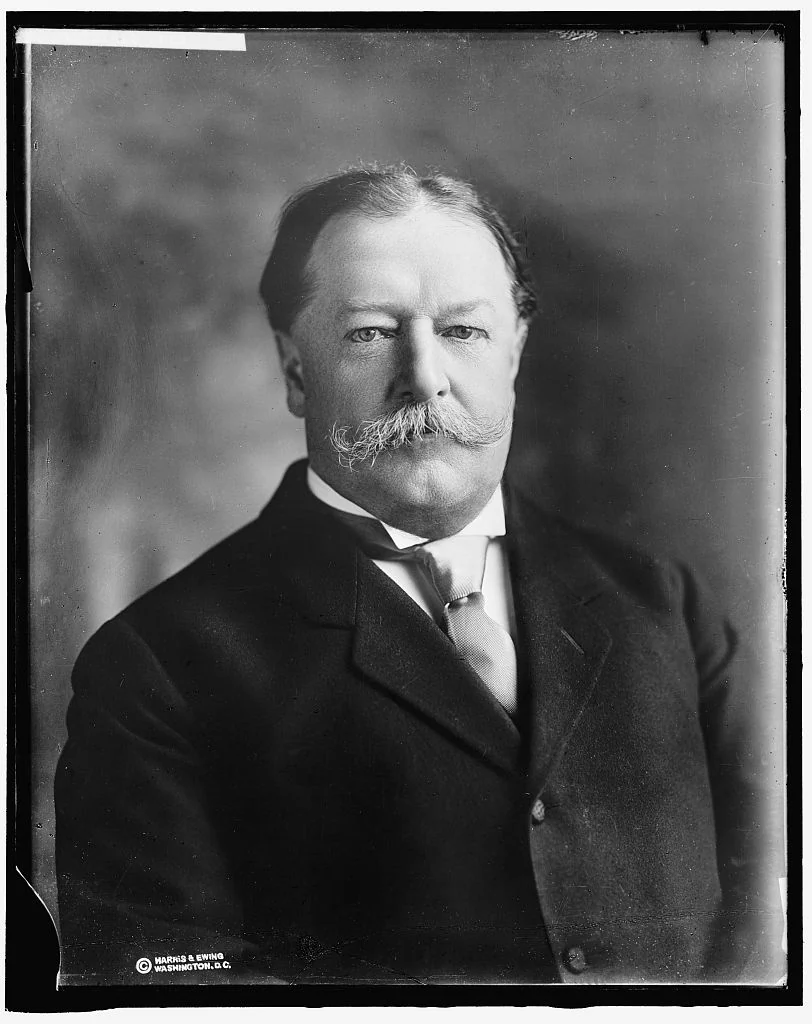
In this biography
Quick facts
- Born
- 15 September 1857
- Died
- 8 March 1930
- Birthplace
- Cincinnati, Ohio, United States
- Country
- United States
- Nationality
- Not independently established
- Known for
- President of the United States, 1909–1913.
Why this life matters
His move between executive and judicial office makes institutional design unusually visible: who administers policy, who reviews it and who controls a court’s workload.
Timeline
Key moments
Executive office
President of the United States.
Judicial office
Chief justice.
A legal and administrative formation
Born in Cincinnati in 1857, Taft graduated from Yale in 1878 and earned his law degree in 1880. Local legal work led to judgeships and service as U.S. solicitor general.
He chaired the Philippine Commission before becoming civil governor in 1901. Secretary of war followed in 1904. These were distinct offices within American imperial administration, not stages in an independent Philippine government.
The presidency was not simply a pause in reform
As president from 1909 to 1913, Taft favoured orderly administration of reform. The Mann–Elkins Act strengthened federal railroad-rate regulation, while tariff revision exposed divisions within his party.
His dollar diplomacy promoted American trade and investment and also employed military intervention, including in Nicaragua. Commercial expansion and coercive power therefore belong in the account together; an administrative temperament does not make a policy politically neutral.
Defeat and a return to the law
Theodore Roosevelt challenged his former ally and ran separately in 1912; Woodrow Wilson defeated both. Taft subsequently taught at Yale before Harding appointed him chief justice in 1921.
Judicial work also raised questions about executive power. In Myers v. United States in 1926, Taft delivered the Court’s opinion on presidential removal of an executive officer. This is a dated decision, not a statement that its whole reasoning governs every modern office.
Reorganising the Court’s work
Taft supported reform that expanded the justices’ discretion over which cases to hear. Willis Van Devanter led the drafting committee behind the 1925 Judges’ Bill; Congress, not the chief justice alone, changed the law.
He resigned from the Court in February 1930 and died the following month. The connected study examines the case-selection mechanism as an institutional achievement, with the difference between opening a route for review and winning the argument kept explicit.
Quick answers
Frequently asked questions about William Howard Taft
- Who was William Howard Taft?
- William Howard Taft was a president and chief justice. His move between executive and judicial office makes institutional design unusually visible: who administers policy, who reviews it and who controls a court’s workload.
- What is William Howard Taft best known for?
- William Howard Taft is best known for president of the United States, 1909–1913..
- When and where was William Howard Taft born?
- William Howard Taft was born on 15 September 1857 in Cincinnati, Ohio, United States.
- When did William Howard Taft die?
- William Howard Taft died on 8 March 1930.
Keep exploring
Lives connected to this story
- Theodore Roosevelt
Compare the presidency of his ally and later electoral rival.
- Earl Warren
Continue to another chief justice and a different set of constitutional questions.
Sources and further reading
Explore the evidence
These references support the biography and offer further reading. Official records, first-person accounts and independent reporting provide different perspectives; image records document attribution and licensing.
- 1. Miller Center, University of VirginiaWilliam Taft: presidential facts
Actual indexed profile and fast-fact table, birth, death, education and presidential dates. Linked life essays are not all claimed read.
- 2. Federal Judicial CenterWilliam Howard Taft: judicial biography
Actual indexed complete short judicial service/education/career entry, distinguishing commission presidency from civil governorship and resignation from death.
- 3. Peri E. Arnold / Miller CenterWilliam Taft: Domestic Affairs
Actual indexed opening discussion of administration, tariff revision and Mann–Elkins Act; no complete presidency archive.
- 4. Peri E. Arnold / Miller CenterWilliam Taft: Foreign Affairs
Actual page opening 24–25 on trade, dollar diplomacy and military intervention. Promotional or psychological characterisations are not added.
- 5. US Supreme Court / Cornell LII transcriptMyers v. United States, 272 U.S. 52
Opening case date, Taft authorship and the removal-power question only; not the full opinion or its later treatment.
- 6. Federal Judicial CenterLandmark Legislation: The Judges’ Bill, historical note
Actual historical note 115–125 on earlier use, drafting, Van Devanter, congressional process and jurisdiction. A separate original statute is also inspected.