In this biography
Quick facts
- Born
- 1 April 1940
- Died
- 25 September 2011
- Birthplace
- Nyeri, Kenya
- Country
- Kenya
- Nationality
- Not independently established
- Known for
- Founding the Green Belt Movement and connecting environmental protection, women’s participation and democratic rights
- Undergraduate degree
- Biological sciences, Mount St. Scholastica College, 1964
- Doctorate
- University of Nairobi, 1971; veterinary anatomy research
- Green Belt Movement
- Founded in 1977 under the National Council of Women of Kenya
- Nobel Prize
- Peace, 2004
Why this life matters
Her work made local environmental repair a means of organising, earning income and questioning how public resources were governed.
Timeline
Key moments
Born in Nyeri
Born on 1 April in central Kenya.
Biological sciences degree
Graduates from Mount St. Scholastica College in Kansas; postgraduate study at Pittsburgh follows.
Nairobi doctorate
Receives her PhD after research in veterinary anatomy.
Green Belt Movement
Develops community tree planting under the National Council of Women of Kenya.
Defending public spaces
Campaigns include Uhuru Park and Karura Forest.
Parliament
Elected to represent Tetu; later serves as an assistant environment minister.
Nobel Peace Prize
Becomes the first African woman to receive the prize.
UN environmental advocacy
Serves as a United Nations Messenger of Peace until her death on 25 September 2011.
A scientific education across continents
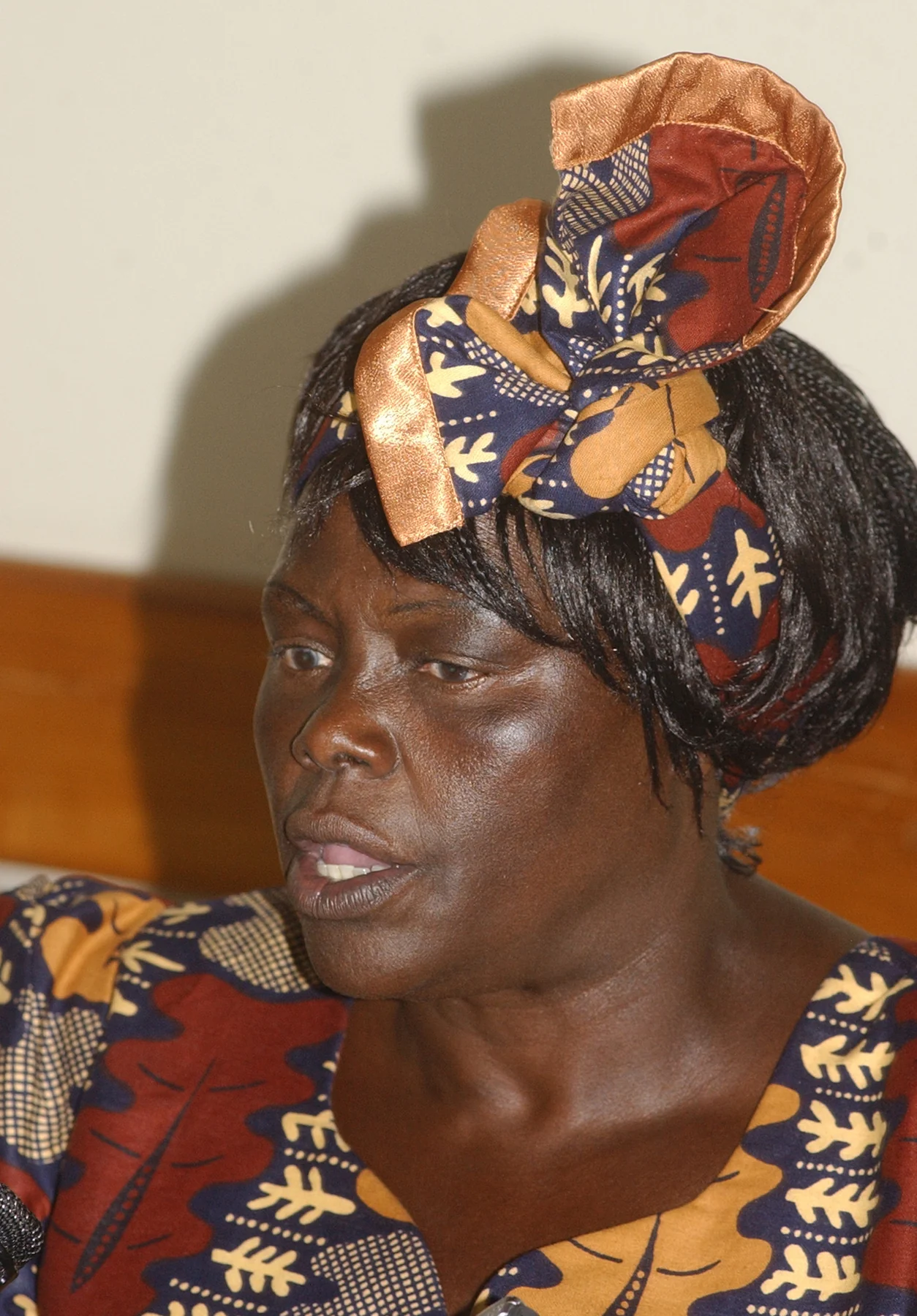
Wangari Muta Maathai was born in Nyeri, Kenya, on 1 April 1940. Her education took her from colonial Kenya to the United States, where she studied biological sciences at Mount St. Scholastica College in Kansas, graduating in 1964. She then earned a master’s degree at the University of Pittsburgh before returning to Kenya.
Postgraduate research also took her to Germany through Nairobi’s university partnership with Giessen. Her University of Nairobi doctorate, awarded in 1971, investigated the early development of the male bovine gonad. This was specialist work in veterinary anatomy. Her later public reputation as a tree planter grew from a career that had already required laboratory research, teaching and academic administration.
An academic career and women’s organisation
Maathai taught veterinary anatomy at the University of Nairobi. She became department chair in 1976 and associate professor in 1977, breaking barriers to women’s advancement within the university. The institution’s account connects those positions with her earlier appointment as an assistant lecturer and her doctoral training, rather than treating her scientific credentials as honorary awards.
She also worked through the National Council of Women of Kenya, which she chaired from 1981 to 1987. That network brought her into conversation with rural women about the work of obtaining fuel, water and food. Their experience helped redirect her attention from the university department toward environmental conditions affecting everyday livelihoods.
Building the Green Belt Movement
In 1977 Maathai founded the Green Belt Movement under the council’s auspices. Women had reported streams drying up, declining food security and longer journeys for firewood. Planting trees offered a practical starting point. The movement encouraged communities to grow seedlings and restore their surroundings while developing the confidence and organisation needed to sustain the work.
Maathai supplied leadership and a public voice, but nursery members, local groups, staff and supporters performed the continuing labour. The achievement depended on caring for young trees as well as announcing planting events. As the organisation developed, education about rights and public accountability became part of its response to environmental damage.
Public land and the costs of dissent
Defending trees also meant confronting powerful decisions about land. Maathai opposed the proposed development in Nairobi’s Uhuru Park from 1989. The Goldman Environmental Prize’s account records public vilification and the loss of her office before investors withdrew and the scheme was cancelled. She received the Goldman Prize in 1991.
The movement’s retrospective also describes the 1992 vigil for political prisoners and the violence met by protesters defending Karura Forest in January 1999. These campaigns involved other activists and affected families. They help explain why her environmentalism became inseparable from demands for political participation: a community could plant seedlings yet still lose its public green spaces through decisions it had little power to challenge.
Parliament, the Nobel and international advocacy
Maathai was elected to Parliament for Tetu in December 2002 and subsequently served as assistant minister for environment and natural resources. Formal office gave her a different means of pursuing concerns developed through civil society. It did not make the earlier movement’s work simply a government programme.
The 2004 Nobel Peace Prize recognised her contribution to sustainable development, democracy and peace. She was the first African woman awarded the prize. In December 2009 the United Nations designated her a Messenger of Peace focusing on the environment and climate change. Her international advocacy drew attention to connections between material insecurity, environmental loss and conflict, rather than presenting conservation as a purely technical task.
Writing and an organisation beyond one life
Her books included The Green Belt Movement, the memoir Unbowed, The Challenge for Africa and Replenishing the Earth. They offered different ways to explain her experience, from personal recollection to wider arguments about development. The books belong alongside her scientific and organising work in understanding how she communicated with different audiences.
Maathai died in Nairobi on 25 September 2011. The Green Belt Movement continued beyond its founder’s lifetime. Her biography therefore includes two related stories: an unusually wide public career, and a collective practice that other people could carry forward through nurseries, community meetings and campaigns over the use of land.
Quick answers
Frequently asked questions about Wangari Maathai
- Who was Wangari Maathai?
- Wangari Maathai was a biologist, environmental organiser and politician. Her work made local environmental repair a means of organising, earning income and questioning how public resources were governed.
- What is Wangari Maathai best known for?
- Wangari Maathai is best known for founding the Green Belt Movement and connecting environmental protection, women’s participation and democratic rights.
- When and where was Wangari Maathai born?
- Wangari Maathai was born on 1 April 1940 in Nyeri, Kenya.
- When did Wangari Maathai die?
- Wangari Maathai died on 25 September 2011.
Keep exploring
Lives connected to this story
- Calestous Juma
Compare environmental civic action with the work of building technology-policy research institutions.
- Grace Alele-Williams
Explore another career connecting women’s higher education with leadership and professional networks.
- Richard Leakey
Compare a distinct Kenyan career joining research institutions and environmental public action.
- Charity Ngilu
Compare the other woman who contested the presidency in 1997 and her later executive career.
- Mekatilili wa Menza
Compare a different era of women’s organisation and public remembrance without implying a direct causal lineage.
- Mary Abukutsa-Onyango
Explore another Kenyan scientist’s documented work connecting plants, livelihoods and public participation.
Sources and further reading
Explore the evidence
These references support the biography and offer further reading. Official records, first-person accounts and independent reporting provide different perspectives; image records document attribution and licensing.
- 1. Nobel Prize OutreachWangari Maathai: award-era biographical statement
Official indexed award-era biography read; direct fetch returned 403. Its self/award-era perspective is identified, and it is not used as a source for events after the award.
- 2. Nobel Prize OutreachWangari Maathai: official life dates and 2004 Peace Prize record
- 3. University of Nairobi, Wangari Maathai InstituteAbout Prof. Wangari Maathai: research and academic appointments
Official indexed text checked; direct retrieval timed out. The institution dates project completion to 1970 and the PhD award to 1971; the draft uses the award year.
- 4. University of Pittsburgh, Dietrich SchoolWangari Maathai: graduate education and public career
This page gives the MSc as 1966 but labels her A&S ’65G. Pittsburgh Alumni and Chronicle records give 1965; Nobel and GBM give 1966. No registrar record was examined. The manuscript therefore leaves the MSc year unstated.
- 5. Green Belt MovementWangari Maathai: biography and books
- 6. Green Belt MovementOur History: women’s concerns and the 1977 foundation
- 7. Goldman Environmental FoundationWangari Maathai: 1991 prize recipient and Uhuru Park campaign
- 8. Green Belt Movement, guest post hosted by Goldman Environmental FoundationThe Green Belt Movement: 40 Years of Impact, 21 March 2018
This is GBM’s own retrospective on Goldman’s site, not independent corroboration of GBM’s history or tree totals. Numerical impact claims are omitted.
- 9. United NationsWangari Maathai: Messenger of Peace and death date
Institutional record verifies the December 2009 UN appointment and 25 September 2011 death. Tree counts on the page are dated organisational reporting, not a present-day audited total.