In this biography
Quick facts
- Born
- 12 October 1956
- Died
- 21 September 2018
- Birthplace
- Not reliably confirmed
- Country
- Vietnam
- Nationality
- Not independently established
- Known for
- Serving as Vietnam’s president during 2016–2018, leading the public-security ministry and chairing the 2017 APEC leaders’ meeting
- Presidency
- Elected on 2 April 2016; died in office on 21 September 2018
- Previous ministry
- Minister of Public Security, August 2011–April 2016
- Earlier training
- People’s Police School and the ministry’s foreign-language school, 1972–1975
- Documented qualification
- Official biography records a PhD in law and the title of professor
- Multilateral role
- Chaired the APEC Economic Leaders’ Meeting in Da Nang in November 2017
- Home-region evidence
- Official biography identifies Quang Thiện, Kim Sơn, Ninh Bình as native land, not explicitly as birthplace
Why this life matters
His career connects Vietnam’s powerful security institutions with the presidency, international economic diplomacy and the contested human-rights record of his leadership period.
Timeline
Key moments
Birth
His date of birth is recorded in the Vietnamese government’s official biography.
Police and language training
Studied at the People’s Police School and the ministry’s School of Foreign Languages.
Deputy minister
Entered the public-security deputy ministry after a career in political protection and security administration.
Public-security minister
Became minister; the official obituary dates this portfolio through April 2016.
Elected president
The National Assembly elected him state president during its eleventh session.
Singapore state visit
Discussed economic connectivity, strategic partnership and regional security with Singapore’s leaders.
APEC host
Chaired the Da Nang leaders’ meeting and addressed the APEC CEO Summit.
Death in office
Died in Hanoi at Military Central Hospital 108 after serious illness, according to the official announcement.
A career inside the security apparatus
Trần Đại Quang rose through Vietnam’s security administration before becoming president. Born on 12 October 1956, he attended the People’s Police School and the ministry’s foreign-language school during 1972–1975. He then worked in political-protection departments, progressing through operational and staff-management positions within the ministry responsible for internal security.
He became deputy minister of public security in 2006 and entered the Politburo in 2011. From August that year until April 2016 he served as public-security minister, also holding responsibilities in party security structures. His presidential election therefore followed a long institutional career in policing and security rather than an earlier diplomatic or provincial-governance trajectory.
The presidency and regional diplomacy
The National Assembly elected Quang state president on 2 April 2016. His new responsibilities brought him into direct engagement with foreign leaders. During an August state visit to Singapore, he met President Tony Tan Keng Yam and Prime Minister Lee Hsien Loong to discuss the two countries’ strategic partnership, investment and practical economic connectivity.
The talks also covered defence, education, tourism and cooperation through ASEAN and the United Nations. Both sides supported peaceful settlement of maritime disputes and work towards a regional code of conduct. The visit illustrated the presidency’s external-facing role: combining commercial relationships with discussion of a regional security environment in which Vietnam had substantial interests.
Hosting APEC in Da Nang
Quang’s most visible multilateral role came when Vietnam hosted APEC in 2017. He chaired the Economic Leaders’ Meeting in Da Nang, after which the member economies issued a declaration addressing innovation, regional integration, smaller enterprises and food security. Its accompanying frameworks addressed economic and social inclusion and workforce development in the digital age.
At the CEO Summit, he called for growth to reach more people and asked businesses to take social responsibility seriously. He linked regional development to women’s economic participation, resilient communities and opportunities for smaller firms. These were the priorities he publicly advanced as host; the declaration was a collective APEC document, not a policy achievement attributable to him alone.
Rights criticism and death in office
International diplomacy occurred alongside serious criticism of Vietnam’s domestic rights record. Before Quang’s 2018 Japan visit, Human Rights Watch urged Prime Minister Shinzo Abe to raise restrictions on expression, assembly and religious activity, and the imprisonment of peaceful critics. Its report described a worsening crackdown during the period in which Quang held the presidency.
That criticism concerns the government and its institutions; it should not be converted into unsupported claims that Quang personally ordered each reported abuse. He died in Hanoi on 21 September 2018 while still president. The official announcement identified Military Central Hospital 108 and serious illness, ending a presidency of approximately two and a half years.
Quick answers
Frequently asked questions about Trần Đại Quang
- When was Trần Đại Quang president of Vietnam?
- He was elected on 2 April 2016 and remained president until his death on 21 September 2018.
- What did Trần Đại Quang do before becoming president?
- He built a career in political protection and security administration, became deputy public-security minister in 2006, and served as minister from August 2011 to April 2016.
- What was his role at APEC in 2017?
- He chaired the Economic Leaders’ Meeting in Da Nang and addressed the CEO Summit. APEC’s resulting declaration was agreed collectively by the member economies.
- Why does his biography discuss human rights?
- Human Rights Watch raised restrictions and the imprisonment of peaceful critics directly in connection with his 2018 Japan visit. Those documented concerns provide essential context without inventing personal orders or judicial findings against him.
Keep exploring
Lives connected to this story
- Nguyễn Phú Trọng
Read about the Communist Party leader who headed Vietnam’s political leadership during Quang’s presidency.
- Nguyễn Thị Kim Ngân
Explore the National Assembly leader whose institutional career coincided with Quang’s period as state president.
Sources and further reading
Explore the evidence
These references support the biography and offer further reading. Official records, first-person accounts and independent reporting provide different perspectives; image records document attribution and licensing.
- 1. Vietnam Government News / VNA · 4 April 2016Biography of President Tran Dai Quang
Read the complete substantive official biography. It supplies birthday, training, security career and recorded academic title/qualification. Its native-land field is not silently converted into birthplace; birthplace remains withheld. No awarding institution or degree date is invented. Its present-tense ministry wording is dated 2016, not current.
- 2. Vietnam Government News · 21 September 2018State President Tran Dai Quang passes away
Read the original substantive obituary and career chronology. It confirms death date/place of treatment, serious illness, election date and the ministry’s 2011–2016 span. The source’s stated age is not repeated because its counting convention differs from completed Western-calendar years. No specific medical diagnosis is inferred.
- 3. Vietnam Government News / VNA · 30 August 2016State President affirms Vietnam’s wish to boost ties with Singapore
Read the full substantive contemporaneous official report. It records meetings and agreed diplomatic positions, not independently measured success of the strategic partnership. Economic totals and promotional evaluations are omitted; no current Singaporean officeholder claim is made.
- 4. APEC · 11 November 2017APEC Leaders Issue Da Nang Declaration
Read the official release’s substantive text. It expressly identifies Quang as meeting chair and outlines the declaration and two annexes. Collective commitments are not attributed to his sole authorship or treated as demonstrated implementation outcomes.
- 5. APEC · 11 November 20176 Things President Tran Dai Quang Said
Read APEC’s original displayed excerpts of his CEO Summit remarks. They establish his stated inclusion, business-responsibility and smaller-enterprise priorities. The feature’s incorrect Vietnam accession-year aside is not used. No long quotation is reproduced.
- 6. Human Rights Watch · 27 May 2018Japan: Urge Vietnam to Respect Human Rights
Read the full substantive original release and its description of HRW’s own letter. Criticism is clearly attributed to the investigating organisation and placed in the 2018 visit context. It does not establish that Quang personally ordered individual abuses; no such claim is made. Its Reuters photograph is not proposed for reuse.
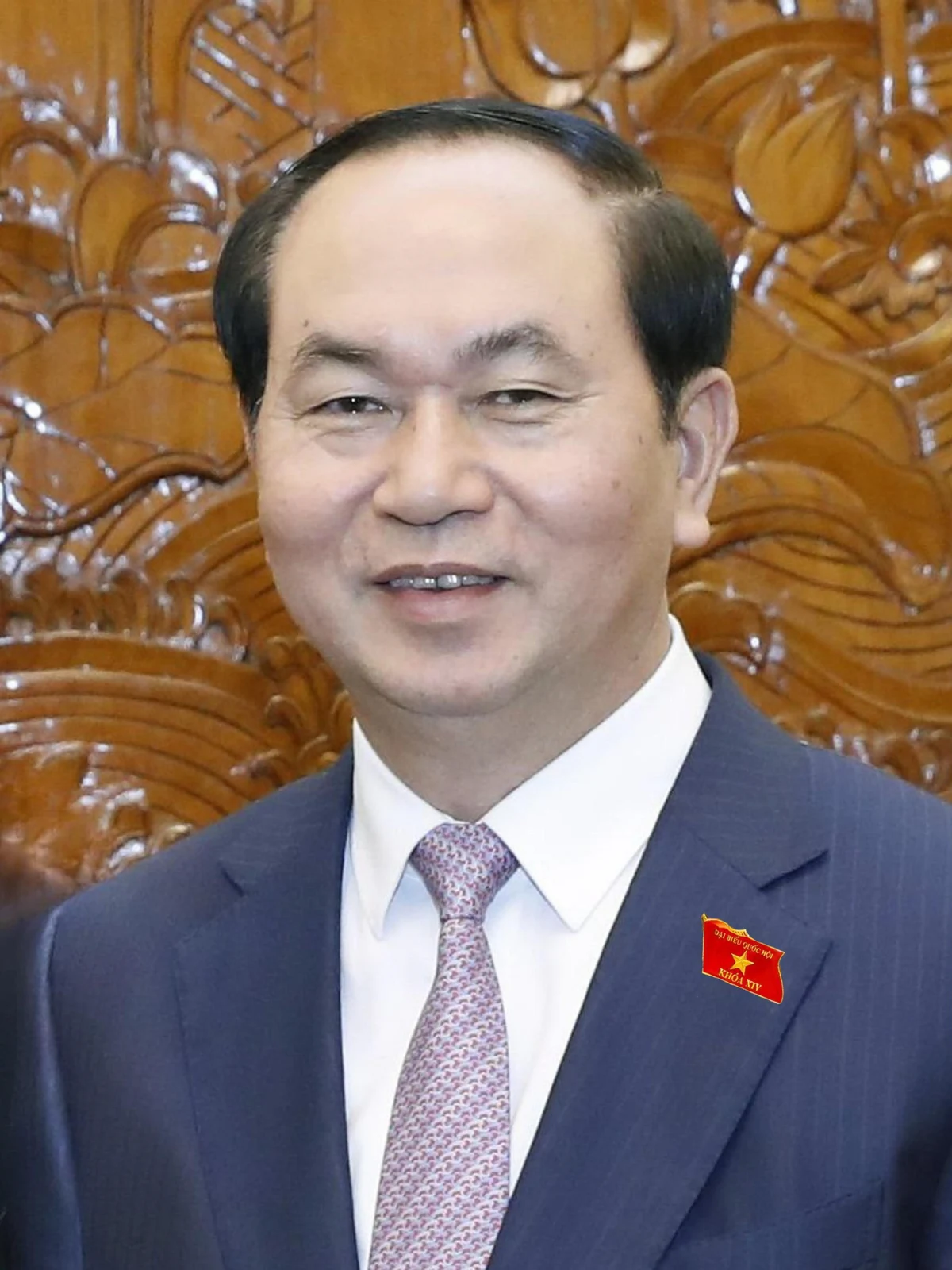
- 7. Wikimedia Commons · RoniteTran Dai Quang 2017.jpg — own work and VRT-confirmed permission
Actual Commons description marks Ronite’s own work and self-releases CC BY-SA 4.0. VRT ticket 2017031510014027, confirmed by Hanay, records copyright-holder approval for this file. Complete embedded metadata have no competing creator/copyright credit. Caption identifies Quang at a Hanoi meeting in 2017, but its March wording conflicts with the 8 February Date field; do not assert an exact day or month. Main visual identity review confirms Quang seated at the meeting; the entire supplied portrait is retained. Main completed the full-original identity and embedded-metadata review on 21 October 2026. Complete supplied 2471 × 3294 frame retained; proportionally resized to 1200 × 1600. Biography Compass converted the photograph to WebP without additional cropping, enlargement or transparency loss.