In this biography
Quick facts
- Born
- 20 July 1954
- Birthplace
- Quế Phú, Quế Sơn, Quảng Nam, Vietnam
- Country
- Vietnam
- Nationality
- Vietnamese
- Known for
- Serving as prime minister in 2016–2021 and president in 2021–2023
- Prime minister
- 7 April 2016–5 April 2021
- President
- 5 April 2021–18 January 2023
- Earlier office
- Deputy prime minister · 2011–2016
- Education
- National Economics University, Hanoi
Why this life matters
Phúc’s career links provincial administration, the premiership, regional diplomacy and the changing accountability of Vietnam’s senior political leadership.
Timeline
Key moments
Born in Quảng Nam
Born on 20 July; official biographies identify his native place as Quế Phú commune.
Chaired the provincial People’s Committee
The official chronology places the Quảng Nam chairmanship after earlier deputy-chair roles.
Became deputy prime minister
Entered the deputy premiership in August after leading the Government Office.
Elected prime minister
Sworn in on 7 April, then elected for the new parliamentary term in July.
Chaired regional summit diplomacy
Chaired the virtual RCEP summit on 15 November during Vietnam’s ASEAN chairmanship.
Moved from premiership to presidency
Elected president on 5 April as the premiership passed to Phạm Minh Chính.
Left the presidency
The Party decision on 17 January was followed by the National Assembly resolution on 18 January.
Received a Party warning
The Politburo announced disciplinary findings on 13 December.
Removed from all Party positions
The Party Central Committee decision was reported at the July plenum; this was distinct from a criminal verdict.
Education and a provincial administrative career
Nguyễn Xuân Phúc was born on 20 July 1954; official biographies identify his native place as Quế Phú commune in Quế Sơn district, Quảng Nam. He studied at Hanoi’s National Economics University from 1973 to 1978 and then worked in the economic and administrative structures of Quảng Nam–Đà Nẵng.
His rise was through civilian administration rather than a military command. The government chronology records planning and tourism responsibilities, deputy-chair roles in Quảng Nam from 1997, and chairmanship of its People’s Committee during 2001–2006. Keeping the deputy and chair periods separate avoids assigning the senior provincial post to his entire earlier service.
Sources for this section: [1]
The Government Office and the premiership
Phúc moved into central government in 2006, became minister-chairman of the Government Office in 2007 and deputy prime minister in August 2011. These jobs placed him within the administration led by Nguyễn Tấn Dũng. They were distinct appointments, not successive names for the same office.
On 7 April 2016 the National Assembly elected him prime minister. He was elected again for the new parliamentary term that July. His inaugural commitments included administrative reform, improving the business environment and fighting corruption. They document his stated agenda; a pledge alone does not establish that the intended results were achieved.
Regional diplomacy during the pandemic
Vietnam held ASEAN’s rotating chairmanship in 2020, bringing Phúc to the centre of a summit programme conducted largely through virtual meetings. On 15 November he chaired the fourth Regional Comprehensive Economic Partnership summit, held as participating countries concluded the agreement’s long negotiation process.
The government’s contemporary report records his emphasis on disrupted trade and investment during COVID-19 and on regional economic cooperation. This was chairing and diplomatic advocacy within a multilateral process, not evidence that he alone negotiated RCEP. Nor did Vietnam’s rotating ASEAN chairmanship make him secretary-general of the ASEAN Secretariat, a separate office.
Sources for this section: [5]
From prime minister to president in April 2021
The National Assembly voted on 2 April 2021 to relieve Phúc as prime minister, but the resolution took effect when a successor was elected. He continued carrying the responsibilities until the 5 April transition, when Phạm Minh Chính became prime minister and Phúc was elected president.
The Presidential Office’s later handover account dates his presidency from 5 April 2021 to 18 January 2023. The move changed his constitutional role from head of government to head of state; it was not an extension of his prime-ministerial term. It also followed Nguyễn Phú Trọng’s presidency, not a succession to the Communist Party general secretaryship.
January 2023: Party decision and state resignation
On 17 January 2023 the Party Central Committee agreed to his request to leave his positions and retire. Its announcement said that, as the former head of government, he bore political responsibility for serious wrongdoing by officials under his administration. This is the Party’s stated explanation and should be attributed as such.
On 18 January the National Assembly approved the resolution relieving him of the presidency. Vice president Võ Thị Ánh Xuân then undertook the acting presidency. The Party decision and the parliamentary act were separate steps on consecutive days, not interchangeable dates for a single procedure.
Later discipline and how to read the record
The Politburo issued Phúc a disciplinary warning on 13 December 2024, citing violations in performing his former responsibilities and in anti-corruption work. At the July 2025 Central Committee plenum, the leadership reported a further decision removing him from all Party positions. Those developments mean his political biography does not end with the January 2023 retirement announcement.
Party sanctions, resignation from state office and a criminal-court judgment are different categories. The official documents cited here record the first two and do not establish a personal criminal conviction. Their institutional perspective also requires care: official career biographies and disciplinary announcements explain appointments and decisions, but are not independent assessments of the whole record of his government.
Quick answers
Frequently asked questions about Nguyễn Xuân Phúc
- When was Nguyễn Xuân Phúc prime minister of Vietnam?
- He became prime minister on 7 April 2016 and served until the 5 April 2021 transition. The National Assembly’s 2 April relief vote took effect when the new prime minister was elected.
- When was Nguyễn Xuân Phúc president?
- The Presidential Office’s handover account dates his presidency from 5 April 2021 to 18 January 2023, after his premiership.
- Why did Nguyễn Xuân Phúc leave the presidency?
- The January 2023 Party announcement said he bore political responsibility for serious wrongdoing by officials under his former government. The National Assembly relieved him on 18 January; this announcement is not itself a personal criminal conviction.
- What happened after his 2023 resignation?
- The Politburo issued a warning in December 2024. A July 2025 Party Central Committee decision subsequently removed him from all Party positions, a different sanction from expulsion from the Party.
Keep exploring
Lives connected to this story
- Nguyễn Tấn Dũng
Read the premiership under which Phúc served as deputy before succeeding him in 2016.
- Nguyễn Phú Trọng
Distinguish the Party leadership and prior presidency from Phúc’s head-of-state role.
- Nguyễn Thị Kim Ngân
Compare the National Assembly leadership during his premiership, a separate institution.
Sources and further reading
Explore the evidence
These references support the biography and offer further reading. Official records, first-person accounts and independent reporting provide different perspectives; image records document attribution and licensing.
- 1. Government News, VietnamBiography of Politburo member Nguyễn Xuân Phúc, January 2021
This is an official career record as of January 2021, not a current-office page. It separates deputy provincial chairmanship from the later chairmanship.
- 2. Wikimedia Commons / The White House2019 portrait crop and public-domain reuse record
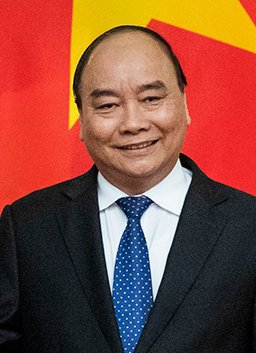
The existing Commons portrait crop derives from the official White House photograph President Trump’s Trip to Vietnam (47176536782), credited to Joyce N. Boghosian. The original caption identifies the Hanoi meeting on 27 February 2019; camera metadata is dated 26 February. The US federal-work public-domain rationale is recorded on both pages. The downloaded 256 × 353 crop is unchanged.
- 3. Government News, VietnamNguyễn Xuân Phúc elected prime minister, 7 April 2016
- 4. Tuổi Trẻ NewsNational Assembly relief vote and its effective date, 2 April 2021
The report distinguishes the 2 April vote from its effective date when a new prime minister was elected on 5 April.
- 5. Government News, VietnamFourth RCEP summit, 15 November 2020
- 6. Vietnam News Agency / VietnamPlusCeremony handing over the President’s work
- 7. Government News, VietnamParty decision on Nguyễn Xuân Phúc, 17 January 2023
The political-responsibility explanation is attributed to the Party announcement. It does not itself establish a criminal conviction of Phúc.
- 8. Vietnam News Agency / VietnamPlusNational Assembly resolution, 18 January 2023
- 9. Government News, VietnamPolitburo disciplinary measures, 13 December 2024
The December 2024 warning is a Party disciplinary measure, separate from his 2023 departure from the state presidency.
- 10. Government News / Vietnam News AgencyClosing speech of the 12th Central Committee plenum, July 2025
The closing speech records removal from all Party positions. It distinguishes that sanction from the expulsion applied to another named official; those penalties must not be conflated.