In this biography
Quick facts
- Born
- 6 March 1936
- Birthplace
- Attapeu (Attapu), Laos
- Country
- Laos
- Nationality
- Not independently established
- Known for
- Holding Laos’s presidency and ruling-party leadership from 2006 to 2016 during deeper international economic integration
- Birth record
- 6 March 1936 in Attapu, according to the official visiting-leader biography published by Nhân Dân in December 2012
- Earlier portfolios
- Defence minister, 1991–2001; vice president, 2001–2006, in the same biographical account
- Party leadership
- Elected Lao People's Revolutionary Party leader on 21 March 2006
- Presidency
- Elected president by the National Assembly on 8 June 2006; succeeded in April 2016
- Economic milestone
- Laos joined the World Trade Organization on 2 February 2013 during his presidency
- Successor
- Bounnhang Vorachith succeeded him as party leader in January 2016 and president on 20 April 2016
Why this life matters
His career illustrates the overlap between military, party and state leadership in Laos, and the contrast between international economic engagement and restricted civic space.
Timeline
Key moments
Born in southern Laos
Nhân Dân’s visiting-leader biography identifies Attapu as his birthplace.
Defence portfolio
Served as minister of defence before moving to the vice presidency, according to the official visit biography.
Vice presidency
Held the vice presidency before succeeding Khamtai Siphandon at the top of the party and state.
Party leadership
The LPRP elected him leader following Khamtai Siphandon’s retirement from that position.
Elected president
The new National Assembly appointed him president alongside a change of prime minister.
Visit to Japan
Japan’s foreign ministry records his visit in the context of economic cooperation and investment promotion.
WTO membership
Laos became a WTO member after fifteen years of accession negotiations.
Leadership handover
Bounnhang Vorachith took over the party leadership in January and the presidency on 20 April.
From defence administration to party and state leadership
Choummaly Sayasone’s rise to Laos’s highest offices followed a long career in its governing institutions. Nhân Dân’s official visiting-leader biography places his birth in Attapu on 6 March 1936 and records service as defence minister from 1991 to 2001, followed by the vice presidency from 2001 to 2006. Those posts preceded his leadership of both party and state.
The Inter-Parliamentary Union records his election as Lao People's Revolutionary Party leader on 21 March 2006, succeeding Khamtai Siphandon. On 8 June, the newly elected National Assembly made him president. The party held 113 of the assembly’s 115 seats, an important institutional context: the change was a succession within an overwhelmingly dominant ruling party, not a competitive presidential election.
Diplomacy and a wider economic opening
As president, Choummaly represented Laos in relationships combining political ties, development assistance and investment. Japan’s foreign ministry records his May 2008 visit and describes economic cooperation and investment promotion as complementary foundations of bilateral relations. An investment-protection agreement entered into force that August, within a broader effort to improve conditions for business in Laos.
The most visible multilateral economic milestone came when Laos joined the World Trade Organization on 2 February 2013. The accession followed fifteen years of negotiations and approval of its membership package in October 2012. It occurred during Choummaly’s presidency, but the WTO identifies Industry and Commerce Minister Nam Viyaketh as chief negotiator; membership was a collective institutional undertaking, not a personal presidential accomplishment.
The unresolved Sombath case and civic space
International engagement coexisted with serious concerns about civic freedom. Civil-society leader Sombath Somphone disappeared in December 2012, during Choummaly’s presidency. In a December 2015 statement, the UN Human Rights Office said the disappearance had created fear among nongovernmental workers and criticised the lack of progress and cooperation in establishing what had happened.
The same statement recorded the government’s position that police investigations were inconclusive and still continuing. OHCHR considered the responses unsatisfactory and called for a thorough, transparent investigation. These were criticisms of the state’s handling of the case under his leadership; the reviewed documents do not establish that Choummaly personally ordered the disappearance.
Sources for this section: [6]
The 2016 succession
Choummaly’s two senior offices passed to Bounnhang Vorachith in separate stages. Bounnhang replaced him as general secretary during the January 2016 party leadership elections. Following the March parliamentary election, the National Assembly elected Bounnhang president on 20 April. Thongloun Sisoulith became prime minister in the same transition.
The handover continued the party’s control while changing its leading personnel. The LPRP won 144 of the enlarged assembly’s 149 seats in 2016. Choummaly’s presidential decade therefore sits between two managed leadership transitions, alongside an economic opening whose international visibility did not resolve the concerns about accountability and political participation documented during his tenure.
Quick answers
Frequently asked questions about Choummaly Sayasone
- When did Choummaly Sayasone become president?
- The National Assembly elected him president on 8 June 2006. He had already been elected leader of the Lao People's Revolutionary Party on 21 March that year; the party and state appointments were separate events.
- Who succeeded him?
- Bounnhang Vorachith replaced him as party general secretary in January 2016 and became president on 20 April 2016. Thongloun Sisoulith became prime minister during the same leadership transition.
- Did he personally negotiate Laos’s WTO membership?
- Laos joined the WTO during his presidency, on 2 February 2013. The WTO identifies Industry and Commerce Minister Nam Viyaketh as chief negotiator, so the accession should not be credited to Choummaly alone.
- Why is the Sombath Somphone case relevant to his presidency?
- The disappearance occurred during his presidency. OHCHR criticised the state’s investigation in 2015, without establishing that Choummaly personally directed the disappearance.
Keep exploring
Lives connected to this story
- Khamtai Siphandon
Read about the leader whom Choummaly succeeded at the head of the ruling party and presidency.
- Bounnhang Vorachith
Follow the separate party and presidential successions that brought Choummaly’s decade in the two offices to an end.
Sources and further reading
Explore the evidence
These references support the biography and offer further reading. Official records, first-person accounts and independent reporting provide different perspectives; image records document attribution and licensing.
- 1. Nhân Dân · 26 December 2012Lao President began official friendship visit — visiting-leader biography
Read the complete substantive original visiting-leader report and biographical paragraph, not merely a search snippet. The official Communist Party newspaper’s protocol biography gives 6 March 1936, Attapu, defence service 1991–2001 and vice presidency 2001–2006. Attapu/Attapeu are rendered as alternative spellings of the same place, not distinct birthplaces. This is a published official-visit biography rather than a retrieved birth certificate; no citizenship or degree is inferred.
- 2. Inter-Parliamentary Union · 2006 election archiveLao People's Democratic Republic — elections in 2006
Read the complete original IPU election background and statistics. It separately dates the party election to 21 March and the National Assembly’s presidential appointment to 8 June 2006, and records 113 LPRP seats out of 115. No direct popular presidential mandate is implied.
- 3. Ministry of Foreign Affairs of Japan · March 2009Working Toward the Development of the Mekong Region: Laos
Read the complete substantive original Japanese foreign-ministry country brief, dated March 2009. It directly records the May 2008 presidential visit and the investment agreement’s August 2008 entry into force. Bilateral developments are contextual, not asserted to have been personally negotiated by Choummaly.
- 4. World Trade OrganizationLao People's Democratic Republic and the WTO — membership date
Read the WTO’s original member-information statement establishing 2 February 2013. Its present membership page is used for that historical fact, not as evidence of Choummaly’s current office.
- 5. World Trade Organization · January 2013Laos ratifies membership package, will join WTO on 2 February
Read the original short accession report. It identifies Nam Viyaketh as chief negotiator and records October 2012 approval after fifteen years of negotiations. The independent member-information page corroborates the entry date because some original news-page header content is absent from extraction.
- 6. UN Human Rights Office · 14 December 2015OHCHR calls for Laos Government to provide answers in Sombath case
Read the complete substantive original OHCHR statement, including its account of the Lao government’s inconclusive, continuing investigation and OHCHR’s criticism. The scope is the state response during the presidency, not proof of an order or individual criminal liability. No claim about a newly verified October 2026 case outcome is made.
- 7. Inter-Parliamentary Union · 2016 election recordLao People's Democratic Republic National Assembly March 2016 election
Read the original 2016 election result and leadership-transition passage. It establishes January party succession and 20 April presidential succession, distinguishing them from the 20 March parliamentary polling date. Other successors’ present offices are not inferred from this archive.
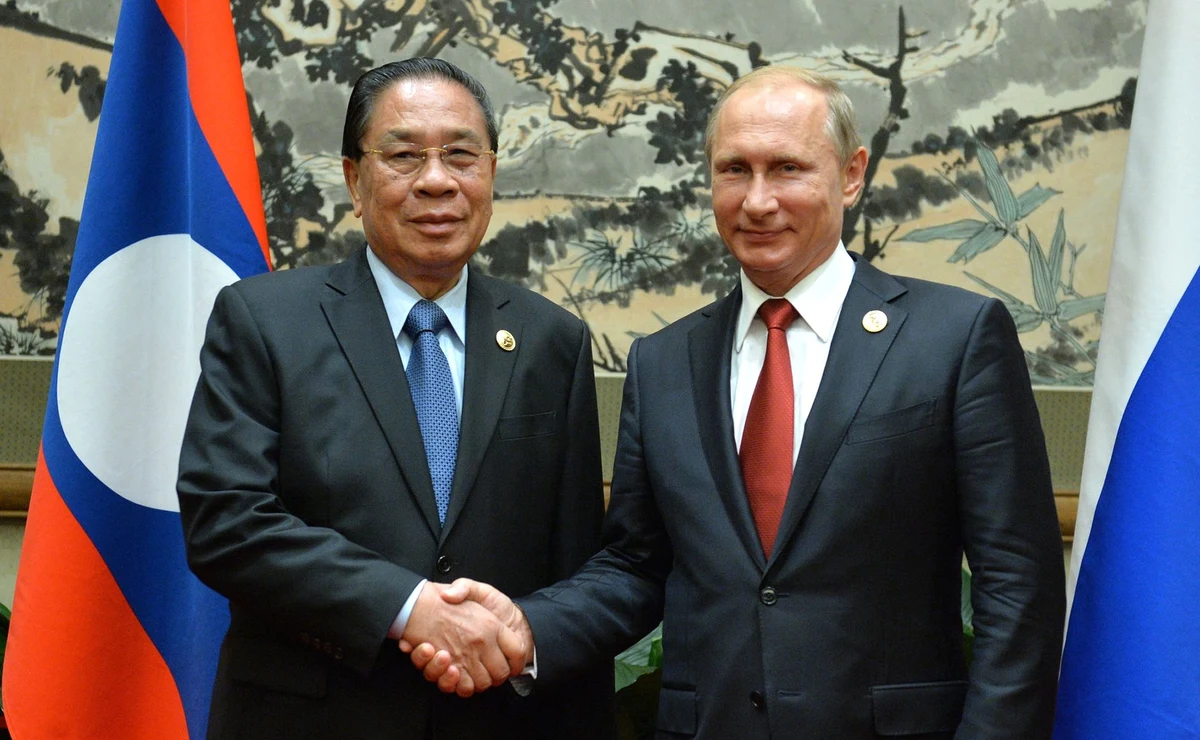
- 8. Wikimedia Commons · Russian Presidential Press and Information OfficeChoummaly Sayasone Vladimir Putin.jpg — complete 2015 photograph and explicit CC BY 4.0 grant
Read exact original Commons wikitext and all available imageinfo/EXIF/expanded rights metadata. It names Russian Presidential Press and Information Office, links a specific static.kremlin.ru original, dates the Beijing meeting 2 September 2015 and explicitly applies CC BY 4.0. Full supplied frame is 1880×1160; EXIF has only the MediaWiki EXIF version and no contrary copyright or individual photographer credit. No separate individual photographer is invented. Editorial review visually checked the complete supplied source and retained its whole frame in the WebP; the captioned subject and source documentation agree.
- 9. Wikimedia CommonsKremlin.ru permission documentation and confirmed VRT ticket
Read the actual complete template documentation and English display template through Commons API. It records confirmed VRT ticket 2008100310034004, explicitly explains the post-8-April-2015 CC BY 4.0 treatment and links the signed agency permission. Private VRT correspondence was not accessed. Live en.kremlin.ru copyright-page attempts timed out or failed SSL, so no successful live terms-page reading is claimed.
- 10. Russian Presidential Press and Information Office · 3 October 2008Signed permission letter — published transcription
Read the complete published transcription of the 3 October 2008 letter signed by press secretary Natalya Timakova, authorising reuse of website materials with Kremlin attribution and explicitly accepting CC BY 3.0. This is the published authorization/transcription, not a newly inspected original PDF scan, and does not independently establish the later version-4 wording; the exact photograph’s explicit grant and Commons source documentation supply that later licence record.