In this biography
Quick facts
- Born
- 1955
- Birthplace
- London, England, United Kingdom
- Country
- United Kingdom
- Nationality
- Not independently established
- Known for
- World Wide Web
- Proposal collaborator
- Robert Cailliau
- Later collaborator
- Nigel Shadbolt
Why this life matters
His proposal made flexible links between heterogeneous information a central design requirement.
Timeline
Key moments
Enquire
A CERN consultancy and private hypertext system.
Standards
Founded W3C at MIT.
Open data
Co-founded the Open Data Institute.
From physics to systems work
Born in London in 1955, Berners-Lee graduated in physics from Oxford in 1976.
His early work at Plessey and D. G. Nash involved communications, transaction systems, printing software and operating systems.
That engineering background precedes the Web. Connecting information depended on systems that could operate across machines and existing working practices.
CERN and the proposal
A 1980 CERN consultancy produced Enquire; he returned to CERN in 1984 to work on distributed real-time systems.
His 1989 proposal was followed by a formal management proposal with Robert Cailliau in November 1990.
The retained proposal describes nodes with different link types and explains why a strict tree cannot represent every useful relationship.
The linked study tests that specific design distinction. It does not credit him with inventing the Internet or every earlier form of hypertext.
Data, institutions and later writing
He founded the Web Foundation in 2009 and the Open Data Institute with Nigel Shadbolt in 2012. His later research included the Solid project; in 2016 he joined Oxford’s Computer Science Department.
He published This is for Everyone in 2025.
These completed events extend the biography beyond the first browser. They trace continuing questions about standards, access and control over information, without treating a present-tense title on an older page as a verified current appointment.
Sources for this section: [2]
Quick answers
Frequently asked questions about Tim Berners-Lee
- Is the original graph exercise a reconstruction of the first Web implementation?
- No. Its nodes and relationships are invented to test one design distinction in a historical proposal.
Keep exploring
Lives connected to this story
- Douglas Engelbart
Compare the earlier NLS demonstration and its collaborative interface work.
- Radia Perlman
Read a different technical problem involving networks and connections.
Sources and further reading
Explore the evidence
These references support the biography and offer further reading. Official records, first-person accounts and independent reporting provide different perspectives; image records document attribution and licensing.
- 1. Computer History MuseumTim Berners-Lee: 2003 Fellow
- 2. W3C/Tim Berners-Lee, retained 31 October 2026Tim Berners-Lee: short and longer biography
Dated career events are used. No current office is inferred from the profile’s present-tense fields, and the books or linked talks were not consumed.
- 3. CERNA short history of the Web
- 4. Tim Berners-Lee, CERN; header March 1989, May 1990Information Management: A Proposal, HTMLized version
The retained HTMLized text is headed March 1989, May 1990. It is not an untouched original-page scan.
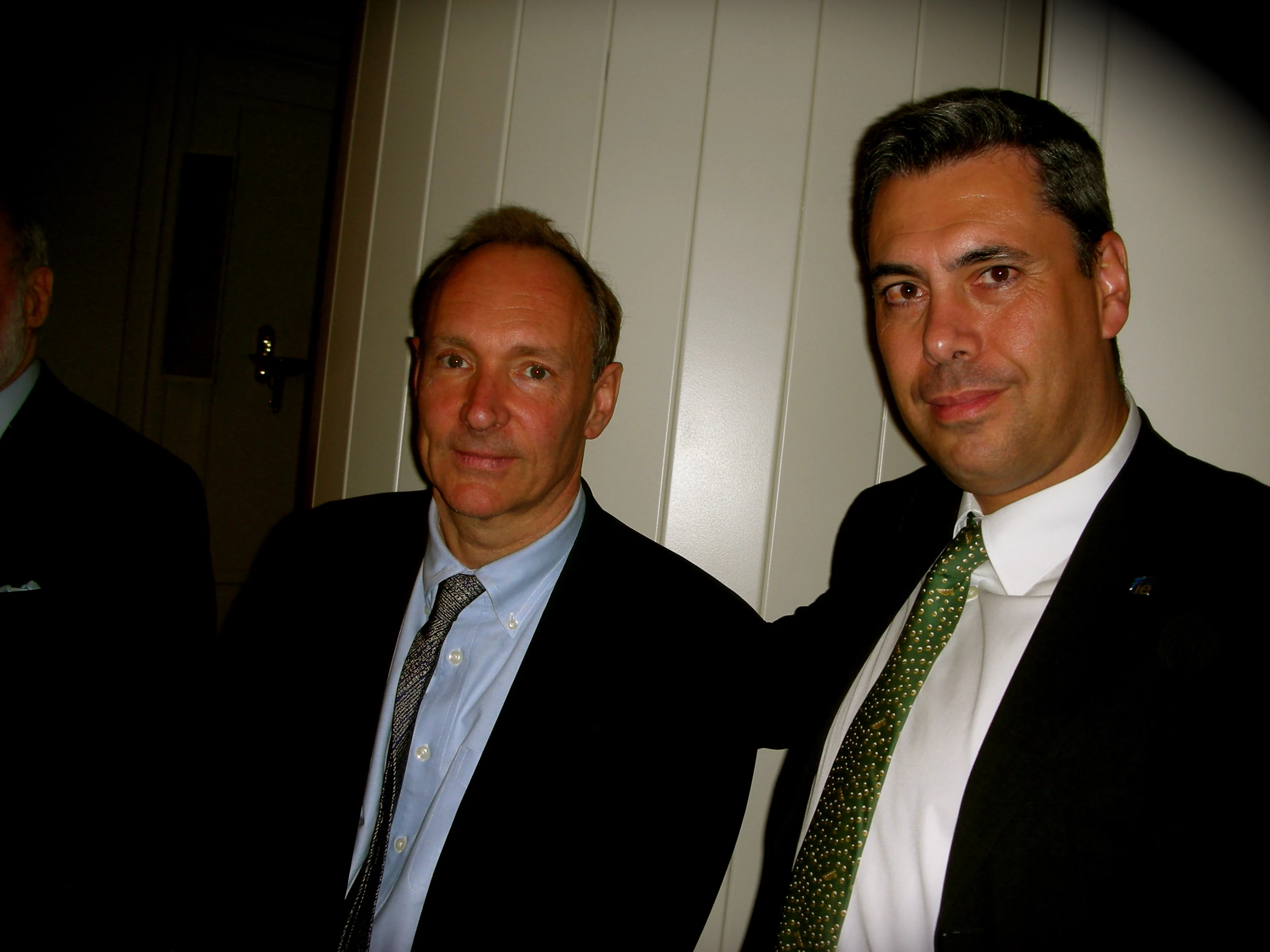
- 5. Enrique Dans, 20 April 2009, CC BY 2.0Con Tim Berners-Lee: full original event photograph