
The short answer
A link can say more than “go here”. If the relationship matters, the labels on the connections can change which question a graph answers.
Selected record and original reasoning
Do not erase the question
Keep the stated conditions attached to each calculation.
| Check | Observation or input | What follows |
|---|---|---|
| Typed query | P and Q depend directly on S | D refers; A made. Their arrows have other meanings. |
| Untyped arrows | Four nodes point to S | Direction alone does not identify the relation. |
| One proposed tree | S appears only under P | An extra reference/identity convention is needed for Q. |
Chronology
A timeline of the turning points
Earlier programme
Enquire at CERN.
Retained text
Proposal version carries both dates.
Standards context
W3C founded at MIT.
The proposal makes relationships explicit
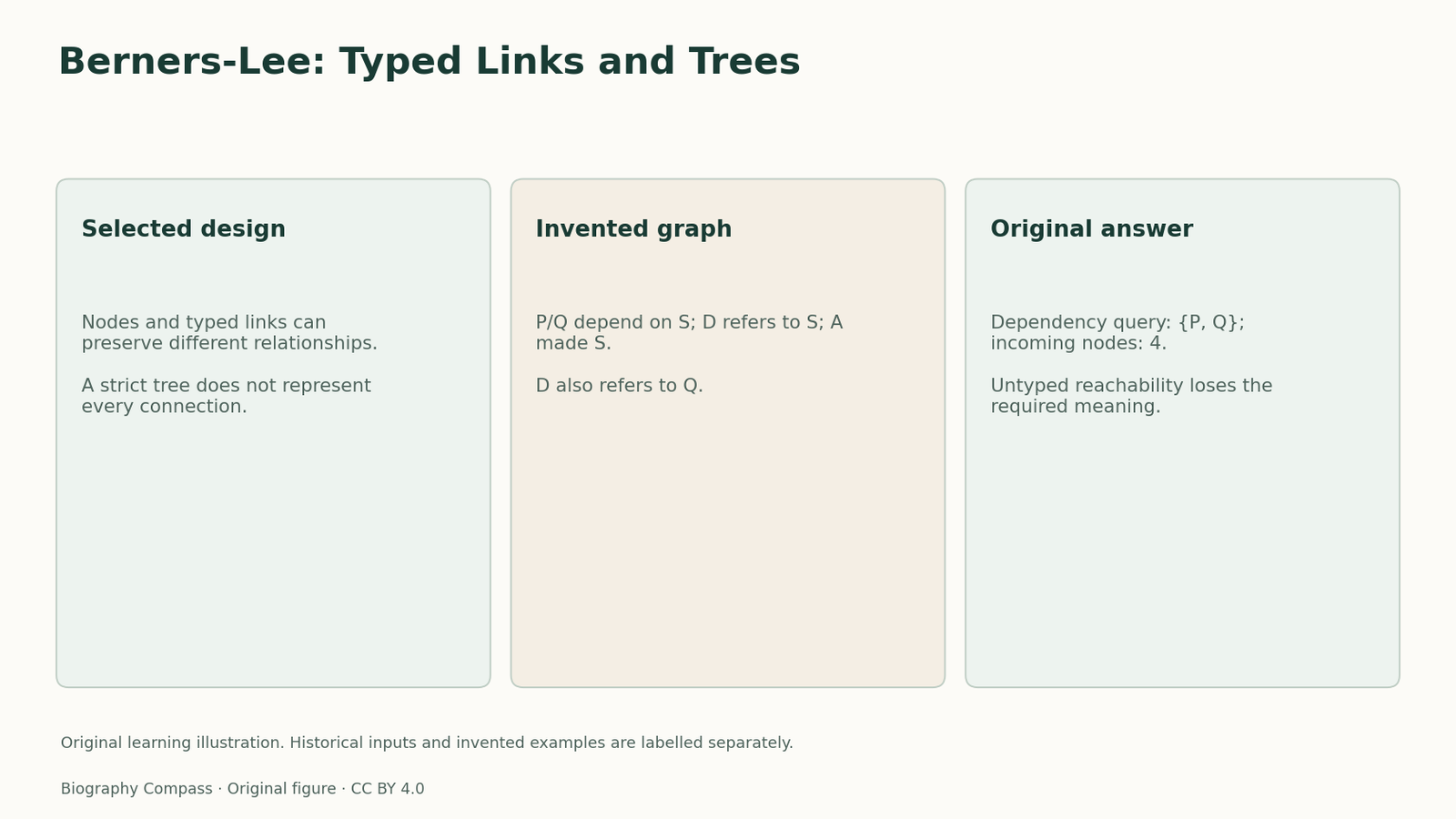
The retained text describes nodes for people, software, projects and documents, with arrows such as depends on, made and refers to. It argues that a strict tree fails when information belongs in several relationships.
A single-parent hierarchy offers an orderly path, but the ease of naming a node is not the same as representing every meaningful connection. This is a design question about the information being preserved.
Sources for this section: [1]
Original graph; state the link meanings
Invent nodes P and Q (projects), S (software), D (document) and A (person). Add five directed edges: P→S depends on; Q→S depends on; D→S refers to; A→S made; D→Q refers to. Define the query as “Which project nodes have a direct depends-on edge to S?”
Answer the query, then erase the edge labels while retaining every arrow. Can the same answer be recovered from arrow direction alone? Finally try placing one single S node under P in a strict single-parent tree with Q in another branch. What extra convention would be needed to preserve both projects’ dependency?
Sources for this section: [1]
Reference answer: reachability is not meaning
The typed query returns P and Q. Four nodes point directly to S, but D and A do not meet the requested relation and type. After labels are erased, all four incoming arrows look alike; the intended dependency answer is not determined by direction alone.
With a single S under P, the proposed tree lacks Q’s direct relationship unless it adds a cross-reference, duplicates the representation or introduces another convention. A duplicate also needs a rule saying whether both copies refer to the same software object. There is no claim that trees are always useless; the question is which information this particular layout omits.
The graph is an original fixture, not a transcription of the proposal’s diagram or the first Web’s implementation. Neither does one typed edge automatically define how every longer path should compose: that would require additional semantics.
Sources for this section: [1]
A proposal and an implementation remain different
The text also calls for linking existing information systems without requiring central coordination.
This enlarges the question beyond drawing a tidy network. A design must say what a node denotes, what a relationship means and how different systems can refer to the same thing. The exercise isolates those choices; it does not claim that its five-edge graph supplies an implementation or proves the later Web’s success.
Sources for this section: [1]
Continue the chronology
Related history guides
Rao and Aryabhata: Recording to Playback
Follow a separate engineering question about stored and transmitted data.
Read the timeline2000Xanadu: Links, Transclusion and Document Versions
Compare an original quotation-and-version example to distinguish a link from transclusion, preserving content identity without pretending reuse grants permission.
Read the timelineBiography context
Explore CERN, Geneva through connected lives
Connected biographies
The research career behind the record
Quick answers
Common questions
- Does every reachable node satisfy a dependency query?
- No. The fixture defines a particular relation, type and direct-edge requirement.
- Was a historical diagram or implementation copied?
- No. The five-node example and its reference answer are original teaching material.
Primary and institutional sources
How this history was checked
Selected records and their reading limits are identified below. The numerical fixtures and reference answers are original. This article was reviewed on 31 October 2026.