In this biography
Quick facts
- Born
- 1925
- Died
- 2 July 2013
- Birthplace
- Portland, Oregon, United States
- Country
- United States
- Nationality
- Not independently established
- Known for
- Collaborative computing researcher.
- Graduate education
- MS and PhD, Berkeley electrical engineering
Why this life matters
The contribution spans a device, the organisation of information and the working habits of a research group; none alone explains the programme.
Timeline
Key moments
Public demonstration
Presented NLS in San Francisco.
Recognition
Received the Lemelson-MIT Prize.
A programme for intellectual work
Engelbart recalled being born in Portland in 1925 in his Stanford oral history. Graduate study in electrical engineering at Berkeley led to an MS and PhD. His later research asked how interactive computing could improve the work of groups addressing complicated problems.
In his oral history, Engelbart recalled entering naval radar training after becoming intrigued by the technology during high school. Servicing and troubleshooting equipment challenged him to understand how it worked, rather than merely memorise procedures.
The research group as a working experiment
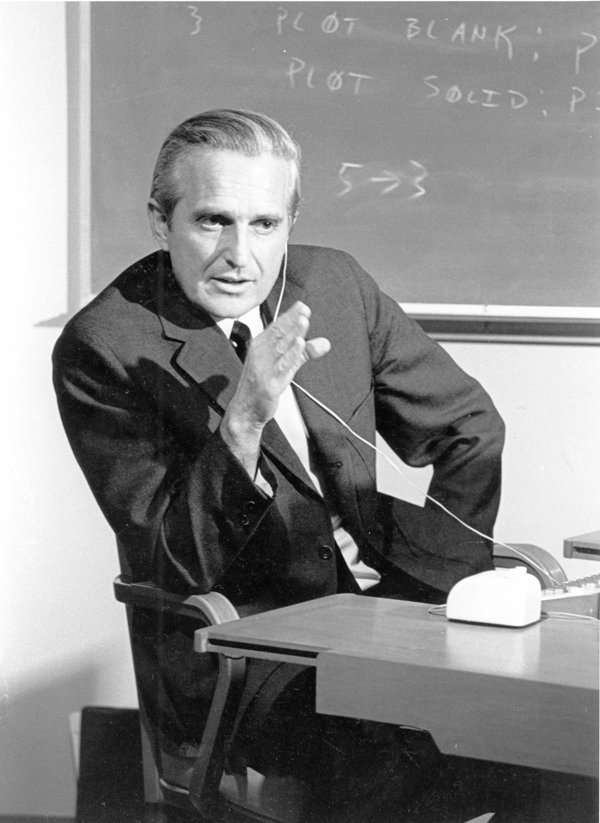
At Stanford Research Institute, Engelbart directed the Augmentation Research Center. The NLS programme joined interface devices with ways of structuring, navigating and revising shared information. Its research group used the system while developing it, so tools and working procedures were deliberately studied together.
The 1968 paper was coauthored with William English. Its authors described their own group as the experimental subject and identified the special needs of a system-development team. That admission is a useful limit: their account was not a controlled demonstration that every organisation would gain the same benefits.
A demonstration made by a team
On 9 December 1968, Engelbart presented NLS at the Fall Joint Computer Conference in San Francisco. The institute’s history credits Bill English with leading the production effort linking the auditorium presentation to the SRI team. The familiar mouse was part of a larger arrangement for manipulating and discussing information.
Sources for this section: [4]
An institutional career after NLS
After ARC, Engelbart worked at Tymshare and McDonnell Douglas. He later founded the Bootstrap Institute with his daughter Christina; it became the Doug Engelbart Institute. The later institutional work continued his concern with organisations’ capacity to improve how they learn and collaborate.
He received the 1997 Lemelson-MIT Prize, and died on 2 July 2013. His contribution is best understood across interfaces, information structures and organisational practice, with English and the wider team retained in the account.
Quick answers
Frequently asked questions about Douglas Engelbart
- Does a screen view contain the whole document?
- No such assumption is made in the guide. Its invented outline deliberately separates stored structure from the subset displayed.
Keep exploring
Lives connected to this story
- Alan Turing
Compare the abstraction of a machine with the experience of using one.
- Radia Perlman
Read another approach to making complex systems usable.
- Tim Berners-Lee
Continue with a later hypertext career and a distinct typed-link question.
- Robert Taylor
Show a NASA/ARPA research sponsor’s complementary career.
Sources and further reading
Explore the evidence
These references support the biography and offer further reading. Official records, first-person accounts and independent reporting provide different perspectives; image records document attribution and licensing.
- 1. Stanford University LibrariesDouglas Engelbart: Interview 1, 19 December 1986
- 2. Lemelson-MITDouglas Engelbart: 1997 Lemelson-MIT Prize
- 3. Doug Engelbart InstituteAbout Doug Engelbart
- 4. Doug Engelbart Institute1968 Demo
- 5. Douglas C. Engelbart and William K. English; AFIPS 33, 1968, 395–410A Research Center for Augmenting Human Intellect
Selected pages 395–399 were read. No demonstration video was watched.