In this biography
Quick facts
- Born
- Not established in reviewed sources
- Birthplace
- Johannesburg, South Africa
- Country
- South Africa
- Nationality
- Not independently established
- Known for
- Pick n Pay chairmanship, family-business governance and consumer-goods industry representation
- Operating career
- Pick n Pay executive until 1999; board appointment in 1990
- Holdings chair
- Pick n Pay Holdings, 2002–2010
- Stores chair
- Pick n Pay Stores, 2010–5 August 2025
- Reviewed role
- Pick n Pay non-executive director, October 2026
Why this life matters
His career helps distinguish family influence, board oversight, executive management and a listed company’s obligations to other shareholders.
Timeline
Key moments
Board and operating responsibilities
An executive board appointment is followed by a joint managing-director role.
A non-executive transition
Moves from executive work to a different form of board responsibility.
Holding-company chairmanship
Chairs the then ultimate holding company before succeeding to the Stores chair.
Pick n Pay Stores chairman
A long tenure spans growth ambitions, declining competitiveness and governance scrutiny.
Recapitalisation and control concessions
The family agrees to relinquish majority voting control as the group raises capital.
Chair succession, continuing directorship
James Formby becomes chairman; Gareth remains a non-executive director.
Early retail work came with the advantages of a family enterprise
Gareth Ackerman was born in Johannesburg and grew up in Cape Town, according to a contemporary 1993 profile. His later interview described Friday-afternoon work in his father’s stores before university. Shelf packing, buying and store management formed part of that training, alongside the access and expectations attached to being Raymond Ackerman’s son.
He did not found the modern Pick n Pay business. His career developed inside an organisation already built by an earlier generation and its employees. The reviewed records establish education and a sequence of responsibilities, but not a sufficiently corroborated exact birthday. Approximate corporate ages are therefore not converted into invented precision.
Executive work and two chairmanships were different jobs
Ackerman served as an executive for fifteen years until 1999, heading divisions and taking joint managing-director responsibilities. He joined the Stores board in 1990 and became a non-executive director in 1999. The change matters: operating a retail division and overseeing management as a director involve different authority and accountability.
From 2002 to 2010, he chaired Pick n Pay Holdings, then the group’s ultimate holding company. In 2010 he became non-executive chairman of Pick n Pay Stores. These were separate legal entities and successive appointments, not one continuous chief-executive position. Nor did a family’s influence make every group asset the chairman’s personal property.
Industry representation extended beyond the family company
Ackerman also worked through consumer-goods industry organisations. The council’s 2026 event biography identifies him as co-chair of the Consumer Goods Council of South Africa and GS1 South Africa, and as a former co-chair of the international Consumer Goods Forum. These roles connected retail leadership with broader industry coordination.
Such associations represent business participants; they are not substitutes for elected government, competition authorities or independent consumer organisations. Company accounts emphasise sustainability and climate initiatives, but programme commitments should not be presented as independently proven environmental outcomes. Industry advocacy and public-interest regulation can overlap in subject matter without becoming the same responsibility.
The 2024 crisis brought governance and control under scrutiny
By 2024, Pick n Pay faced financial and competitive difficulties requiring recapitalisation and a turnaround under chief executive Sean Summers. SABC’s reporting recorded criticism of repeated recovery promises and described proposed store closures or conversions. A long-serving chairman’s record therefore includes questions about oversight, not only the family’s earlier achievements.
The Ackerman family agreed to follow its rights in the capital raising while surrendering majority voting control and special nomination rights. Gareth announced an intended chair succession while continuing as a director. The rights offer and Boxer listing helped recapitalise the company; neither was a personal sale by him of the entire retail group.
Leaving the chair did not mean leaving every business responsibility
James Formby succeeded Ackerman as chairman on 5 August 2025. At the October 2026 review, the live board page still identified Ackerman as a non-executive director, with finance and remuneration committee responsibilities. Calling him the current chairman would erase a completed succession; calling him entirely retired would erase his continuing board role.
The company’s problems also continued beyond that handover. Its 2026 accounts described a further Boxer share sale and consultation over store labour arrangements. These are corporate processes with consequences for shareholders and employees, not automatic evidence of individual criminal liability. Family history, governance decisions and operational recovery require separate evaluation.
Quick answers
Frequently asked questions about Gareth Ackerman
- Did Gareth Ackerman establish Pick n Pay?
- No. He developed his career within the family’s existing retail business.
- Was he continuously the group’s chief executive?
- No. Executive work, the Holdings chairmanship and the Stores non-executive chairmanship were distinct roles.
- Is he still Pick n Pay’s chairman?
- No. James Formby succeeded him in August 2025; the reviewed 2026 record identifies Gareth as a non-executive director.
- Did the family retain majority voting control after the 2024 rights offer?
- No. The recapitalisation included a reduction below 50%; voting rights should not be confused with the company’s separate holding in Boxer.
Keep exploring
Lives connected to this story
- Raymond Ackerman
Separate the earlier generation’s establishment of Pick n Pay from Gareth’s later operating and board responsibilities.
- Michael Jordaan
Compare another business leader’s transitions between executive management, board oversight and investment.
Sources and further reading
Explore the evidence
These references support the biography and offer further reading. Official records, first-person accounts and independent reporting provide different perspectives; image records document attribution and licensing.
- 1. Contemporary profile / South African History Online archival collectionGareth Ackerman and René de Wet: Stepping into the limelight, selected 1993 archival article
Selected indexed contemporary article, not a reading of the entire large archival compilation. No unsupported middle-name expansion is adopted.
- 2. Sonya Culverwell / Moneyweb11 April 2018: Gareth Ackerman’s retail training and leadership journey
- 3. Pick n Pay2019 annual report: selected board biography and distinct holding-company and operating-company chairmanships
- 4. Pick n PayLive board record checked 24 October 2026: Gareth Ackerman, non-executive director
Live 2026 record checked against the dated succession footnote; old photograph and speaker captions are not current-role evidence.
- 5. Consumer Goods Council of South AfricaGS1 Indaba 2026: selected Gareth Ackerman speaker biography and industry roles
- 6. Pick n Pay2024 announcement: family rights participation, voting-control concessions and intended board succession
- 7. Liabo Setho / SABC News27 May 2024: turnaround, governance changes and independent analyst criticism
- 8. Pick n Pay2025 integrated report: selected recapitalisation chronology; indexed passage only
- 9. Pick n PayH1 FY2026 interim report, corporate information: chair succession effective 5 August 2025
- 10. Nqobile Dludla / Reuters25 November 2024: independent report on pricing and retained parent stake
- 11. Pick n PayFY2026 financial statements: selected notes 22, 36.1 and 36.4 on control, labour consultation and later share sale
Selected subsequent-event notes only. Labour consultation is not described as a completed agreement or a personal finding.
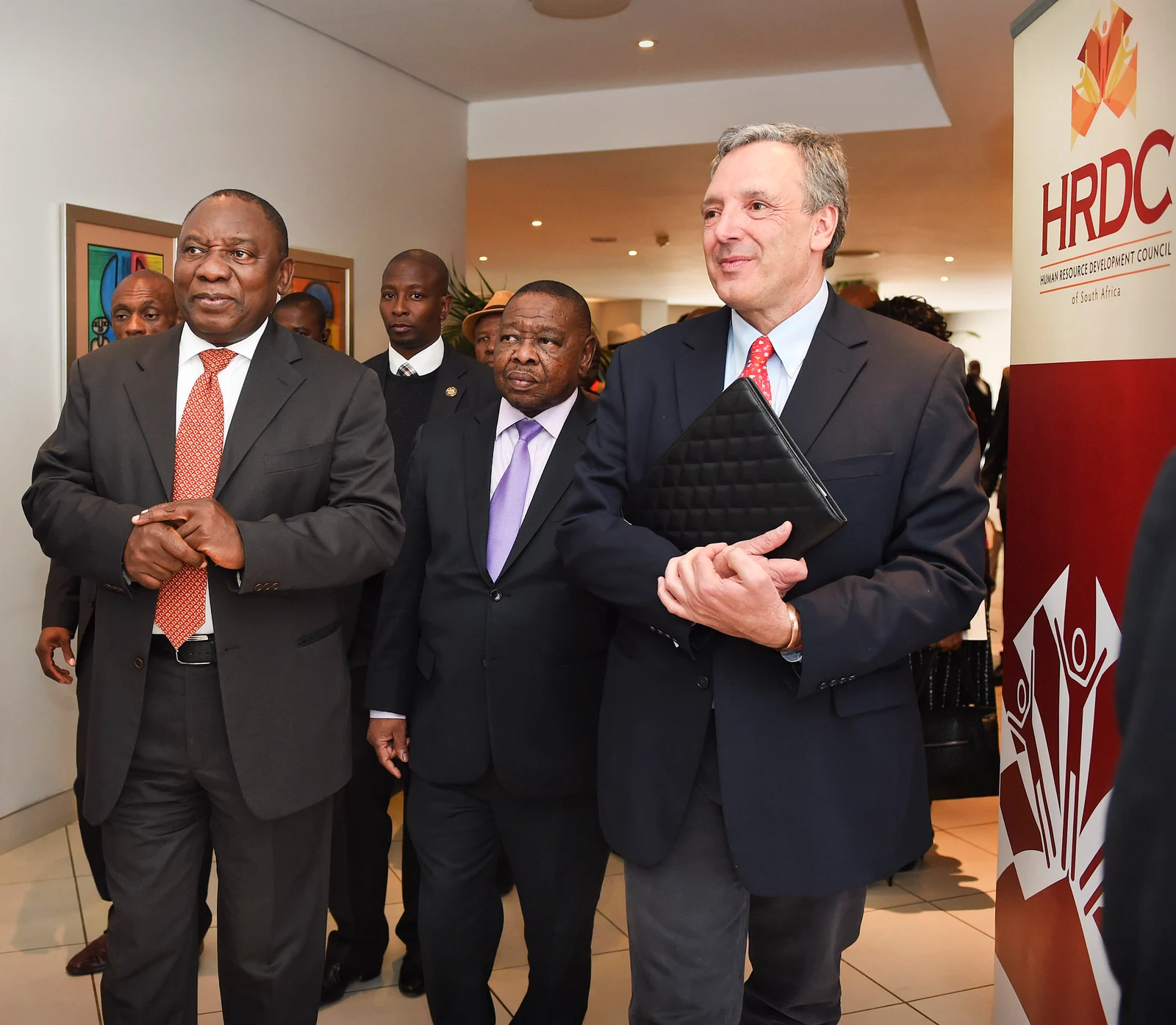
- 12. Siyasanga Mbambani / GCIS, GovernmentZAHuman Resource Development Council meeting, 7 August 2015
Exact photographic grant retained. Small, partly obscured wall paintings are incidental meeting background; no independent licence or public-domain claim is made for those works.
- 13. Creative CommonsAttribution-NoDerivs 2.0: section 3 permits necessary technical media and format conversion
- 14. Creative CommonsAttribution-NoDerivs 2.0 legal code, section 3: necessary technical modifications only