In this biography
Quick facts
- Born
- 16 November 1952
- Birthplace
- Sonobe, Kyoto Prefecture, Japan; now part of Nantan
- Country
- Japan
- Nationality
- Japanese
- Known for
- Donkey Kong, Super Mario, The Legend of Zelda and Nintendo design leadership
- Education
- Kanazawa College of Art, graduated 1977; industrial design
- Nintendo
- Joined April 1977
- Early design breakthrough
- Donkey Kong, arcade, 1981
- Current role, checked 27 October 2026
- Executive Fellow and Representative Director, Member of the Board, Nintendo
Why this life matters
Miyamoto helped establish ways of building readable, expressive games under hardware constraints, then carried creative and production responsibilities across teams and media.
Timeline
Key moments
Born in Sonobe
Born on 16 November in Kyoto Prefecture.
Design graduation and Nintendo
Graduated from Kanazawa College of Art and joined Nintendo in April.
Donkey Kong
The arcade game introduced the character later known as Mario.
Famicom launch period
Worked on the software line-up while a different team converted Donkey Kong.
Hall of Fame recognition
Received the inaugural Academy of Interactive Arts and Sciences Hall of Fame award.
Design account recorded
Discussed the early Mario games with Satoru Iwata.
Creative responsibilities discussed
Explained the difference between original arcade work and later conversions.
Current corporate role verified
Nintendo lists him as Executive Fellow and Representative Director, Member of the Board.
Industrial design supplied a way of asking questions
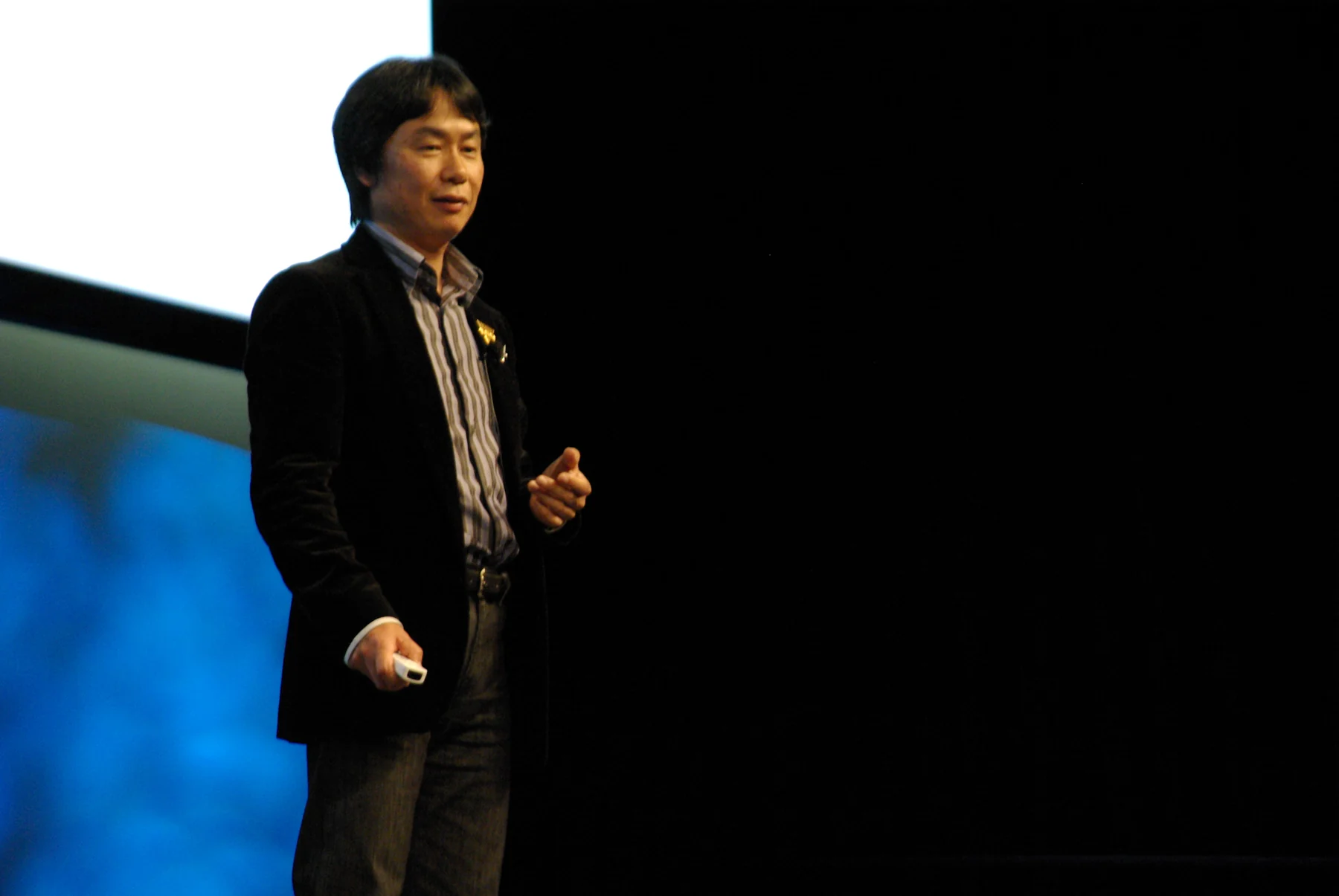
Shigeru Miyamoto was born on 16 November 1952 in Sonobe, Kyoto Prefecture. He graduated from Kanazawa College of Art in 1977 and joined Nintendo that April. The Agency for Cultural Affairs’ career profile and Nintendo’s director record establish this route into the company. His field was industrial design. In a later conversation with Satoru Iwata, Miyamoto explained that he examined successful arcade games by asking why people wanted another attempt after losing. The important object of design was therefore not only a character’s appearance, but the relationship between an understandable action and a player’s decision.
Donkey Kong grew through colleagues and constraints
Before taking responsibility for a game, Miyamoto had worked on graphics, packaging and cabinets. In Nintendo’s retrospective interview he described Gunpei Yokoi explaining aspects of game design and presenting his proposals to president Hiroshi Yamauchi. A project first explored through Popeye characters developed into Donkey Kong, released for arcades in 1981. Its original programming was undertaken at Ikegami Tsushinki. Programmer Hirohisa Komanome’s later account names himself, Minoru Iinuma, Mitsuhiro Nishida and Yasuhiro Murata. Miyamoto’s planning contribution remains central, but calling him its only maker would erase the engineering that made the proposed game work.
A character had to be legible in a small space
In the second part of the Iwata interview, Miyamoto explained choices behind Mario’s early appearance. A small pixel grid constrained the face; the hat and moustache made features readable with limited detail. Contrasting clothing helped distinguish an arm from the torso during movement. Overalls also fitted the construction-site setting. This is a useful example of visual decisions serving animation and player recognition together. The account is retrospective, but its explanation connects a familiar character to concrete production restrictions. The recognisable silhouette did not begin as an unlimited drawing later reduced without consequence to a machine.
Sources for this section: [5]
A recurring character could outlive one game
Miyamoto also recalled wanting the character to appear across his games. He associated this idea with Hitchcock’s appearances and with recurring characters in the manga of Osamu Tezuka and Fujio Akatsuka. This is a statement about influences he remembered, rather than proof that every later Mario appearance followed a plan fixed in 1981. The Agency for Cultural Affairs records a subsequent career spanning Super Mario, The Legend of Zelda, Pikmin and other projects. His changing responsibilities included design, direction and production. A series bearing a consistent identity could still involve different directors, technical teams and generations of hardware.
Original development and a later conversion differ
Nintendo’s 2016 Donkey Kong interview provides an unusually useful boundary around Miyamoto’s credit. Asked whether he converted the arcade game for Famicom, he said that another team handled that work while he concentrated on the launch software line-up. The arcade version appeared in 1981 and the Japanese Famicom version in 1983. Distinguishing them avoids carrying an original creator credit automatically into every implementation. The same interview discusses the 2016 miniature console, whose development began at Nintendo European Research and Development in France; Miyamoto described checking its progress rather than personally building its system.
Sources for this section: [6]
Recognition and a continuing corporate position
Miyamoto’s influence has been recognised beyond Nintendo. The Agency for Cultural Affairs records the inaugural Academy of Interactive Arts and Sciences Hall of Fame award in 1998 and French recognition in 2006, alongside Japanese awards. As checked on 27 October 2026, Nintendo lists him as Executive Fellow and Representative Director, Member of the Board. That current title should be kept separate from older profiles describing former management positions. His career is best understood through both its widely known characters and the evolving work of setting creative direction, judging prototypes and supporting teams that turn concepts into finished entertainment.
Quick answers
Frequently asked questions about Shigeru Miyamoto
- Was Miyamoto the only developer of Donkey Kong?
- No. His planning and design worked with Gunpei Yokoi, Nintendo colleagues and Ikegami Tsushinki programmers.
- What is Miyamoto’s current Nintendo title?
- Nintendo’s roster checked on 27 October 2026 lists Executive Fellow and Representative Director, Member of the Board.
Keep exploring
Lives connected to this story
- Osamu Tezuka
Explore the manga artist whose recurring-character practice he identified as an influence.
- Gunpei Yokoi
Read the colleague with whom he discussed Donkey Kong’s design and carried proposals to company management.
- Hiroshi Yamauchi
Explore the president’s role in financing development and shaping product decisions.
- Satoru Iwata
Read the programmer and later president with whom he discussed hardware, input and audiences.
Sources and further reading
Explore the evidence
These references support the biography and offer further reading. Official records, first-person accounts and independent reporting provide different perspectives; image records document attribution and licensing.
- 1. Nintendo2024 shareholders’ meeting notice: director birth date and career
- 2. Agency for Cultural Affairs, JapanShigeru Miyamoto: Media Arts Festival career profile
- 3. NintendoDirectors and Executive Officers, current roster
Live English roster checked on 27 October 2026. Current role is Executive Fellow and Representative Director, Member of the Board; old Agency for Cultural Affairs management title is not treated as current.
- 4. NintendoIwata Asks, New Super Mario Bros. Wii, part 1: early Mario
Actual Japanese Nintendo interview read; no unsupported claim that Miyamoto was the sole programmer or that the 1981 arcade and 1983 Famicom editions were the same implementation.
- 5. NintendoIwata Asks, part 2: Mario’s visual design
- 6. NintendoDonkey Kong developer interview, 4 November 2016
- 7. Hirohisa Komanome / ShmuplationsDonkey Kong: A Record of Struggle (1997), credited English translation
Read first-person 1997 account in the credited 2023 English translation, including named programmers, constraints and development process. No ROM inspection or verification of every machine-level assertion claimed.