
The short answer
A memorable design and a working arcade machine require connected contributions. First-person accounts let us ask which decisions belonged to planning, software, hardware and a later conversion.
Original comparison of first-person evidence
A proposal becomes several kinds of work
Keep the contribution, speaker and version together.
| Country | Contribution or question | Evidence and limit |
|---|---|---|
| Miyamoto and Yokoi | Planning, design discussion and company approval. | Nintendo’s retrospective interview establishes a working relationship, without an exhaustive attribution for every idea. |
| Ikegami programmers | Implementation and engineering changes. | Komanome names the four programmers and gives examples; his account remains retrospective testimony. |
| Development duration | About three months versus four or five months. | The speakers may be measuring different stages. Exact reconciliation is not established. |
| Famicom conversion | A different team and different hardware. | Miyamoto distinguishes his original work from the conversion; Uemura supplies the hardware viewpoint. |
| Toy movement exercise | Choose state, update order and parameters. | The result explains an engineering obligation; it is not a historical measurement or game simulation. |
Chronology
A timeline of the turning points
Arcade development
Nintendo planning and engineering worked with Ikegami Tsushinki programmers.
Famicom version
A separate team converted the arcade game for the Japanese console launch.
Programmer’s account
Hirohisa Komanome described the project in bit magazine, drawing on retained documents and memory.
Nintendo interviews
Miyamoto and other participants discussed decisions and responsibilities retrospectively.
Versions distinguished
Nintendo’s Arcade Archives announcement identified arcade variants and a stage absent from the Famicom release.
Begin with the 1981 arcade project
Nintendo’s official records distinguish the 1981 arcade game from the 1983 Famicom version. Miyamoto’s Iwata interview describes earlier graphics and cabinet work, then an opportunity to design a game. Gunpei Yokoi discussed game structure with him and carried proposals to president Hiroshi Yamauchi. The project first explored Popeye characters before taking its eventual form. That account establishes a planning relationship rather than a one-person production. It also explains why assigning every design decision to the most recognisable name loses information about how a company decides to develop a proposal.
Read the programmers as participants
In his 1997 first-person account, available in a credited English translation, Hirohisa Komanome names four Ikegami Tsushinki programmers: Minoru Iinuma, Mitsuhiro Nishida, Yasuhiro Murata and himself. He describes reviewing Miyamoto’s proposal, identifying problems and turning it into a working game. He specifically credits Nishida with jump calculations and parameter adjustment, and Murata with optimising collision checks. These are engineering contributions to the player’s experience. His retrospective account uses retained documents as well as memory; it is evidence from a participant, not an independently reconstructed staff roll.
Sources for this section: [3]
Design changed when it met the machine
Miyamoto recalls asking for scrolling and being told that the available board could not provide it. Separate screens became a response to that constraint. The cabinet already supplied a joystick and a button; the team’s discussion of jumping connected an available input to movement and obstacles. This is a history of negotiation among a proposed experience, controls and implementation. A design drawing can state what should happen without specifying every calculation that will make it happen repeatedly on the hardware. Conversely, a technically possible action still needs a clear purpose in the game.
Sources for this section: [1]
Compare different clocks without pretending to settle them
Komanome dates the programmers’ abrupt project assignment to 6 April 1981 and describes roughly three months of development. In the 2016 interview Miyamoto recalls the game taking four or five months. These durations may measure different scopes, including proposal work before the programming assignment; the accounts alone do not prove that reconciliation. A careful comparison records the speaker, remembered starting point and uncertainty. Selecting the shortest figure as a definitive creation time would discard the difference between planning and implementation, while silently adding the periods would invent a schedule neither source supplies.
An original engineering exercise
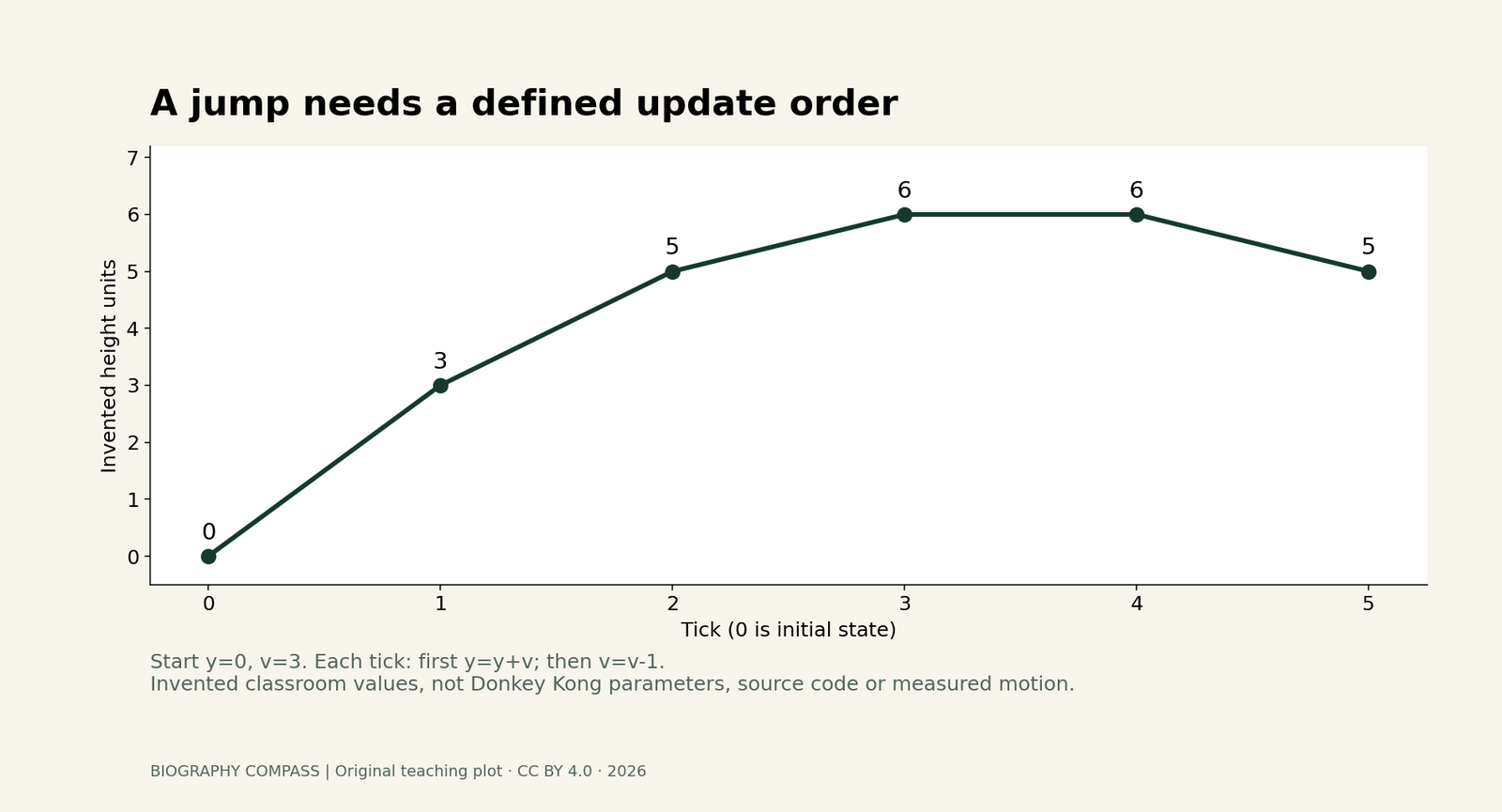
To see why movement needs more than a sketch, use this newly invented discrete model. Start at height y = 0 with upward step v = 3. On each tick, first add v to y, then subtract 1 from v. After the first tick the state is y = 3, v = 2; after the second it is y = 5, v = 1. Exercise: calculate the next three heights and say whether the object immediately falls after its upward step reaches zero. These are teaching values, not Donkey Kong’s parameters, measured movement, source code or a claim about its collision behaviour.
Sources for this section: [3]
Answer: order and state make a visible difference
The next three heights are 6, 6 and 5. At the third tick the previous upward step of 1 raises y to 6, then v becomes 0. At the fourth tick adding zero leaves the height unchanged, after which v becomes −1. Only the next update lowers it. Reversing the order of the two instructions would produce a different sequence from the same starting numbers. A working implementation must choose such details, even when the original drawing merely says jump. This arithmetic example illustrates a general design-to-programming question; it does not emulate or validate the original machine.
Sources for this section: [3]
A conversion has its own engineering history
Miyamoto explicitly said another team handled the Famicom conversion while he worked on the launch line-up. In a separate Nintendo interview, hardware leader Masayuki Uemura recalled discussing a home system capable of reproducing Donkey Kong with Ricoh engineers. Nintendo’s 2018 announcement also distinguishes the arcade variants from Famicom, including a stage absent from the latter. Together these records show why a game title is insufficient to identify an implementation. They support a history with planners, software engineers, hardware engineers and conversion teams, each working on a specified version and problem.
Continue the chronology
Related history guides
Biography context
Explore Japan through connected lives
Connected biographies
Design and collaborative development
1952–
Shigeru Miyamoto
Game designer, producer and Nintendo Executive FellowShigeru Miyamoto brought industrial design to Nintendo’s game development. His work on Donkey Kong and later series joined character design and player experience with the contributions of programmers, engineers and other designers.Read biography1941–1997
Gunpei Yokoi
Toy and game-system developer; Nintendo development manager and Koto founderGunpei Yokoi moved from Nintendo’s machinery maintenance into toys, electronic games and handheld systems. His work connected economical components with distinctive forms of play, through teams that included engineer Satoru Okada.Read biography1927–2013
Hiroshi Yamauchi
Nintendo president, 1949–2002, and later adviserHiroshi Yamauchi led Nintendo through its expansion from playing cards into toys, arcade games, home consoles and handheld systems. He combined decisions about products and staff with a lasting emphasis on distinctive software.Read biographyQuick answers
Common questions
- Did Miyamoto program Donkey Kong by himself?
- No. Komanome’s first-person account identifies a four-person Ikegami Tsushinki programming team working from Nintendo’s proposals.
- Is the motion exercise the original jump algorithm?
- No. It is a newly written model with invented values, used to show why implementation decisions matter.
- Can the two remembered development durations be reconciled exactly?
- Not from these accounts alone. Their starting points and scope should be recorded before claiming a single precise duration.
Primary and institutional sources
How this history was checked
Actual corporate interviews and a programmer’s first-person article support the history. The role comparison and arithmetic exercise are original. No complete ROM analysis, original machine test or full staff-roll inspection is claimed. This article was reviewed on 27 October 2026.
- NintendoIwata Asks: New Super Mario Bros. Wii, part 1
- NintendoDonkey Kong developer interview, 4 November 2016
- Hirohisa Komanome / ShmuplationsDonkey Kong: A Record of Struggle, 1997 article in credited English translation
- NintendoIwata Asks: Super Mario 25th Anniversary, Famicom and Mario, part 2
- NintendoArcade Archives Donkey Kong announcement, 15 June 2018