
In this biography
Quick facts
- Born
- 1921
- Died
- 30 November 2007
- Birthplace
- New York City, United States
- Country
- United States
- Nationality
- Not independently established
- Known for
- Fine-structure mapping of the bacteriophage rII region and genetic investigation of behaviour
Why this life matters
His work separated genetic position from biological function and helped establish behavioural traits as subjects of molecular genetic investigation.
Timeline
Key moments
Born in New York
Benzer grew up in Brooklyn.
rII fine-structure paper
Reported recombination and functional tests within a bacteriophage genetic region.
Caltech professorship
Joined the biology faculty after a period as a visiting associate.
Physics training and a change of subject
Seymour Benzer was born in New York in 1921 and grew up in Brooklyn. He studied physics at Brooklyn College, graduating in 1942, and completed a physics doctorate at Purdue University in 1947. His early research concerned semiconductor materials and wartime radar-related technology. Bacteriophage genetics then offered a different experimental challenge. Visits to Cold Spring Harbor, Caltech and the Pasteur Institute introduced him to the emerging molecular-genetics community while he remained connected to Purdue’s faculty.
A genetic region could be examined internally
Benzer’s 1955 paper investigated the rII region of bacteriophage T4. Differences in growth on bacterial hosts made it possible to detect rare wild-type recombinants from crosses between mutants. The experiments showed that mutations within a functionally related region could occupy distinguishable positions. They also used mixed infections to ask whether mutant genomes could supply complementary functions. Position and functional relationship were therefore experimentally separable questions rather than two names for one indivisible unit.
From phage to the genetics of behaviour
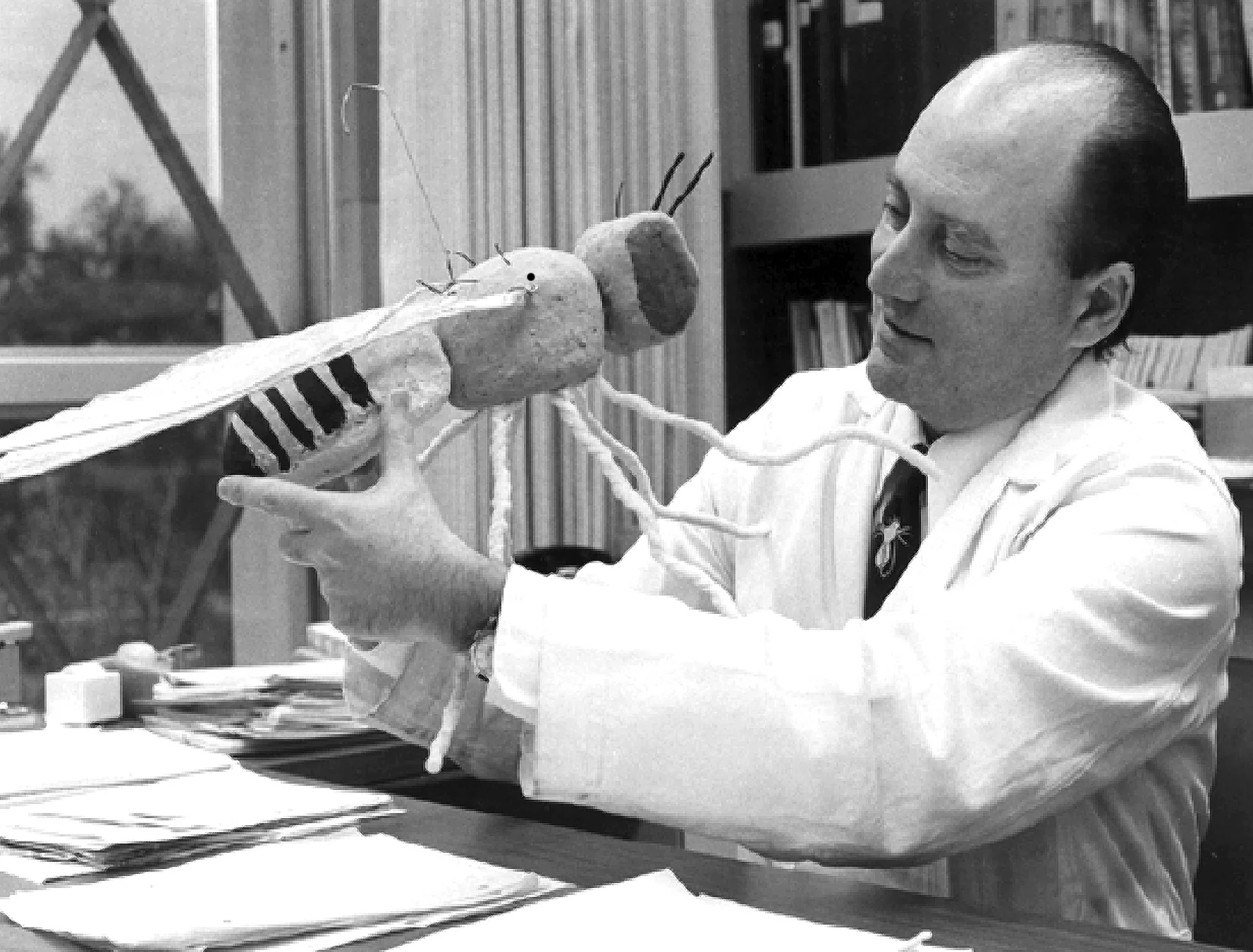
Benzer became a visiting associate at Caltech in 1965 and a biology professor in 1967. He turned to Drosophila as a model for investigating behaviour through mutations. His laboratory’s work included studies of circadian rhythms with Ronald Konopka and broader questions about learning, vision and nervous-system function. Researchers trained in this environment included Jeffrey Hall, whose later clock work continued the connection between genes and behaviour. The new programme extended experimental genetics into a subject that could otherwise appear too complex to approach molecularly.
Recognition across two research careers
Benzer received Gairdner recognition in 1964 for molecular-genetic work and again in 2004 for neurogenetics. He died in Pasadena on30 November 2007. The two awards help mark the breadth of his career without collapsing its phases into a single experiment. His lasting contribution included methods for asking sharper questions: where is a mutation, what function is disrupted, and how can an altered genotype be connected with behaviour? Those questions supported different research communities, from bacteriophage mapping to the molecular analysis of nervous systems.
Quick answers
Frequently asked questions about Seymour Benzer
- What did the rII experiments distinguish?
- They separated recombination-based genetic position from functional complementation between mutant genomes.
- When did Benzer join Caltech’s biology faculty?
- Caltech records a visiting period from 1965 and a professorial appointment in 1967; these are different stages.
Keep exploring
Lives connected to this story
- Sydney Brenner
Compare two experimental routes into molecular genetics and the use of tractable organisms to investigate biological mechanisms.
- Jeffrey Hall
Meet a researcher who trained with Benzer before developing a major circadian-genetics programme.
- Thomas Hunt Morgan
Explore Thomas Hunt Morgan’s related research on drosophila genetics.
- Alfred Hershey
Explore Alfred Hershey’s related research on bacteriophage.
Sources and further reading
Explore the evidence
These references support the biography and offer further reading. Official records, first-person accounts and independent reporting provide different perspectives; image records document attribution and licensing.
- 1. California Institute of TechnologyNeurogenetics Pioneer Seymour Benzer Dies
- 2. Caltech Archives Oral History ProjectInterview with Seymour Benzer
Caltech distinguishes a 1965–67 visiting association from the 1967 professorship, resolving the compressed 1965 move in the Gairdner summary.
- 3. Gairdner FoundationSeymour Benzer: Gairdner awards
- 4. Seymour Benzer / PNAS,1955Fine Structure of a Genetic Region in Bacteriophage
- 5. William A. Harris / PLOS BiologySeymour Benzer 1921–2007: The Man Who Took Us from Genes to Behaviour
The PLOS retrospective contains unrelated historical slips. The methods here are checked against the 1955 paper and Konopka’s name is corrected.