
The short answer
Why did recombination mapping and complementation answer different questions about the gene?
Read the evidence
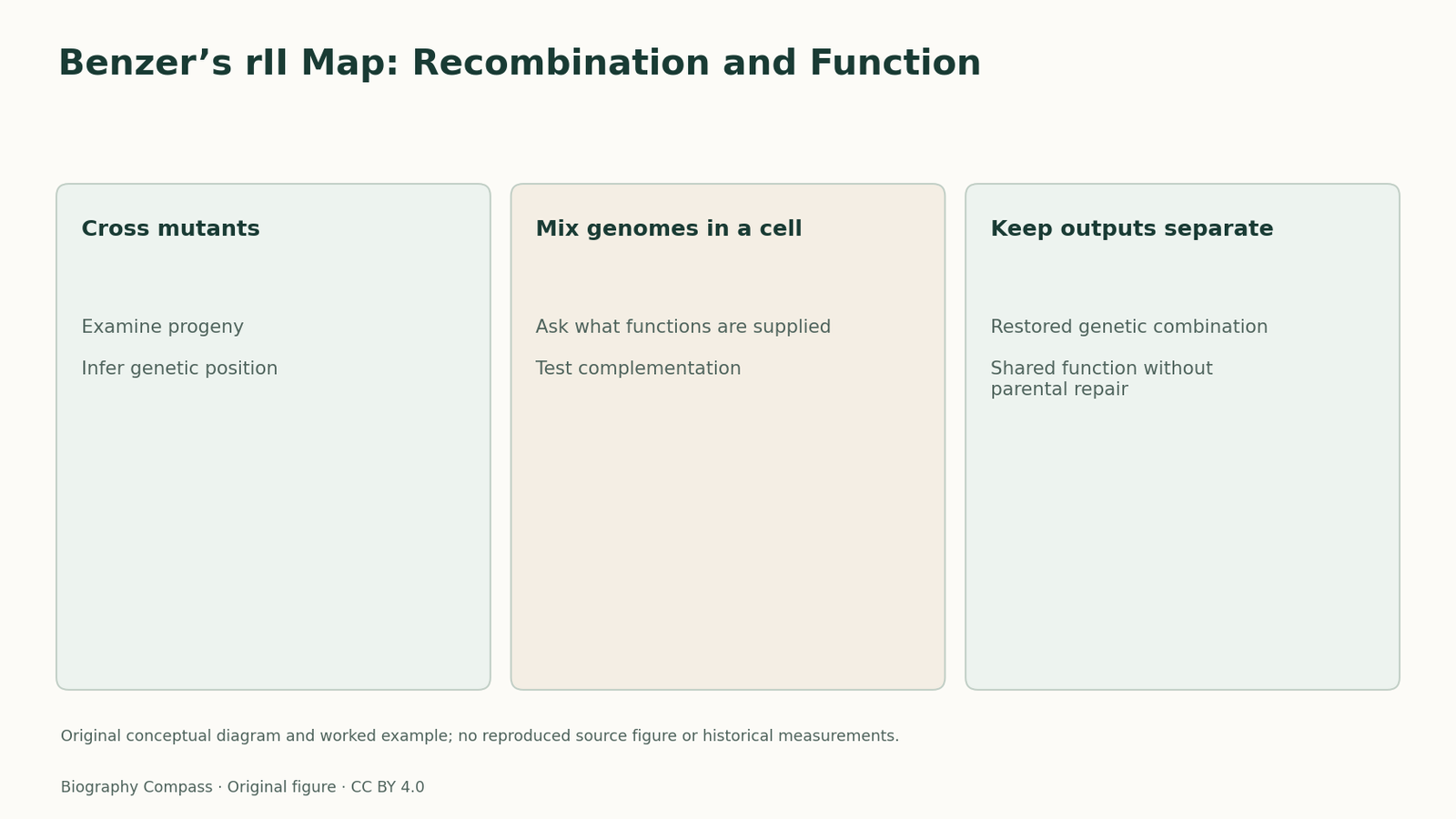
Two tests within one genetic region
The outcome must be interpreted in the experimental arrangement that produced it.
| Record or test | What it establishes | What remains different |
|---|---|---|
| Recombination cross | Can distinguish and order separable mutation sites. | Is not itself a test of two genomes sharing function. |
| Mixed-infection complementation | Tests whether genomes together provide required functions. | Does not prove that a parental genome was repaired. |
| No detected recombinant | Sets a limit under the sample and assay conditions. | Does not establish absolute genetic inseparability. |
A selective host made rare events visible
Benzer’s 1955 study exploited differences between bacterial hosts. Mutant phages could grow on a permissive host but failed to form plaques on a restrictive lysogenic host, where wild-type phage could grow. This created a way to detect rare wild-type progeny after crossing mutant phages. The important methodological move was selection: a rare relevant outcome became visible against a much larger background of progeny that could not produce the same plaque on the restrictive host.
Sources for this section: [4]
Recombination asks about genetic position
Crossing two mutants could yield wild-type recombinants if their alterations were genetically separable. Comparing such outcomes helped order mutations within the region. The paper explicitly notes that failing to find a recombinant in a finite sample does not prove two changes are inseparable; sensitivity matters. The retrospective PLOS account explains the significance of examining fine structure within what had appeared a single genetic unit. A genetic map describes relationships inferred from crosses, not a direct chemical sequence readout.
Complementation asks about function in a cell
The same paper used mixed infection to simulate two mutant genomes acting within one bacterial cell. Some pairs could supply complementary functions, whereas pairs affecting the same functional segment generally could not. This is a different question from whether recombination produced a genetically restored progeny. A cell can receive useful functions from two genomes without either parental genome becoming wild type. Keeping the questions separate explains why functional grouping and fine genetic position could be investigated within the same experimental system.
Sources for this section: [4]
An original two-test exercise
Imagine two fictional mutations that occupy distinct positions but disrupt the same required function. Could a cross produce a restored genetic combination while a mixed-infection functional test fails to complement? Yes: the first question concerns genetic exchange and the second concerns what the genomes provide within a cell. Now imagine two mutations in different functional units. They may complement during mixed infection without that observation proving either original genome has been repaired. These examples contain no historical recombination values or reconstructed rII map. The supported answer is to label the output of each test before comparing them: progeny genotype for mapping, shared cellular function for complementation. This prevents a plaque outcome from being described as evidence for whichever mechanism a reader happens to have in mind.
Continue the chronology
Related history guides
The Clock Loop: RNA Versus Protein Timing
Read the 1990 period RNA study alongside the later clock model, with a worked exercise separating daily correlation, feedback and direct molecular binding.
Read the timeline1992Clock Location: Which Cells Keep Time?
Explore the 1992 period-expression and mosaic study, distinguishing labelled brain cells, functional evidence and the limits of locating a fly’s clock.
Read the timeline1986Cell Death: Lineage Versus Mechanism
Compare the 1986 ced-3 and ced-4 findings with lineage observations and corpse removal, using a worked exercise on what an absent cell can mean.
Read the timelineBiography context
Explore United States through connected lives
Connected biographies
Researchers and related approaches
1921–2007
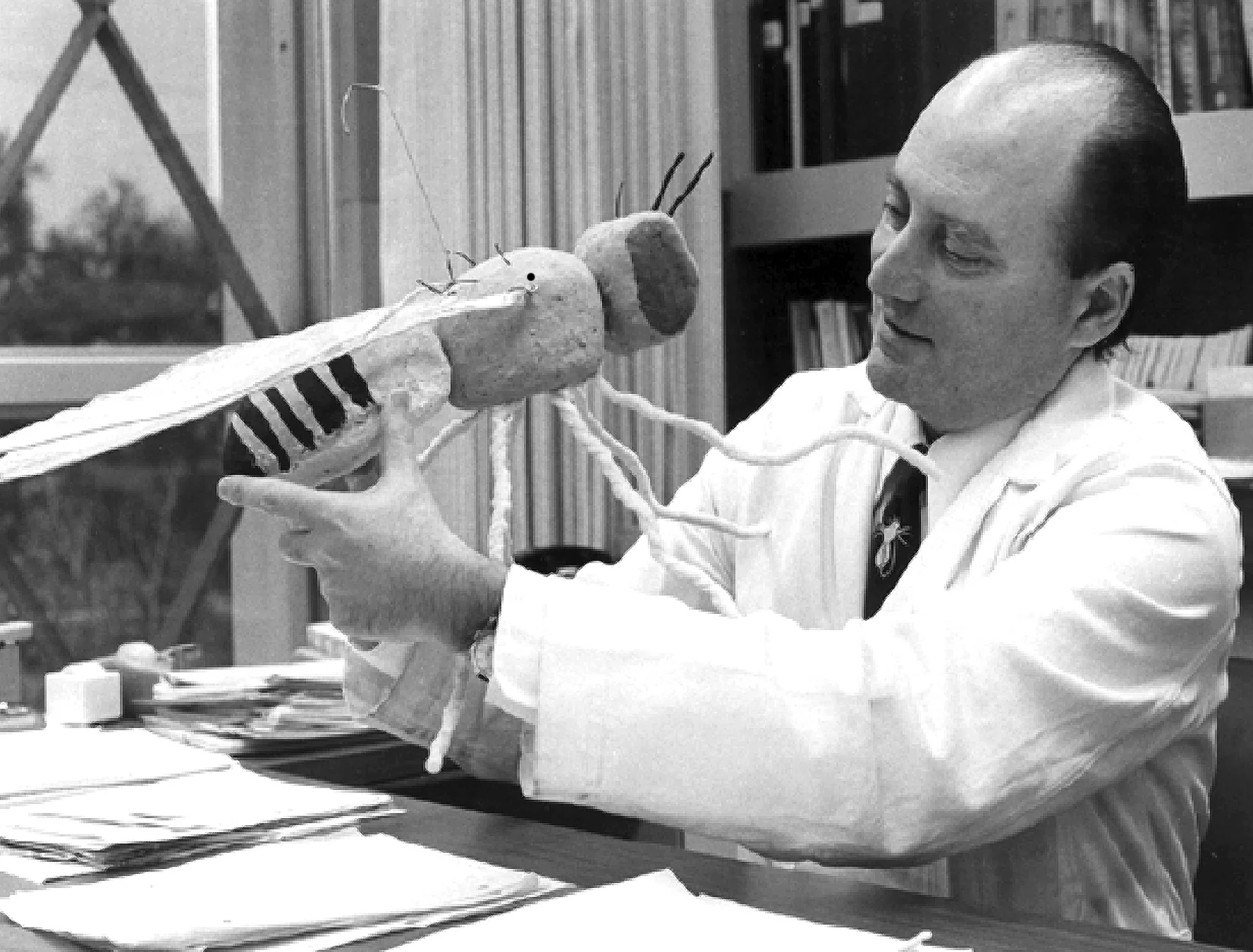
Seymour Benzer
Physicist, molecular geneticist and neurogenetics pioneerSeymour Benzer moved from solid-state physics to molecular genetics and then to fruit-fly behaviour, repeatedly finding new questions for experimental genetics.Read biography
1927–2019
Sydney Brenner
Molecular biologistSydney Brenner helped establish messenger RNA’s role and made a small nematode a tractable model for studying genes, development and the nervous system.Read biographyQuick answers
Common questions
- Is complementation the same as recombination?
- No. Complementation concerns supplied function within a cell; recombination concerns genetic exchange and the resulting progeny.
- Why was the restrictive host useful?
- It allowed rare wild-type progeny to be detected because the mutant background did not form the same plaques under those conditions.
Primary and institutional sources
How this history was checked
Selected 1955 primary methods establish the two tests. Institutional and retrospective accounts supply the career context without turning later maps into the 1955 dataset. This article was reviewed on 7 November 2026.
- California Institute of TechnologyNeurogenetics Pioneer Seymour Benzer Dies
- Caltech Archives Oral History ProjectInterview with Seymour Benzer
- Gairdner FoundationSeymour Benzer: Gairdner awards
- Seymour Benzer / PNAS,1955Fine Structure of a Genetic Region in Bacteriophage
- William A. Harris / PLOS BiologySeymour Benzer 1921–2007: The Man Who Took Us from Genes to Behaviour