
The short answer
How did radioactive labelling distinguish phage components without by itself proving every role of DNA?
Read the evidence
Different records within the same investigation
The following comparison distinguishes the specific questions answered by the inspected records.
| Record or test | What it establishes | What remains different |
|---|---|---|
| Label distribution | Tracks specified material through a preparation and separation. | Does not identify every entering substance. |
| Continued progeny production | Connects infected cells with subsequent viral growth. | Does not assign every role to one molecule. |
| Later DNA-growth studies | Investigate intracellular material and development. | Answer questions beyond the original entry experiment. |
Why phage components could be followed separately
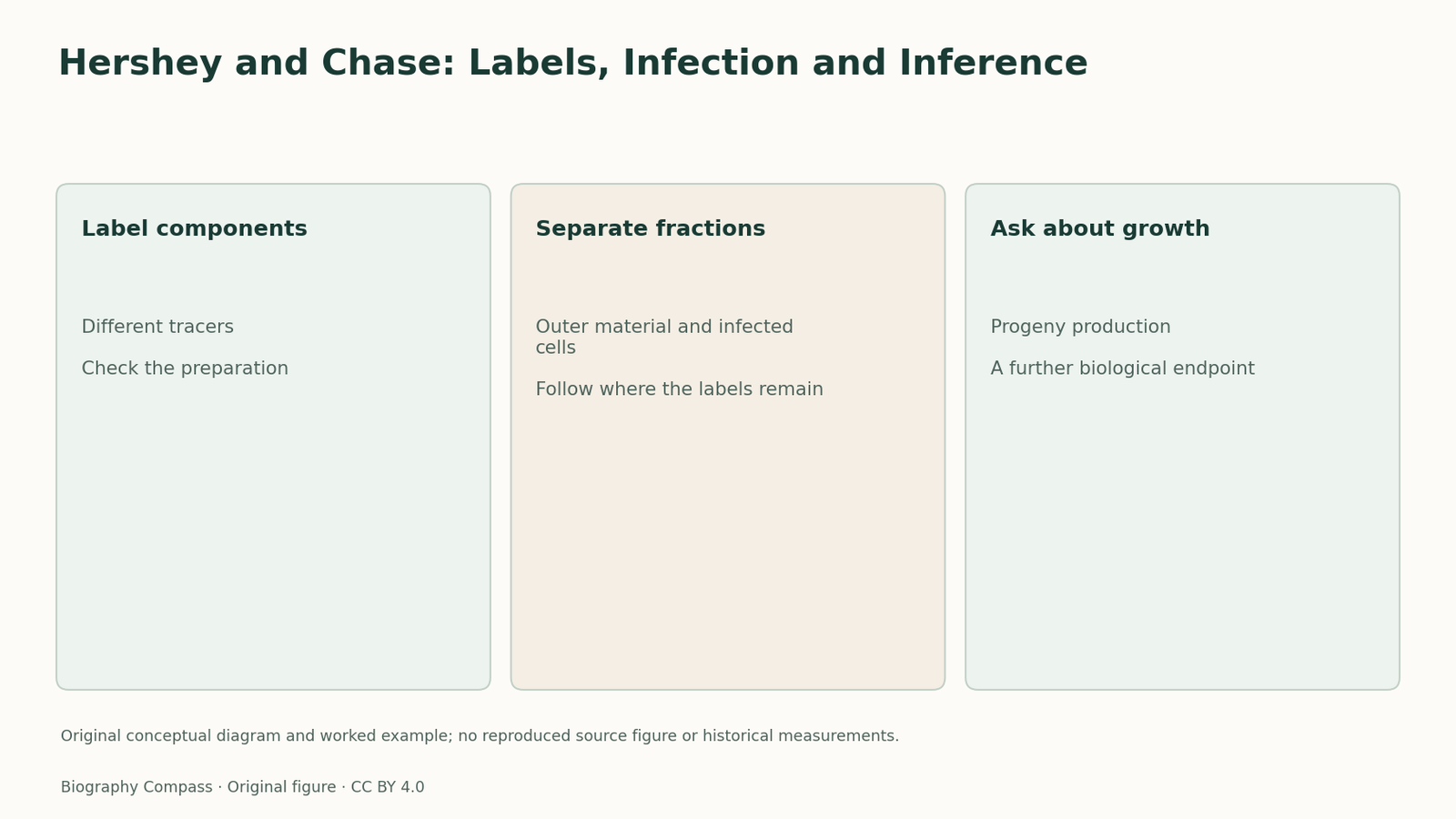
The phage programme investigated how a virus attached to a bacterium and generated progeny. Hershey and Chase used radioactive labels associated with different components to follow their behaviour during this process. The experimental logic depended on retaining that distinction through preparation, infection and separation. A label was a tracer for specified material under defined conditions, not a miniature photograph identifying every molecule that crossed the bacterial surface.
A separation connected location with continued growth
In the 1952 experiments, agitation removed much of the sulfur-associated coat material while infected bacteria remained capable of producing progeny. Most DNA-associated material behaved differently. Together, the observations supported a distinction between the material remaining mainly outside and material entering the infected cell. The paper also stated that entry of sulfur-free substances other than DNA had not been determined. That limit belongs to the original result and prevents a stronger chemical conclusion from being attributed to the experiment.
Sources for this section: [1]
The growth programme did not end at entry
Hershey’s 1953 study addressed DNA metabolism during phage development, including a pool whose phosphorus later appeared in phage DNA. His Nobel lecture describes additional physical investigations of DNA molecules. These later questions show why infection history contains several stages: attachment, entry, intracellular processes and progeny production. Evidence about the location of a tracer at one stage does not automatically describe the whole sequence. The value of combining studies is that each adds a different record to the mechanism. In particular, a material’s entry and its subsequent incorporation are experimentally different observations.
An original tracer-interpretation exercise
Imagine a fictional virus with two separately labelled components. After a separation step, one label remains mainly with an outer fraction while the other remains mainly with infected cells. The cells later produce progeny. Which conclusion is best supported: the labels behaved differently, every entering substance has been identified, or the outer component has no possible function at any stage? The first is directly supported; the others require additional evidence. Now add a control showing that a label can detach from its intended component before infection. That would weaken the tracer interpretation and motivate a preparation check. This exercise contains no invented historical percentages. Its answer distinguishes a measured fraction, an inference about entry and a wider claim about biological function.
Continue the chronology
Related history guides
Crick 1958: Sequence Hypothesis and Central Dogma
Read Crick’s 1958 principles alongside his 1970 clarification, with an original exercise separating sequence transfer from regulation and molecular influence.
Read the timeline1910The White-Eyed Fly: Sex Linkage and Crosses
Read Morgan’s 1910 inheritance reports through the logic of crosses, with a worked exercise separating a recessive trait from a sex-linked transmission pattern.
Read the timelineBiography context
Explore United States through connected lives
Connected biographies
Researchers and related approaches
1908–1997
Alfred Hershey
Bacteriophage geneticist and experimental biologistAlfred Hershey used bacteriophages to investigate genetic structure and viral growth, co-authoring the component-labelling experiments with Martha Chase.Read biography
1921–2007
Seymour Benzer
Physicist, molecular geneticist and neurogenetics pioneerSeymour Benzer moved from solid-state physics to molecular genetics and then to fruit-fly behaviour, repeatedly finding new questions for experimental genetics.Read biographyQuick answers
Common questions
- Did the paper identify every entering molecule?
- No. It explicitly retained uncertainty about sulfur-free material other than DNA.
- Why distinguish entry from later growth?
- They are different stages that require different observations and experimental controls.
Primary and institutional sources
How this history was checked
The references below distinguish the original study from later explanations. The worked exercise and comparison are newly written for this article. This article was reviewed on 8 November 2026.
- Alfred Hershey and Martha Chase / Journal of General Physiology, 1952Independent functions of viral protein and nucleic acid in growth of bacteriophage
- Alfred Hershey / Journal of General Physiology, 1953Nucleic acid economy in bacteria infected with bacteriophage T2
- Nobel Prize OutreachAlfred Hershey — Nobel lecture
- Nobel Prize OutreachAlfred Hershey — Facts
- Nobel Prize OutreachAlfred Hershey — Biographical