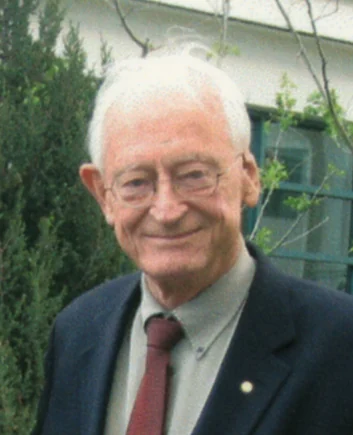
In this biography
Quick facts
- Born
- 22 January 1936
- Birthplace
- Sioux City, IA, USA
- Country
- United States
- Nationality
- Not independently established
- Known for
- Developing conducting polymers with Alan MacDiarmid and Hideki Shirakawa
Why this life matters
Developing conducting polymers with Alan MacDiarmid and Hideki Shirakawa
Timeline
Key moments
Birth
Alan Heeger was born in Sioux City, IA, USA.
Conducting-polymer paper
Coauthored the report on halogen-doped polyacetylene with Shirakawa, Louis, MacDiarmid and Chiang.
Nobel recognition
Received Nobel recognition for the work described in the official award record.
An experimental direction in physics
Alan Heeger was born in Sioux City, Iowa, in 1936. He studied at the University of Nebraska before graduate work at Berkeley. Initially interested in a theoretical thesis with Charles Kittel, he instead joined Alan Portis’s experimental group after discussing his direction with Kittel. Heeger’s autobiography treats that advice as important to his formation. The resulting career combined experimental condensed-matter physics with a sustained interest in theoretical interpretation rather than separating measurement from the models used to understand it.
A Pennsylvania collaboration across chemistry
Heeger joined the University of Pennsylvania after his doctorate and worked on magnetic impurities, metals and molecular conductors. Interactions with Robert Schrieffer contributed to his many-body-physics education, while Anthony Garito helped introduce molecular materials into the programme. The later collaboration with Alan MacDiarmid and Hideki Shirakawa brought polymer preparation and physical measurement together. Conducting polymers required both a suitable chemical material and an explanation of how its electronic behaviour could be altered; neither disciplinary contribution alone was the complete research programme.
Doping polyacetylene changed its conductivity
The 1977 paper by Shirakawa, Edwin Louis, MacDiarmid, Chwan Chiang and Heeger reported conducting halogen derivatives of polyacetylene. It established that chemical treatment could greatly change the material’s electrical conductivity. The lesson was more specific than saying all plastics conduct electricity or that alternating bonds automatically make a polymer metallic. Heeger’s later lecture connected conjugated structures, electronic states and doping, placing the original result within a wider effort to understand and control semiconducting and conducting polymers.
A programme extending into organic electronics
Heeger later moved to the University of California, Santa Barbara, where collaboration with Fred Wudl and others continued the materials programme. Work also involved ultrafast spectroscopy and the company UNIAX. He shared the 2000 Nobel Prize in Chemistry with MacDiarmid and Shirakawa for conducting polymers. His career illustrates how a striking material result can grow into a research platform without making every later device part of the original experiment. The collaboration linked chemical synthesis, electronic structure and measurements of what the resulting materials could actually do.
Quick answers
Frequently asked questions about Alan Heeger
- Who shared Heeger’s Chemistry Nobel?
- Alan MacDiarmid and Hideki Shirakawa, in 2000.
- Was the 1977 paper a solo discovery?
- No. It was authored by Shirakawa, Louis, MacDiarmid, Chiang and Heeger.
Keep exploring
Lives connected to this story
- Philip Anderson
Compare different condensed-matter approaches to electronic states and conductivity.
Sources and further reading
Explore the evidence
These references support the biography and offer further reading. Official records, first-person accounts and independent reporting provide different perspectives; image records document attribution and licensing.