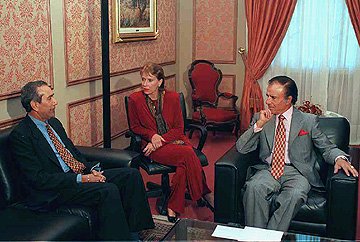
In this biography
Quick facts
- Born
- 27 April 1936
- Died
- 19 April 2019
- Birthplace
- Manila, Philippines
- Country
- Philippines
- Nationality
- Filipino
- Known for
- Leading ASEAN through the aftermath of the Asian financial crisis and the completion of its ten-member enlargement
- ASEAN office
- 10th Secretary-General
- Term
- 1 January 1998 – 31 December 2002
- Earlier office
- Undersecretary of Foreign Affairs
- Later role
- Founding head, ASEAN Studies Centre
Why this life matters
Severino helped sustain ASEAN through financial and environmental crises, then became one of the institution’s most prolific interpreters and historians.
Timeline
Key moments
Joined an overseas diplomatic posting
Began a long assignment at the Philippine Embassy in Washington after entering the foreign service.
Ambassador to Malaysia
Represented the Philippines in a neighbouring ASEAN member state.
Foreign affairs undersecretary
Served as an ASEAN senior official and helped develop the ASEAN Regional Forum.
Secretary-general of ASEAN
Led the Secretariat during the Asian financial crisis, transboundary haze and Cambodia’s admission as the tenth member.
Led the ASEAN Studies Centre
Became the founding head of the centre at ISEAS and expanded his research and writing on regional cooperation.
Died in Manila
Died on 19 April, eight days before his 83rd birthday.
Diplomatic experience before the ASEAN Secretariat
Rodolfo C. Severino Jr. built his career in the Philippine foreign service before taking an international office. The Department of National Defense’s career summary records embassy work in Washington from 1967 to 1974, a later posting in Beijing and service as consul general in Houston from 1979 to 1986. He also served as assistant secretary for Asian and Pacific affairs and the Philippines’ ASEAN senior official from 1986 to 1988.
He represented the Philippines as ambassador to Malaysia from 1989 to 1992 and then served as foreign affairs undersecretary and the country’s ASEAN senior official until 1997. Experience inside national diplomacy helped prepare him for a Secretariat that depended on cooperation among governments rather than instructions from one capital.
Sources for this section: [1]
Secretary-general from 1998 to 2002
ASEAN’s official roster identifies Severino as its tenth secretary-general, serving from 1 January 1998 to 31 December 2002. He followed Ajit Singh and was succeeded by Ong Keng Yong. The numbered office is useful for locating his term, but it should not be confused with ASEAN’s rotating chairmanship, held by member governments.
In his contemporary explanation of the organisation, Severino described an intergovernmental association whose decisions rested on member consensus. The Secretariat could initiate, advise, coordinate and support implementation. It did not possess a regional parliament’s lawmaking authority, command an ASEAN army or independently compel national governments to follow its preferences.
Financial crisis, social costs and transboundary haze
Severino entered office during the Asian financial crisis. In an interview published by ASEAN, he emphasised not only trade and investment but also unemployment, poverty and reduced incomes. He linked the December 1998 Hanoi Plan of Action with financial surveillance, closer economic cooperation and measures intended to address the crisis’s social impact.
He also described new Secretariat units dealing with economic surveillance and haze from land and forest fires. These examples show the administrative demands behind regional cooperation: gathering information, coordinating sectors and following national commitments. His interview describes priorities and institutional responses; it does not prove that he personally ended the crisis or eliminated cross-border air pollution.
Sources for this section: [6]
Cambodia’s admission and an enlarged association
Cambodia joined ASEAN on 30 April 1999 during Severino’s term, completing the association’s then ten-country membership. His discussion of enlargement placed it within a broader effort to connect Southeast Asian states after decades of conflict and competing alignments. The historical ten-member milestone should not be used as an undated statement about ASEAN’s membership today.
The institutional challenge extended beyond the admission ceremony. New members needed to participate in existing economic and diplomatic arrangements while the Secretariat’s workload expanded. Severino’s account presents integration as continuing coordination, not an automatic consequence of adding a country’s name to a membership list.
An institutional memory preserved through research
After leaving office, Severino moved into teaching and research. ISEAS’s 2015–2016 annual report identifies him as founding head of its ASEAN Studies Centre from its inception in 2008 until his departure in August 2015. This later institutional role was separate from the Secretariat post he had completed in 2002.
The publisher’s catalogue records Southeast Asia in Search of an ASEAN Community in 2006, The ASEAN Regional Forum in 2009 and Where in the World is the Philippines? in 2010. It also distinguishes books he authored from volumes he edited or compiled. His writing turned diplomatic experience into arguments readers could examine, rather than treating an official career as a substitute for evidence.
Quick answers
Frequently asked questions about Rodolfo C. Severino Jr.
- When was Rodolfo Severino ASEAN secretary-general?
- He served as the tenth secretary-general from 1 January 1998 to 31 December 2002, between Ajit Singh and Ong Keng Yong.
- Was Severino the rotating ASEAN chair?
- No. He headed the Secretariat as secretary-general; the rotating chairmanship belongs to a member government. Those are different institutional roles.
- Did Cambodia join ASEAN during his term?
- Yes. Cambodia joined on 30 April 1999, completing the then ten-member association. This is a historical membership milestone, not an undated current total.
- What did he do after leaving the Secretariat?
- He taught and researched regional affairs, led the ASEAN Studies Centre at ISEAS from 2008 to 2015 and wrote books on ASEAN cooperation and Philippine territorial questions.
Keep exploring
Lives connected to this story
- Ajit Singh
His predecessor in the ASEAN Secretariat, not a concurrent rotating chair.
- Ong Keng Yong
The secretary-general who followed him in 2003.
- Narciso G. Reyes
Compare an earlier Filipino holder of the regional office.
Sources and further reading
Explore the evidence
These references support the biography and offer further reading. Official records, first-person accounts and independent reporting provide different perspectives; image records document attribution and licensing.
- 1. Philippine News AgencyDND mourns passing of former Ambassador Severino
The departmental career summary was readable through indexed text after live retrieval was restricted; it supports national postings, not independent proof of policy outcomes.
- 2. ISEAS – Yusof Ishak InstituteRodolfo C. Severino Jr. — The ASEAN Man
- 3. ISEAS PublishingRodolfo C. Severino publications and profile
- 4. Wikimedia CommonsRodolfo Severino portrait and public-domain record
- 5. ASEANFormer secretaries-general: official term roster
- 6. ASEANNo Alternative to Regionalism: Severino interview
A contemporary participant interview documents priorities and institutional changes, not an independent evaluation that they solved the regional crises.
- 7. ASEANASEAN and the Growth of Regional Cooperation: Severino interview
- 8. ISEAS – Yusof Ishak InstituteAnnual report 2015–2016: ASEAN Studies Centre succession
The indexed annual-report passage records the centre’s 2008 inception and his August 2015 departure. No complete PDF or visual-page inspection is claimed.