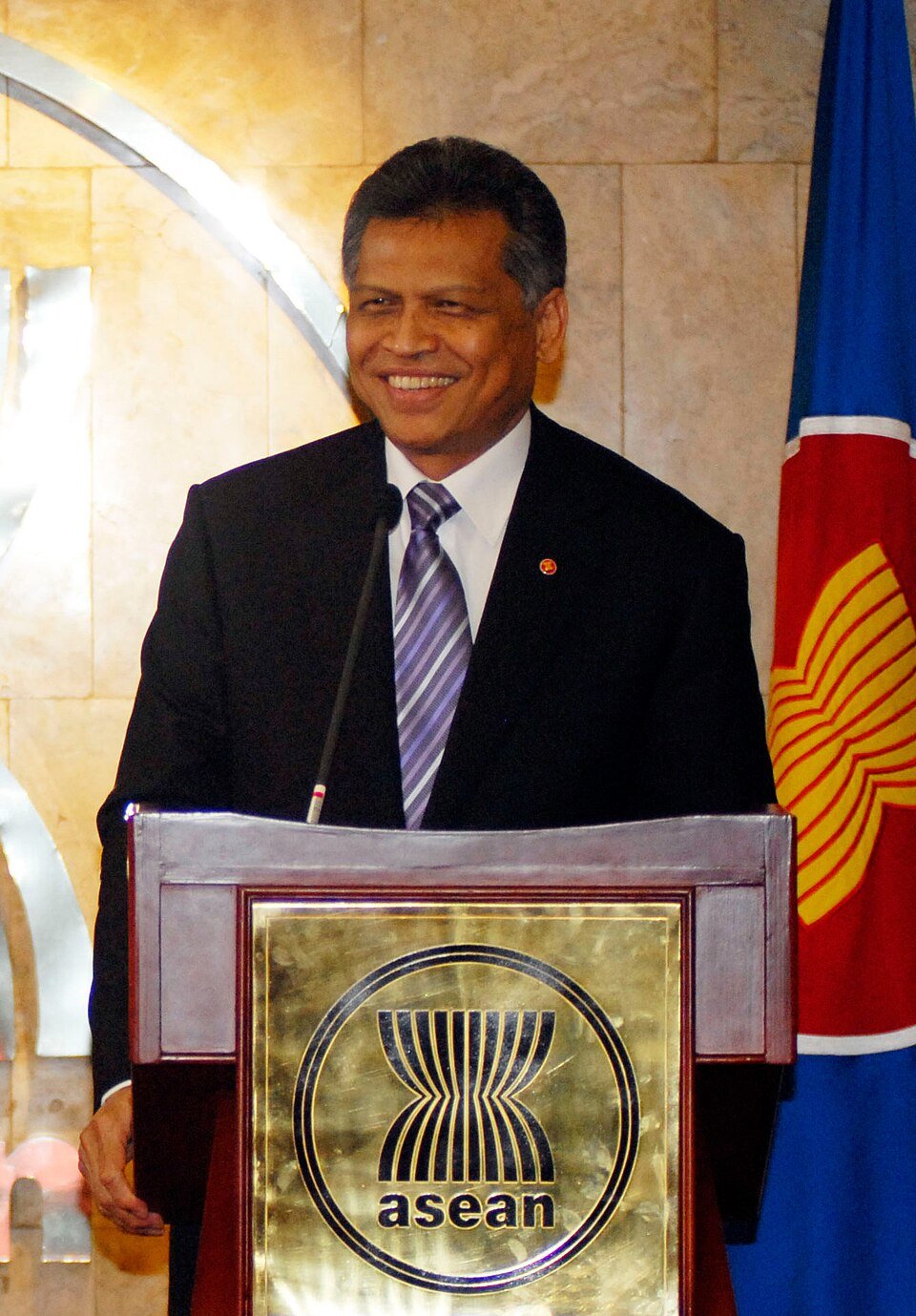
In this biography
Quick facts
- Born
- 6 January 1954
- Birthplace
- Singapore
- Country
- Singapore
- Nationality
- Singaporean
- Known for
- Leading the ASEAN Secretariat from 2003 to 2007 as the region prepared its Charter and accelerated Community building
- ASEAN office
- 11th Secretary-General
- Term
- 1 January 2003 – 31 December 2007
- Diplomatic service
- Joined in 1979
- Education
- University of Singapore; Georgetown University
Why this life matters
Ong’s term connected ASEAN’s early-2000s Community plans with the institutional reforms codified in the 2007 ASEAN Charter.
Timeline
Key moments
Born in Singapore
Born on 6 January; later attended Anglo-Chinese School and St Andrew’s School.
Entered Singapore’s diplomatic service
Began a career that included postings in Saudi Arabia, Malaysia and the United States.
Completed Arab studies at Georgetown
Earned an MA after his 1979 law degree at the University of Singapore.
High commissioner to India
Represented Singapore in India and was concurrently accredited to Nepal.
Press secretary to the prime minister
Served Prime Minister Goh Chok Tong before moving to ASEAN.
Secretary-general of ASEAN
Led the Secretariat through the Bali Concord II period and the drafting and signing of the ASEAN Charter.
Charter signing and later entry into force
The Charter was signed in November 2007, during his term, but entered into force on 15 December 2008 after Surin Pitsuwan succeeded him.
Directed the Institute of Policy Studies
Moved from ASEAN administration into Singapore-based policy research before his Malaysia posting.
High commissioner to Malaysia
Returned to bilateral diplomacy after leading ASEAN.
Chaired the Singapore International Foundation
The RSIS career record identifies a completed chairmanship, distinct from his continuing policy-school appointments.
Legal education, Arab studies and overseas service
Ong Keng Yong was born in Singapore on 6 January 1954. He graduated from the University of Singapore with an honours law degree in 1979, the year he joined the Ministry of Foreign Affairs. An MA in Arab Studies from Georgetown University followed in 1983, giving his diplomatic training a regional specialisation beyond Southeast Asia.
His overseas assignments included Saudi Arabia in 1984–1988, Malaysia in 1989–1991 and the United States in 1991–1994. These postings involved embassy leadership and representation across different political settings. They preceded his ASEAN appointment rather than arising from it, establishing a substantial national diplomatic career before he entered regional administration.
Sources for this section: [3]
India, Nepal and work with Goh Chok Tong
Ong served as Singapore’s high commissioner to India from 1996 to 1998, concurrently accredited as ambassador to Nepal. From September 1998 to December 2002, he was press secretary to Prime Minister Goh Chok Tong. He also held senior information-ministry responsibilities and led the People’s Association during that period.
The combination brought bilateral negotiation together with public communication and domestic administration. As ASEAN’s eleventh secretary-general from January 2003, based in Jakarta, he entered an organisation whose Secretariat had to coordinate national governments rather than replace them. His background helps explain the range of experience he brought to that role without treating a civil-service appointment as an electoral mandate.
Bali Concord II and the Community timetable
Ong’s 2003–2007 term coincided with a major change in ASEAN’s planning. Bali Concord II, adopted on 7 October 2003, set out a Community comprising political-security, economic and socio-cultural cooperation. The three pillars made regional integration broader than a trade agenda and required coordination among many different national agencies.
In January 2007, leaders at Cebu accelerated the Community target from 2020 to 2015. The Secretariat’s work connected these collective decisions to continuing programmes and institutional preparation. Ong was part of that administrative process, not the sole creator of the Community. The declarations also preserved consultation, sovereignty and consensus, constraints that shaped what regional leadership could deliver.
Charter preparation is different from entry into force
The ASEAN Charter was signed on 20 November 2007, near the end of Ong’s term. It gave the organisation a more explicit legal framework, including legal personality under Article 3. The change concerned the regional institution’s standing and procedures, not a transfer of all member-state authority to the secretary-general.
Signing did not make the Charter immediately operative. It entered into force on 15 December 2008 after member states completed ratification, under Ong’s successor Surin Pitsuwan. Separating those dates gives both administrations their proper place: Ong led the Secretariat during preparation and signing, while implementation of the new framework extended beyond his five-year tenure.
Bilateral diplomacy and policy research after ASEAN
Ong directed the Institute of Policy Studies from 2008 to 2011 and then served as high commissioner to Malaysia in 2011–2014. His appointment announcement specified an expected assumption date of 18 July 2011. The return to Kuala Lumpur connected his regional experience with a neighbouring country where he had already served earlier in his career.
The RSIS profile consulted on 15 October 2026 lists him as executive deputy chairman, director of its Institute of Defence and Strategic Studies and head of its international political-violence and terrorism-research centre. It also records his Singapore International Foundation chairmanship in 2015–2023. These later roles connect diplomacy with research and public engagement while remaining distinct from his completed ASEAN term.
Quick answers
Frequently asked questions about Ong Keng Yong
- When was Ong Keng Yong ASEAN secretary-general?
- He was ASEAN’s eleventh secretary-general, serving a five-year term from January 2003 through 2007. Surin Pitsuwan succeeded him in 2008.
- What did Ong Keng Yong study?
- He earned an honours law degree at the University of Singapore in 1979 and an MA in Arab Studies at Georgetown University in 1983.
- Did the ASEAN Charter enter into force during Ong’s term?
- No. It was signed in November 2007 during his term, but entered into force on 15 December 2008 after ratification, under his successor. Preparation, signing and implementation are separate stages.
- What did Ong do after leaving ASEAN?
- He directed the Institute of Policy Studies in 2008–2011 and served as high commissioner to Malaysia in 2011–2014. His later work includes leadership at RSIS and a completed 2015–2023 chairmanship of the Singapore International Foundation.
Keep exploring
Lives connected to this story
- Goh Chok Tong
The Singapore prime minister whose press secretary Ong served before joining ASEAN.
- Ajit Singh
Compare an earlier ASEAN secretary-general during the Secretariat’s institutional strengthening.
- Surin Pitsuwan
Ong’s successor led ASEAN when the Charter entered into force in December 2008.
Sources and further reading
Explore the evidence
These references support the biography and offer further reading. Official records, first-person accounts and independent reporting provide different perspectives; image records document attribution and licensing.
- 1. ASEAN SecretariatFormer Secretaries-General of ASEAN
- 2. S. Rajaratnam School of International StudiesAmbassador Ong Keng Yong — profile
The readable institutional biography was consulted on 15 October 2026 for current listed roles and completed appointments. It describes offices, not an independent assessment of policy outcomes.
- 3. Ministry of Foreign Affairs SingaporeAppointment of Singapore’s High Commissioner to Malaysia
The readable 2011 appointment record supplies education, postings and the expected Malaysia start date. Its January 2008 shorthand for the ASEAN handover is not treated as an additional full year of office.
- 4. ASEAN SecretariatDeclaration of ASEAN Concord II, 7 October 2003
Indexed declaration passages establish the three pillars and collective intergovernmental commitments. Full-page retrieval was unavailable.
- 5. ASEAN SecretariatAEC 2015 progress and key achievements — accelerated Community timetable
The indexed January 2007 timetable passage was consulted; the full report was not read.
- 6. ASEAN SecretariatASEAN Annual Report 2008–2009 — Charter signing and ratification
Indexed Charter chronology confirms the 20 November 2007 signing date; this is not a claimed reading of the entire annual report.
- 7. ASEAN SecretariatSignificance of the ASEAN Charter — December 2008 fact sheet
The indexed December 2008 fact sheet supplies legal personality, ratification and the entry-into-force timetable. Full PDF retrieval was unavailable.
- 8. ASEAN SecretariatASEAN Charter — entry into force
The institutional archive’s indexed summary confirms actual entry into force on 15 December 2008; full-page access was unavailable.
- 9. Wikimedia CommonsOng Keng Yong portrait — image and licence record
The local 620 × 706 image shows the same complete subject-crop frame, but is re-encoded rather than byte-identical. Commons links the crop to the forum’s original Flickr photograph and its CC BY-SA 2.0 review. This is an image-rights source, not evidence for the biography.