In this biography
Quick facts
- Born
- 12 December 1927
- Died
- 3 June 1990
- Birthplace
- Burlington, Iowa, United States
- Country
- United States
- Nationality
- Not independently established
- Known for
- The silicon integrated circuit, Fairchild Semiconductor and Intel
- Earned degrees
- BA, Grinnell, 1949; PhD, MIT, 1953
- Fairchild
- Co-founder, 1957
- Integrated-circuit patent
- Filed 1959; issued 1961
- Intel
- Co-founded with Gordon Moore, 1968
Why this life matters
Noyce’s work joined a manufacturable circuit concept with the organisational and commercial resources needed to develop an industry.
Timeline
Key moments
Born in Iowa
Born in Burlington on 12 December.
Physics education
Graduated from Grinnell and completed a doctorate at MIT.
Shockley laboratory
Moved from Philco to Shockley Semiconductor Laboratory.
Fairchild founding
Joined seven colleagues in the new silicon-device company.
Interconnection patent
Filed the device-and-lead structure patent in July 1959; it issued in April 1961.
Intel
Co-founded Intel with Gordon Moore.
SEMATECH leadership
Became the first chief executive of the manufacturing consortium.
Death
Died on 3 June.
Physics became a way into a new industry
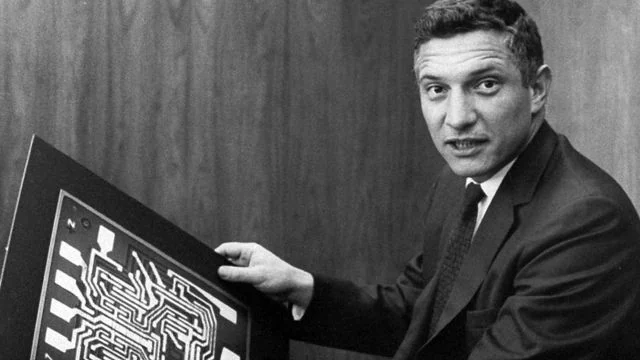
Robert Norton Noyce was born in Burlington, Iowa, on 12 December 1927. At Grinnell College he studied mathematics and physics, graduating with a BA in 1949. His teacher Grant Gale obtained an early transistor, giving Noyce a close view of a device that could replace bulky vacuum-tube functions. Noyce completed a doctorate at MIT in 1953 and joined Philco as a research engineer. These were earned qualifications; a later professional medal should not be confused with a degree. In 1956 he moved to California to work for transistor pioneer William Shockley.
Fairchild required a group with complementary skills
In 1957 Noyce joined seven Shockley colleagues in founding Fairchild Semiconductor. The group included Julius Blank, Victor Grinich, Jean Hoerni, Eugene Kleiner, Jay Last, Gordon Moore and Sheldon Roberts. Arthur Rock and Alfred Coyle helped find corporate backing, while Sherman Fairchild and Fairchild Camera and Instrument supplied an essential financing arrangement. The founders still had to build equipment and turn silicon into dependable transistors. Last recalled working with Noyce on optical patterning. Noyce’s importance was real, but the company’s emergence cannot be explained by one physicist’s insight alone.
An invention connected devices during manufacture
The Computer History Museum preserves Noyce’s notebook entry of 23 January 1959 on isolating and interconnecting multiple devices. Jean Hoerni’s planar process provided an important foundation. Noyce proposed using an insulating oxide surface with metal connections laid across it, allowing circuit elements on one silicon body to be connected during fabrication. His US patent 2,981,877 was filed on 30 July 1959 and issued on 25 April 1961. Jack Kilby at Texas Instruments had independently demonstrated an integrated circuit in 1958. Their different contributions belong in the history together; neither a patent date nor a commemorative label describes the whole development process.
A patent was followed by difficult development
Noyce moved into general management while Jay Last’s group tackled practical integrated-circuit fabrication. Lionel Kattner and Isy Haas worked on diffusion and isolation; Robert Norman and colleagues examined circuit design and operation. Their work addressed questions that the conceptual drawing did not settle: how to isolate components, reproduce patterns, obtain useful yields and make a product customers could employ. The distinction matters for a business biography. Noyce helped provide direction and institutional support while other investigators carried much of the day-to-day development. Crediting those tasks makes the achievement more intelligible.
Intel began with memory rather than a finished PC future
Noyce and Moore left Fairchild to found Intel in 1968. Rock organised financing and became its first chairman; Andy Grove, recruited from Fairchild, became an essential operational leader. Their initial target was semiconductor memory, pursued through several technologies. The later 4004 project began with Japanese calculator company Busicom and required contributions from Ted Hoff, Stan Mazor, Federico Faggin and Masatoshi Shima. Noyce helped secure rights to market the resulting products beyond the original calculator agreement. He should not therefore be described as the engineer who personally designed the 4004.
Leadership widened from a firm to manufacturing cooperation
A contemporary 1982 Intel biography records Noyce as president until 1975, chairman from 1975 to 1979 and subsequently vice chairman. The IEEE awarded him its Medal of Honor in 1978. In 1988 he became the first chief executive of SEMATECH, a consortium intended to strengthen semiconductor manufacturing through shared work. He died on 3 June 1990. His career shows several connected kinds of contribution: an engineering concept, support for development teams, the creation of companies and later coordination across firms. None makes the outcome inevitable; each depended on colleagues, customers, production learning and institutions.
Quick answers
Frequently asked questions about Robert Noyce
- Did Noyce design the Intel 4004 by himself?
- No. Hoff, Mazor, Faggin and Shima contributed to its architecture, implementation and calculator application. Noyce’s role included business leadership and marketing rights.
- Was Noyce the only inventor of the integrated circuit?
- No. Kilby’s independent demonstration, Hoerni’s planar process, Noyce’s interconnection approach and the development teams must be distinguished.
Keep exploring
Lives connected to this story
- Gordon Moore
Read his Fairchild colleague and Intel cofounder’s distinct technical and business work.
- Andy Grove
Follow the engineer who became Intel’s operational leader.
- Jay Last
Read the colleague whose development group connected an integrated-circuit concept to practical fabrication.
Sources and further reading
Explore the evidence
These references support the biography and offer further reading. Official records, first-person accounts and independent reporting provide different perspectives; image records document attribution and licensing.
- 1. IEEE History Center, Engineering and Technology History WikiRobert Noyce oral history, Michael Wolff, 1975
The education, childhood and invention passages were read. Noyce explicitly says Burlington and a Grinnell BA. An older IEEE pioneer page says Denmark and BS; the first-person account and newer IEEE profile are preferred.
- 2. IEEE Computer SocietyRobert N. Noyce: education, career and awards
- 3. Computer History MuseumThe Relics of St. Bob: Noyce notebook and the development team, David Laws, 2013
Museum analysis and reproduced notebook context read; no claim to have read all of Noyce’s notebooks.
- 4. Robert N. Noyce; United States Patent Office, via Google PatentsUS 2,981,877: Semiconductor device-and-lead structure, filed 30 July 1959, issued 25 April 1961
Original patent header, description and interconnection claims were read. Patent filing and issuance dates are distinguished from notebook conception and product development.
- 5. Computer History Museum, X4158.2008Oral History of Jay Last, Craig Addison, 15 September 2007
- 6. Fairchild Camera and Instrument Corporation; Computer History Museum archiveFairchild Camera and Instrument annual reports, 1958–1961: original corporate records
- 7. Bancroft Library, University of California, BerkeleyArthur Rock: Venture Capitalist, oral history by Sally Smith Hughes, 2008–2009
- 8. Computer History Museum, X7227.2015Gordon Moore and Arthur Rock oral history panel, original transcript, 9 July 2014
- 9. Intel Corporate HistoryAnnouncing a New Era of Integrated Electronics: the Intel 4004
- 10. Computer History Museum, X3774.2006Ted Hoff and Stan Mazor on their contributions to the Intel 4004, 20 September 2006
- 11. Intel biography retained in Gordon Bell collectionRobert N. Noyce: contemporary speaker biography, Ethernet seminar announcement, 1982
Contemporary Intel speaker biography read through the indexed original seminar PDF; it supplies the presidency and chairmanship chronology.
- 12. National Academies of Sciences, Engineering, and MedicineStrategies to Enable Assured Access to Semiconductors for the Department of Defense, chapter 2
Institutional chapter excerpt read for SEMATECH’s 1987 formation and Noyce’s first-CEO role. The draft distinguishes formation from his 1988 appointment.
- 13. Dataquest, contemporary industry record retained by Computer History MuseumIntel company background: Noyce’s July 1988 SEMATECH appointment, in worldwide semiconductor companies service, 1989
The original contemporary company-profile passage was read through indexed text for the July 1988 appointment. The large combined Dataquest scan was not downloaded or read in full.