
The short answer
What had to come together for the Fairchild group to turn silicon-device knowledge into a business, and what control did its corporate backer obtain? Compare technical capability, finance and legal ownership rather than treating the startup as one person’s invention.
Original evidence comparison
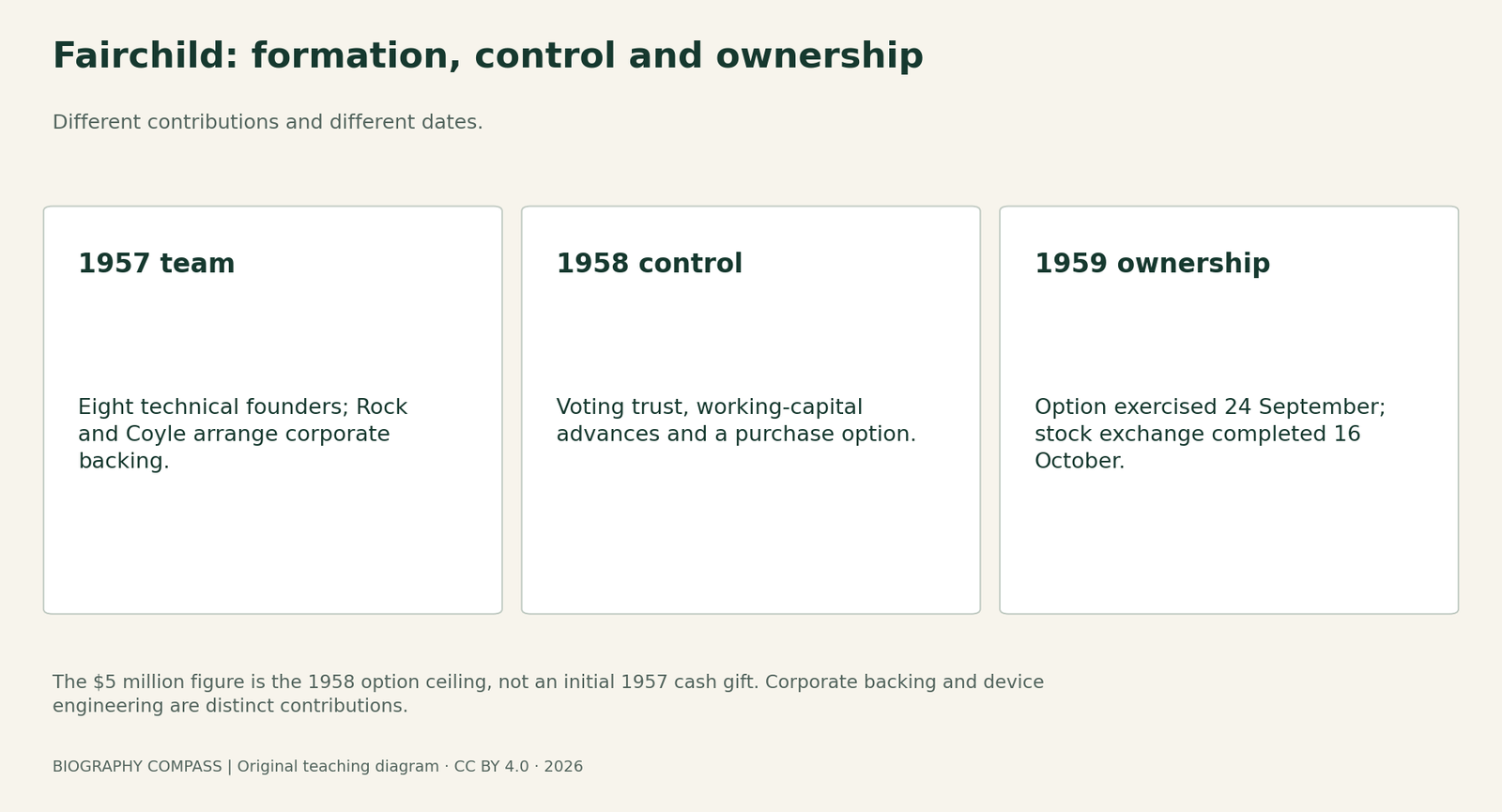
Three different things made the enterprise possible
Technical capability, finance and control are related, but they are not interchangeable.
| Country | Evidence and contribution | Limit of the claim |
|---|---|---|
| Technical team | Eight founders brought complementary material, device, optical, equipment and applications skills. | A capable group did not yet constitute a production line or a proven market. |
| Organisers and backing | Rock and Coyle helped find support; Sherman Fairchild and the corporation enabled the arrangement. | Arranging finance is not the same contribution as designing or fabricating a transistor. |
| 1958 voting trust | The original report describes control, advances and a purchase option. | Control does not establish that all the stock had already been acquired. |
| 1959 stock exchange | The original report dates option exercise and completion of wholly owned status. | The eventual acquisition date cannot be moved back to the 1957 founding. |
Chronology
A timeline of the turning points
The group seeks a way forward
Seven Shockley colleagues initially sought to remain together; Noyce joined them in the new enterprise.
Fairchild arrangement
Rock and Coyle helped arrange backing associated with Sherman Fairchild and Fairchild Camera and Instrument.
From development to sales
The parent’s annual report describes transistor development costs and the start of commercial production.
Ownership changes
The corporate report dates option exercise to 24 September and completion of the stock exchange to 16 October.
A team was the initial unit of opportunity
Fairchild’s founders did not begin by offering investors a finished integrated circuit. Jay Last’s 2007 interview recalls a group wanting to continue work on silicon transistors together after leaving Shockley. Arthur Rock’s Berkeley interview describes the request that reached Hayden, Stone through the Kleiner connection and the search for a corporate sponsor. Noyce joined the initial seven. Both accounts were recorded decades later, so they illuminate participants’ purposes and recollections; they are not substitutes for a contemporaneous contract or a complete account of every negotiation.
Complementary knowledge still needed equipment and customers
The eight technical founders were Blank, Grinich, Hoerni, Kleiner, Last, Moore, Noyce and Roberts. Their strengths covered more than transistor theory. Last describes optical patterning work with Noyce, diffusion work involving Hoerni and Moore, silicon-crystal work by Roberts and other tasks in equipment, applications and organisation. The group had to prepare material, form devices, connect and package them, then test them. This is why a founding story needs to examine capabilities rather than allocate all credit to a patent holder. Even a strong technical team needed facilities, working capital and customers.
Sources for this section: [1]
Financial backing carried control rights
Fairchild Camera and Instrument’s 1958 annual report is more precise than a broad description of an outside investor funding eight inventors. Note 1 says Semiconductor had no direct ownership by the reporting group at that point but was controlled through a voting trust. A subsidiary held an option, expiring in 1965, to purchase the capital stock under an earnings-based formula capped at $5 million. The report also describes working-capital advances used mainly for development. The cap is an option term, not a claim that $5 million was paid in 1957.
Sources for this section: [3]
Control and ownership have separate chronologies
The 1959 annual report states that the company exercised its option on 24 September and completed the stock exchange on 16 October. Semiconductor then became a wholly owned subsidiary. Therefore, 1957 formation, 1958 voting-trust control and 1959 ownership should not collapse into one event. Rock and Coyle helped assemble the arrangement; Sherman Fairchild and the corporation made support possible; the engineers supplied the development work. The corporate report establishes formal relationships more directly than a later memory of being equals. It does not reveal every informal decision or bargaining conversation.
Development and commercial evidence answer different questions
The 1958 report records expenses needed to develop transistors and put them into commercial production. By the 1959 report, management described rapidly expanding sales, employment and manufacturing space. These statements show an operating business taking shape. They do not prove that an integrated-circuit market was already assured at founding. Hoerni’s planar work, Noyce’s interconnection concept and Last’s later development group belong to subsequent chapters. The startup’s technical ambition and the corporation’s willingness to finance it were necessary parts of the history, but neither guaranteed every later application.
Original exercise: audit a proposed museum label
A draft label reads: “In 1957 Rock gave eight inventors $5 million, bought their company and launched the integrated-circuit market.” Identify four corrections using the evidence above. First distinguish the organiser from the corporate backer. Next classify the $5 million figure. Then separate control from ownership. Finally decide whether the 1957 purpose can be described through a later product. This is a newly written source-reading exercise. It asks what the documents support, rather than asking the reader to invent a valuation, a return or a hypothetical share price.
Suggested answer: replace a legend with dated claims
Rock and Coyle helped arrange support; the funding relationship involved Fairchild Camera and Instrument. The $5 million figure is the 1958 report’s ceiling on a purchase-option formula, not an initial cash gift. The 1958 report describes voting-trust control, while the 1959 report dates completion of full ownership. The group initially pursued silicon transistors; integrated-circuit development followed. A stronger label would name the team, explain its complementary capabilities and put the financial arrangement beside the technical work. The available sources do not justify reconstructing the complete 1957 contract from these later summaries alone.
Continue the chronology
Related history guides
Moore’s law: evidence and revision
Continue to a later argument about integration economics; the scaling argument was not a finished 1957 business plan.
Read the timeline1969–1974What did Intel sell in 1971?
Follow a different technical and commercial arrangement involving Busicom and the MCS-4 family.
Read the timelineBiography context
Explore United States through connected lives
Jay Last
Read the wider career and institutional setting beyond this focused historical question.
Explore the biographiesCountry archiveUnited States biographies and research
Explore related work in science, industry and the institutions supporting technical development.
Explore the biographiesConnected biographies
People and technical enterprises
1927–1990
Robert Noyce
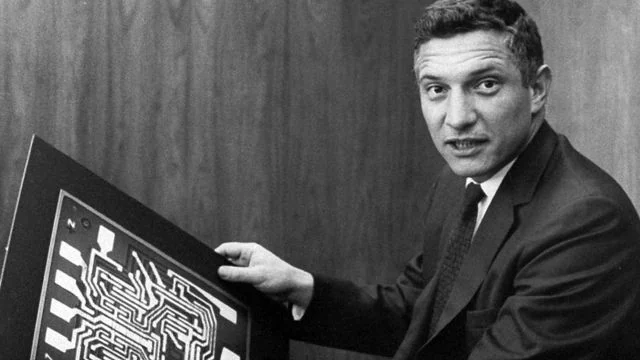
Physicist, integrated-circuit inventor and semiconductor executiveRobert Noyce connected semiconductor research with company building. A co-founder of Fairchild Semiconductor and Intel, he developed a practical interconnection approach for silicon integrated circuits and helped organise teams that turned devices into manufactured products.Read biography1929–2021
Jay Last
Physicist, semiconductor development leader and publisherJay Last combined optical training with semiconductor development. A member of Fairchild’s founding group, he led an early integrated-circuit team, later worked at Amelco and Teledyne, and built an influential second career in publishing and collecting.Read biography1926–
Arthur Rock
Technology financier, company organiser and board leaderArthur Rock helped semiconductor researchers become company founders. Working first at Hayden, Stone and later in California partnerships, he connected technical teams with financing and took active roles in company governance.Read biography
1929–2023
Gordon Moore
Semiconductor chemist, Intel cofounder and philanthropistA chemist and business leader who helped build semiconductor companies, forecast growing chip complexity and later supported science and conservation.Read biographyQuick answers
Common questions
- Was Fairchild a conventional independent venture fund investment in 1957?
- Its specific arrangement involved corporate advances, a voting trust and a purchase option. Later venture-capital terminology should not obscure those terms.
- Does the 1958 report mean the whole founding contract was read?
- No. It supplies original corporate evidence about the relationship. The complete signed founding contract was not accessed in this research.
Primary and institutional sources
How this history was checked
Original corporate records, patents, advertisements and participant accounts support this history. Comparisons and exercises are newly written teaching aids; they are not financial advice or reproductions of archival figures. This article was reviewed on 27 October 2026.
- Computer History Museum, X4158.2008Oral History of Jay Last, Craig Addison, 15 September 2007
- Bancroft Library, University of California, BerkeleyArthur Rock: Venture Capitalist, oral history by Sally Smith Hughes, 2008–2009
- Fairchild Camera and Instrument Corporation; Computer History Museum archiveFairchild Camera and Instrument annual reports, 1958–1961: original corporate records
- Computer History MuseumThe Relics of St. Bob: Noyce notebook and the development team, David Laws, 2013