In this biography
Quick facts
- Born
- 2 September 1936
- Died
- 21 March 2016
- Birthplace
- Budapest, Hungary
- Country
- United States
- Nationality
- Not independently established
- Known for
- Intel operations, the DRAM withdrawal and management writing
- Earned education
- City College chemical engineering, 1960; Berkeley PhD, 1963
- Fairchild
- Joined research laboratory, 1963
- Intel
- First recruit in 1968; president from 1979
- Chief executive
- 1987–1998
Why this life matters
Grove connected device science, production discipline and organisational decisions as Intel grew from memory products into microprocessors.
Timeline
Key moments
Born in Budapest
Born on 2 September.
Migration
Left Hungary after the uprising and reached the United States in 1957.
Engineering degrees
Graduated from City College and completed a Berkeley PhD.
Fairchild research
Joined Gordon Moore’s laboratory.
Intel
Became Noyce and Moore’s first recruit.
President
Added the presidency to his operating responsibilities.
DRAM decision
Helped decide to leave dynamic memory while Intel retained other products.
Executive and chair
CEO from 1987 to 1998; chairman from 1997 to 2005.
Death
Died on 21 March.
A refugee trained as a chemical engineer
Andy Grove was born András Gróf in Budapest on 2 September 1936. He survived the persecution of Hungarian Jews during the Second World War and left Hungary following the suppression of the 1956 uprising. He reached the United States in 1957 and studied chemical engineering at the City College of New York, graduating in 1960. He then completed an earned PhD in chemical engineering at the University of California, Berkeley, in 1963. His doctoral work concerned fluid dynamics. That preparation helps explain his later comfort with quantitative processes without turning his early experiences into a simple formula for business success.
Device research preceded management fame
Gordon Moore recruited Grove to Fairchild Semiconductor in 1963. Grove’s research group studied problems of silicon surfaces and metal-oxide-semiconductor devices, helping improve their stability and reliability. The work involved colleagues and a wider research laboratory, rather than an isolated executive invention. Grove’s 1967 textbook, Physics and Technology of Semiconductor Devices, grew from this technical period. When he considered leaving Fairchild, Moore and Noyce promoted him to assistant director of the laboratory. The IEEE’s later Medal of Honor citation recognised both his MOS research and his leadership in the semiconductor industry.
An early recruit made production his responsibility
When Robert Noyce and Gordon Moore established Intel in 1968, Grove was their first recruit. Institutional accounts sometimes loosely call him a founder; Intel’s own memorial identifies Noyce and Moore as the founders and Grove as their first hire. The distinction leaves his importance intact. He became the company’s operational force, concerned with making products reliably and coordinating the people who designed and manufactured them. Moore supplied technical strategy, while Noyce helped explain and support the business externally. Grove’s growing responsibilities eventually included the presidency in 1979.
The 1985 decision concerned DRAM, not every memory
Intel’s 1985 annual report, signed by president and chief operating officer Grove and chairman and CEO Moore, announced withdrawal from dynamic random-access memory. The same report described continued emphasis on EPROMs and the newly introduced 80386 microprocessor. Manufacturing adaptation involved plant closures, layoffs and continued development spending. It was a difficult reallocation within an existing business, not an instantaneous conversion from making memory to inventing processors. The 1986 report still recorded a net loss and explained that Intel remained in EPROMs. Later success should not erase that uncertain transition or the workers who experienced its costs.
Executive responsibility included difficult judgments
Grove became chief executive in 1987, following Moore, and served until 1998. He was chairman from 1997 to 2005. Intel expanded with the personal-computer market, but the company also faced failures and disputes. The opening chapter of Only the Paranoid Survive recounts the 1994 Pentium floating-point problem and Intel’s inadequate initial response to customers. This is a participant’s later interpretation, useful for studying how his view changed. It does not supply an independent account of every participant’s actions. His management books made methods and mistakes part of his public work.
Writing, recognition and educational support
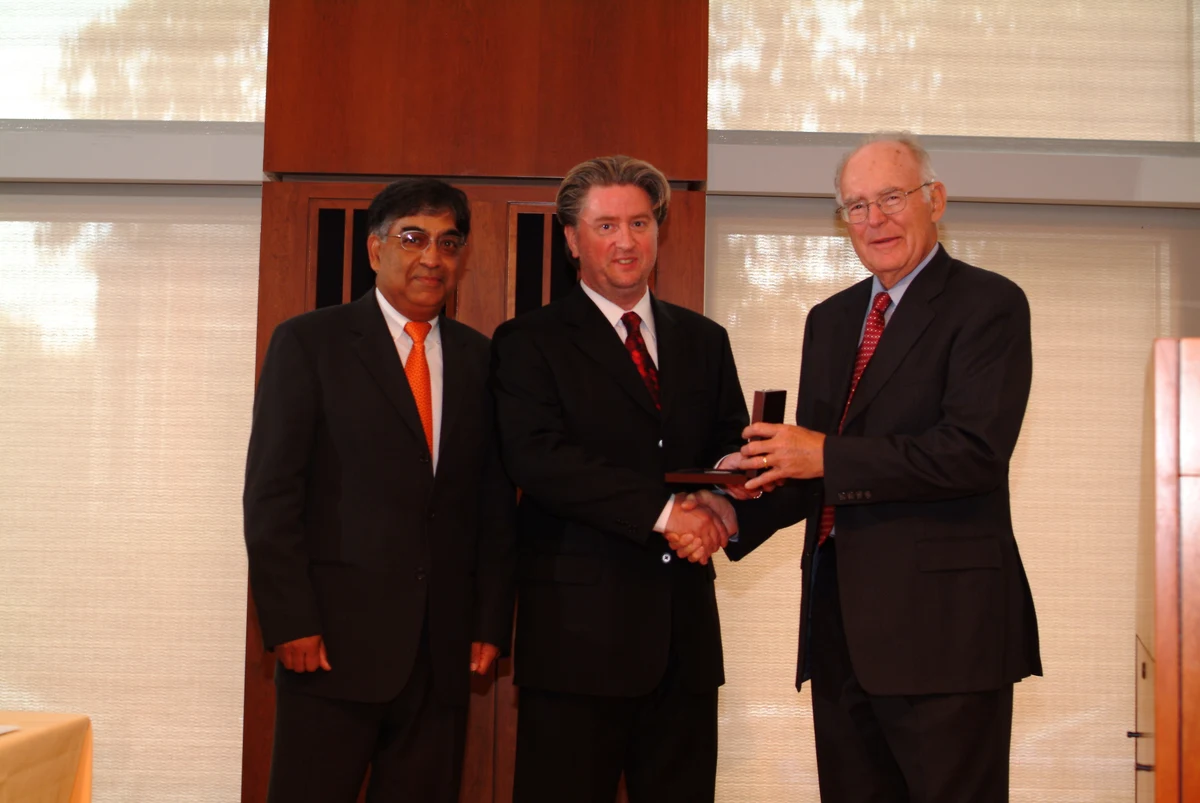
High Output Management appeared in 1983, and Grove’s later writing examined organisational change and strategic uncertainty. His practices included quantitative objectives and direct debate, although some methods were criticised by employees. The IEEE awarded him its Medal of Honor in 2000. He supported City College, including a major gift that helped establish the Grove School of Engineering, and remained active in philanthropy after leaving executive office. Grove died on 21 March 2016. His career connects engineering research with the less visible work of manufacturing, staffing and organisational adaptation, while leaving room to assess the consequences of individual decisions.
Quick answers
Frequently asked questions about Andy Grove
- Was Grove Intel’s first chief executive?
- No. Noyce and then Moore preceded him. Grove became CEO in 1987 after many years directing operations.
- Did Intel leave all memory products in 1985?
- No. The DRAM decision was specific. Contemporary reports describe continued EPROM development and sales.
Keep exploring
Lives connected to this story
- Gordon Moore
Read the technical leader and chief executive with whom Grove worked through the DRAM decision.
- Robert Noyce
Follow the Intel cofounder whose role differed from Grove’s research and operating responsibilities.
Sources and further reading
Explore the evidence
These references support the biography and offer further reading. Official records, first-person accounts and independent reporting provide different perspectives; image records document attribution and licensing.
- 1. City College of New York, Grove School of EngineeringAbout Andy Grove: Andrew Stephen Grove ’60 ChE
Read for childhood, migration and the 1960 degree. Its loose co-founder language, Noyce name typo and simplified Moore’s-law claim are not reproduced.
- 2. Computer History MuseumRemembering Andy S. Grove, David C. Brock, 21 March 2016
- 3. Science History InstituteAndrew S. Grove oral history, David C. Brock and Arnold Thackray, 14 July and 1 September 2004
The full online transcript was available. Selected education, recruitment, Fairchild research and Intel-formation passages were read; no claim of listening to the complete recordings.
- 4. IEEE Computer SocietyAndrew S. Grove: 2000 IEEE Honors Ceremony biography and award citation
Institutional indexed 2000 ceremony biography read; direct page request returned 403. Its present-tense chairman description is historical, not current.
- 5. Intel CorporationAndrew S. Grove 1936–2016, 21 March 2016
Corporate memorial read for appointment and death dates. The draft makes no diagnosis, treatment recommendation or cause-of-death assertion.
- 6. Intel CorporationIntel Corporation 1985 Annual Report, financial highlights and management report, printed pp. 1–3
- 7. Intel CorporationIntel Corporation 1986 Annual Report, financial highlights and management report, printed pp. 1–3
- 8. Andrew S. Grove; Profile BooksOnly the Paranoid Survive: publisher’s limited preview, preface and opening chapter
Only the publisher’s 26-page preview, containing the preface and opening Pentium chapter, was read. It does not include the DRAM chapter, and no claim of reading the complete book is made.